Domestic Research Teams Including KIST Identify Substance Inducing Tau Protein Autophagy
[Asia Economy Reporter Kim Bong-su] With one in ten elderly people aged 65 and over in South Korea suffering from dementia, domestic researchers have attracted attention by developing a new dementia treatment method that effectively removes the causative substances.
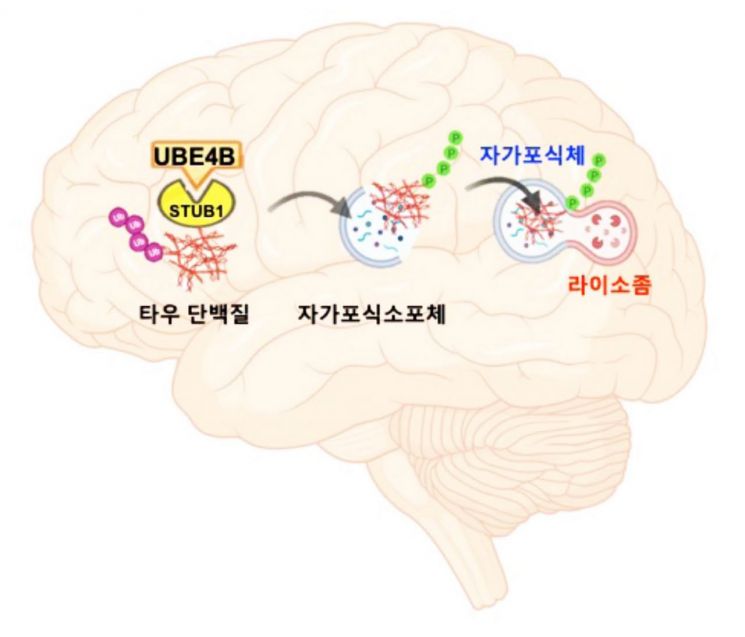
The Korea Institute of Science and Technology (KIST) announced on the 24th that it has discovered the principle of degrading 'tau protein,' a major suspected cause of dementia, through autophagy. Most existing studies have induced tau protein removal using the proteasome, a protein-degrading enzyme, but have yet to achieve significant results. Therefore, elucidating the mechanism of tau protein degradation via autophagy is expected to bring significant changes to existing dementia treatment strategies.
Abnormal aggregation of tau protein within brain nerve cells has long been cited as a primary cause of dementia. It is known that tau protein misfolds and tangles, destroying nerve cells and causing cognitive and memory loss. However, the exact process by which tau protein aggregates and degrades within nerve cells has not been clarified until now.
In experiments using dementia fruit fly and mouse models, the research team confirmed that increasing the expression of the UBE4B protein by manipulating mRNA genes reduced abnormal tau protein aggregation and improved the behavior of dementia model animals. This demonstrated that an increase in UBE4B promotes the degradation of tau protein.
Through this, the researchers gained more detailed knowledge about the previously difficult-to-explain cellular tau protein degradation mechanism. They found that autophagy is more effective than the previously known proteasome in removing tau protein. As the possibility of developing dementia diagnostics and therapeutics targeting UBE4B, which induces autophagy, increases, the research team is currently applying for a patent on this new tau protein degradation regulatory factor.
Dr. Ryu Hoon of KIST said, "It is highly significant that we identified the process by which tau protein molecules are degraded through autophagy, opening a new path for preventing and improving dementia pathology," adding, "The new tau protein degradation mechanism discovered in the fruit fly dementia model was also confirmed in the mouse dementia model, suggesting a new strategy for dementia response."
The research results were published in the latest issue of the international journal Nature Communications.
© The Asia Business Daily(www.asiae.co.kr). All rights reserved.

















