[Asia Economy Reporter Kim Hyung-min] The organizational reform plan, which primarily aims to reduce direct investigations by the prosecution, passed the vice ministerial meeting on the 24th. Accordingly, the reform plan will be submitted to the Cabinet meeting scheduled for the 29th.
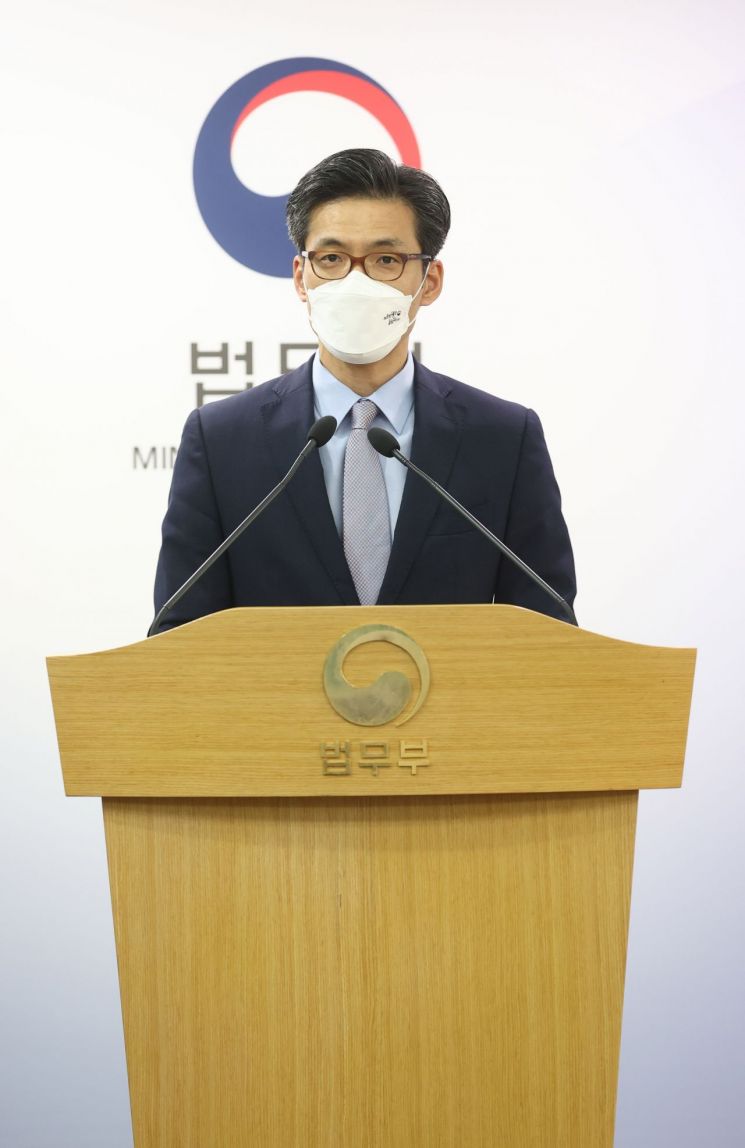
The Ministry of Justice held a briefing at the Government Complex Gwacheon in the afternoon to explain the main contents of the reform plan and announced this fact. Based on the reform plan, mid-level personnel appointments in the prosecution are expected to be announced as early as the 25th, or at the latest around the 28th or 29th.
Through this organizational reform, the Ministry of Justice intends to reduce the prosecution's direct investigations by converting some direct investigation departments and dedicated criminal divisions into human rights protection divisions and criminal divisions, and by integrating anti-corruption, violent crime, public, and foreign affairs investigation functions in some district prosecutor's offices.
The Seoul Central, Suwon, Busan, and Gwangju District Prosecutors' Offices will reorganize the relevant departments in accordance with this policy. In particular, Busan will establish a dedicated anti-corruption crime investigation division to respond to corruption crimes.
The Ministry of Justice explained that this is a follow-up measure with continuity from the previous organizational reform.
In October 2019, the Ministry reduced 10 special investigation divisions across 7 offices to 6 anti-corruption investigation divisions across 3 offices, and in January last year, 13 direct investigation departments were converted into criminal and trial divisions. Subsequently, in September last year, 14 direct investigation and dedicated investigation departments were converted into criminal divisions.
Additionally, investigative departments such as criminal divisions will be tripartite: ▲ criminal divisions handling general criminal cases, ▲ criminal final divisions in district and branch offices authorized by the Prosecutor General to conduct direct investigations of six major crimes, and ▲ dedicated divisions that can directly investigate six major crimes without the Prosecutor General's approval.
Furthermore, the Ministry of Justice announced the establishment of an Anti-Corruption and Violent Crime Investigation Cooperation Division at the Seoul Central District Prosecutors' Office and a Financial and Securities Investigation Cooperation Unit at the Seoul Southern District Prosecutors' Office to strengthen cooperation with the police, the Corruption Investigation Office for High-ranking Officials (CIO), the National Tax Service, and the Financial Supervisory Service.
It was also added that human rights protection divisions will be established at eight district prosecutors' offices nationwide (Seoul Central, Seoul Southern, Incheon, Suwon, Daejeon, Daegu, Busan, Gwangju). These divisions will be responsible for reviewing warrants and corrective actions to prevent violations of citizens' fundamental rights during investigations.
Moreover, the police will have the authority to conclude first-instance investigations. If the police close a case with no charges and forward the records to the prosecution, and the prosecution requests reinvestigation, these divisions will handle such cases. In addition, the current human rights inspectors will be renamed human rights protection officers and will be expanded and deployed to six high prosecutors' offices and five local branch offices nationwide.
© The Asia Business Daily(www.asiae.co.kr). All rights reserved.
![Clutching a Stolen Dior Bag, Saying "I Hate Being Poor but Real"... The Grotesque Con of a "Human Knockoff" [Slate]](https://cwcontent.asiae.co.kr/asiaresize/183/2026021902243444107_1771435474.jpg)
















