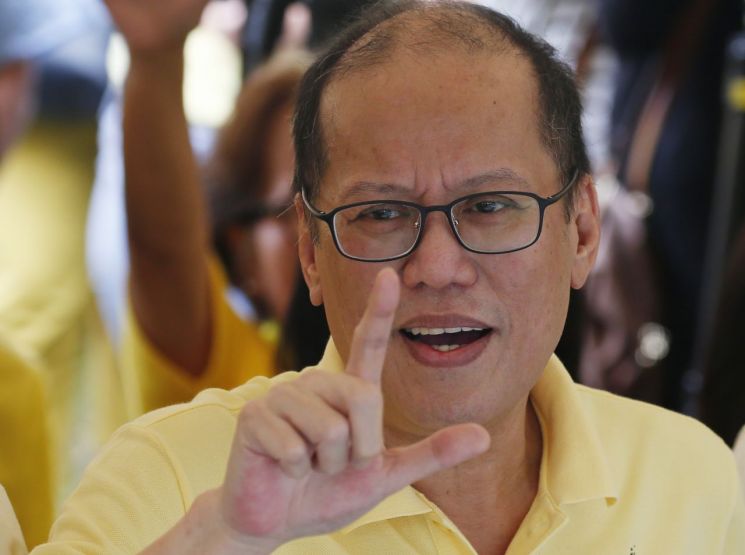
[Asia Economy Reporter Kim Suhwan] Benigno Aquino, the former president of the Philippines who is credited with establishing modern democracy in the country, has passed away at the age of 61.
On the 24th, foreign media reported that former President Aquino died at the age of 61.
The exact cause of his death has not yet been revealed. According to local media, he was recently transferred to a hospital and was hospitalized.
Theodore Locsin, the Minister of Foreign Affairs, expressed his condolences on Twitter, saying, "He was as incorruptible as the blue sea."
The Aquino family is known as one of the leading landowning and politically prominent families who led the democratization movement in the Philippines.
Former President Aquino was born on February 8, 1960, to Corazon Aquino, the first female president, and the well-known politician, former Senator Ninoy Aquino.
His father, former Senator Ninoy Aquino, was assassinated by soldiers at Manila Airport in 1983 during the dictatorship of former President Ferdinand Marcos.
Following his father's death, democratization movements spread throughout the Philippines. Ultimately, his mother, riding on the legacy of her late husband, governed the Philippines as president from 1986 to 1992.
After his mother passed away from cancer, former President Aquino entered the 2010 presidential election late and was elected.
During his tenure from 2010 to 2016, former President Aquino is credited with leading major economic reforms and implementing extensive anti-corruption policies, thereby advancing democracy in the Philippines.
He also focused on poverty eradication during his administration.
Former President Aquino was also known as one of the Southeast Asian leaders who confronted China. Regarding the South China Sea territorial disputes, he filed a case against China at the Permanent Court of Arbitration (PCA), which delivered a historic ruling stating that China’s territorial claims lacked clear basis.
However, from the midpoint of his term, he faced various criticisms from different sectors. Regarding Typhoon Haiyan, which struck the Philippines in 2013, his government was criticized for a lack of decisive action in disaster response, which worsened the damage.
Additionally, corruption allegations involving his close aides and senior officials damaged his anti-corruption image.
In particular, the 2015 incident where 44 police officers died in clashes with Muslim rebels is regarded as the most controversial event during his administration. After his retirement, anti-corruption prosecutors claimed that former President Aquino should be held responsible for this incident.
He handed over power to the current president, Rodrigo Duterte, in 2016 and stepped down.
© The Asia Business Daily(www.asiae.co.kr). All rights reserved.
![Clutching a Stolen Dior Bag, Saying "I Hate Being Poor but Real"... The Grotesque Con of a "Human Knockoff" [Slate]](https://cwcontent.asiae.co.kr/asiaresize/183/2026021902243444107_1771435474.jpg)
















