Ando Geol, Deputy Minister of Finance, Chairs Fiscal Management Strategy Committee
World's First Full Autonomous Driving Commercialization... Support for 'C-ITS Infrastructure'
Gathering Opinions on 'Information and Communications Promotion Fund + Broadcasting and Communications Development Fund'
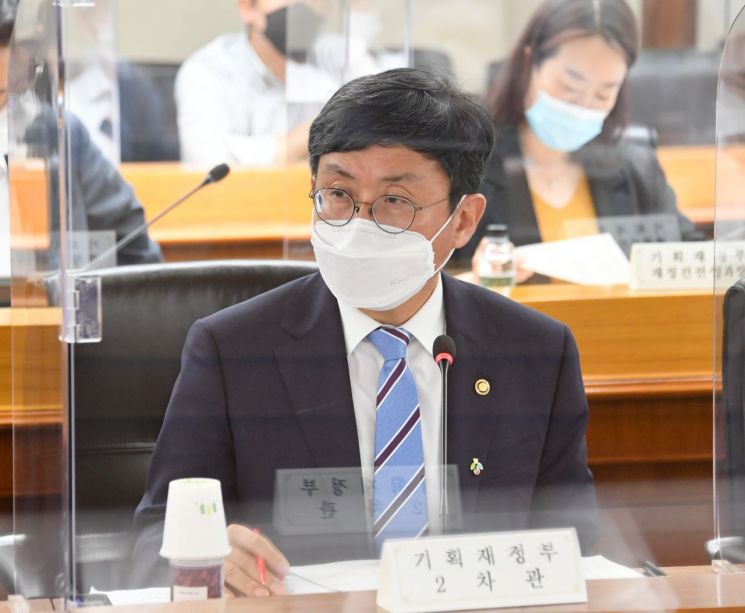 Ando-geol, 2nd Vice Minister of the Ministry of Economy and Finance. (Photo by Ministry of Economy and Finance)
[Sejong=Asia Economy Reporter Moon Chaeseok] The government has decided to change the incentive payment method for high school graduates' employment from a lump-sum payment to an installment payment to promote employment among high school graduates.
On the 23rd, the Ministry of Economy and Finance held the '5th Fiscal Management Strategy Committee' at the Export-Import Bank of Korea, chaired by Deputy Minister Ando Geol, to review the performance of major execution projects and announced plans to improve fiscal support methods.
First, to create conditions for long-term employment of high school graduate workers, the incentive payment method for high school graduate employees will be changed. The existing incentive of 5 million won, previously paid as a lump sum upon employment of a high school graduate worker, will be paid in installments. To increase incentives for companies hiring vocational high school students, plans to further reduce the labor cost burden of participating companies from the current 70% level are also being considered.
Regarding regulatory free zones aimed at enhancing corporate competitiveness, instead of designating additional zones beyond the current 24, further fiscal support will be promoted. Among the zones that have completed two years of fiscal support, those with outstanding performance will be selected to supplement demonstration projects and provide additional fiscal support to commercialize verified products or services.
To achieve the world's first full autonomous driving commercialization by 2027, focused support will be provided for building next-generation intelligent transportation system (C-ITS) infrastructure, including certification management centers and integrated management centers for vehicle-to-vehicle or vehicle-to-traffic communication, and securing service compatibility between local governments. The C-ITS communication technology standards will prioritize a project next year to compare and demonstrate the existing WiFi method and new mobile communication methods, and based on the results, the necessity of follow-up investments will be reviewed. The subsidy program for IoT-based facilities and equipment investment for smart factory construction will be converted to a low-interest loan method after achieving the target volume of 30,000 units by 2022.
Opinions from related ministries and experts were also gathered on next year's priority investment projects, including the budget allocation for convergence Official Development Assistance (ODA) and the fiscal investment direction for the K-semiconductor strategy. The convergence ODA collaboration budget for next year will be significantly expanded from this year's 324.8 billion won, prioritizing green investments such as renewables, digital investments such as data centers, and public healthcare sectors like K-quarantine, which are core areas of the Korean New Deal.
The K-semiconductor strategy will continue to focus on projects such as ▲market-leading advanced technology development R&D projects ▲field-oriented customized workforce training projects ▲joint production infrastructure construction for producing verified prototypes.
New projects will complete preliminary procedures such as feasibility studies as planned, concretize project plans, and actively reflect them in next year's budget proposal. Alongside this, new investment directions to proactively respond to economic, environmental, and social structural changes such as the 4th Industrial Revolution, climate change, and the COVID-19 pandemic, as well as measures to improve expenditure efficiency of existing projects, were discussed.
Meanwhile, at the meeting, as part of fiscal support system efficiency tasks, the integration plan of the Information and Communication Promotion Fund and the Broadcasting and Communications Development Fund was discussed in line with the ICT convergence trend. Through this, opinions were also gathered on utilizing the estimated 12 trillion won level of frequency auction funds expected by 2030 as investment resources for the Digital New Deal.
© The Asia Business Daily(www.asiae.co.kr). All rights reserved.

















