International Competition Results: 111 Entries from 39 Countries
11 Selected from New Southern, New Northern, and Europe Regions
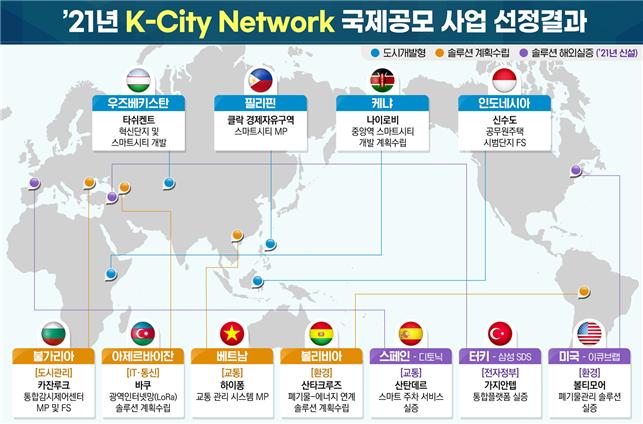
[Asia Economy Reporter Kangwook Cho] The 'Korean-style Smart City' is expanding into 11 countries worldwide, including Uzbekistan, the Philippines, Kenya, and Indonesia.
The Ministry of Land, Infrastructure and Transport, Korea Overseas Infrastructure & Urban Development Corporation, and the Korea Agency for Infrastructure Technology Advancement announced on the 23rd that they have selected a total of 11 projects (in 11 countries) through the 'K-City Network Global Cooperation Program' public contest.
The selected projects include 4 urban development-type countries, 4 solution-type planning countries, and 3 solution-type overseas demonstration countries. By region, 3 projects are from the New Southern and New Northern regions, and 5 others (2 in Europe, 1 each in North America, South America, and Africa) were selected.
The Ministry of Land, Infrastructure and Transport established the overseas solution demonstration project this year to enable Korean companies to secure overseas demonstration achievements and create a foundation for cross-demonstration with advanced countries. As countries with secured demonstration bases were selected, cooperation projects with the United States and Europe were chosen.
The urban development-type planning projects received 57 applications from 24 countries, and 4 projects in 4 countries were selected: the Clark Economic Free Zone Smart City in the Philippines, the pilot complex for government official housing in the new capital of Indonesia, the Tashkent Innovation District and Smart City in Uzbekistan, and the Nairobi Central Station Smart City in Kenya.
The solution planning projects received 40 applications from 16 countries, and 4 projects in 4 countries were selected: the Hai Phong Traffic Management System Construction Project in Vietnam, the Santa Cruz Waste-to-Energy Linkage Project in Bolivia, the Baku Metropolitan Internet Network (LoRa) Construction Project in Azerbaijan, and the Kazanluk Integrated Surveillance Control Center Construction Project in Bulgaria.
For the solution overseas demonstration projects, Korean companies applied for 14 projects in 12 countries, and 3 projects were selected: Samsung SDS's Gaziantep Smart City Integrated Platform Demonstration Project in Turkey, iCube Lab's Baltimore Waste Management Solution Demonstration in the United States, and Ditonic's Santander City Smart Parking Service Demonstration in Spain.
The Ministry of Land, Infrastructure and Transport plans to finalize the support budget for each project within this month and select project executors next month. To establish a G2G cooperation foundation from the preparation stage, overseas government officials will directly participate in the project executor selection process. The 8 planning-type projects (urban development-type and solution planning) will commence in August after selecting project executors, and the 3 overseas demonstration projects will start in July after budget adjustments.
Choi Im-rak, Director of Urban Policy at the Ministry of Land, Infrastructure and Transport, said, "This year, we will promote cooperation projects not only with developing countries but also with advanced countries such as the United States and Spain. The K-City Network will be a great opportunity to globally spread the Korean-style smart city and enhance the competitiveness of our companies."
© The Asia Business Daily(www.asiae.co.kr). All rights reserved.

















