On the 23rd, the Ministry of Science and ICT holds a 6G Strategy Meeting... Establishing the '6G R&D Implementation Plan'

[Asia Economy Reporter Eunmo Koo] The government has embarked on strengthening international collaboration as well as public-private cooperation to maintain global technological leadership in 6G following its success in 5G mobile communications.
On the 23rd, the Ministry of Science and ICT announced that it held a joint public-private '6G Strategy Meeting' and established a '6G Research and Development (R&D) Execution Plan' to lead the upcoming 6G era. At the meeting, Minister Hyesook Lim of the Ministry of Science and ICT urged, "Next-generation mobile communication networks are the foundation of digital innovation. Based on our experience and know-how in the network field, let us boldly and challengingly work together in the public and private sectors to lead the global market in the 6G era."
Next-generation mobile communication technology is a core technology that serves as the growth foundation for future new industries as well as the digital transformation. To secure leadership in the global market, it is essential to initiate proactive technology development and efforts to preoccupy international standards. Considering that generational shifts in mobile communications typically occur every 10 years, the international community expects the commercialization of 6G to take place between 2028 and 2030.
Major countries have already expanded their investments in 6G and entered the competition for technological supremacy. The United States has strengthened 6G technology cooperation with key allies after initiating long-term R&D led by the Defense Advanced Research Projects Agency (DARPA) under the Department of Defense. China established a dedicated 6G organization in 2019. Japan also formed and operates the public-private 'Beyond 5G Consortium' last year.
At the strategy meeting, measures to expand exchanges such as joint research in the 6G field between Korea and the United States were discussed, utilizing the outcomes of last month's Korea-US summit. To this end, the Institute for Information & Communications Technology Planning & Evaluation (IITP) and the US National Science Foundation (NSF) signed a joint research cooperation Memorandum of Understanding (MOU) and decided to actively promote joint research in the 6G field between the two countries starting this year.
Minister Lim said, "The cooperation foundation between the two countries was well established at the Korea-US summit. We will make good use of this to promote global collaboration from the early stages of 6G preparation and closely cooperate with related ministries, large and small-medium enterprises to secure future competitiveness and further enhance the status of a digital powerhouse."
220 billion KRW Investment by 2025 to Secure Core 6G Technologies and Standards
At the meeting, discussions were held on the 6G R&D execution plan and strategies to lead global 6G standards. The 6G R&D execution plan includes detailed implementation plans for three strategic areas to realize the 'world's best 6G technology powerhouse': ▲ securing next-generation core source technologies ▲ preoccupying international standards and patents ▲ establishing research and industrial infrastructure.
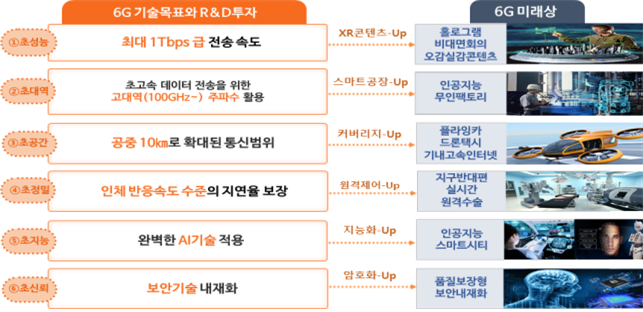
First, to secure next-generation core source technologies, a total of 200 billion KRW will be invested by 2025, including 17.9 billion KRW this year (for 12 projects), targeting '10 strategic technologies in 6 key focus areas' such as low Earth orbit communication satellites and ultra-precise network technologies, which are difficult for the private sector to actively invest in immediately.

In particular, in the 6G era, integration of satellite and terrestrial networks will be promoted to enable gigabit-per-second (Gbps) communication even for flying vehicles such as flying cars and drones, as well as in maritime and disaster areas. To this end, satellite-terrestrial integrated access technology will be developed, and the 'Satellite Communication Technology Development Strategy' will be concurrently implemented, which includes launching a total of 14 low Earth orbit satellites for verification and demonstration by 2031.
This year, as the first year of 6G technology development, the groundwork will be laid to secure source technologies by establishing technical requirements for each core 6G field and designing element technologies, and a foundation will be prepared for the localization of key equipment and components. Additionally, to establish a cooperative system with major countries, joint research on core 6G technologies and international cooperation on 6G frequencies will be promoted with countries leading 6G research such as the United States, China, and Finland under national leadership. An MOU will also be signed to facilitate cooperation between global private 6G organizations such as the US 'Next G Alliance' and the domestic 5G Forum.
Regarding 6G international standardization, achievements such as Korea's advancement to chair the ITU 6G Vision Group and the 3GPP RAN1 (Physical Layer) chair positions were shared. To lead future international standards, the plan includes ways to play a leading role from the 6G vision establishment stage, which serves as the blueprint for standardization. Furthermore, in cooperation with the Korean Intellectual Property Office, R&D funds and patent acquisition strategy maps will be provided as a package starting this year for 6G core technologies with high potential for securing standard patents. Additional technical fields will be selected next year for package support, and strategy maps will be established in advance.
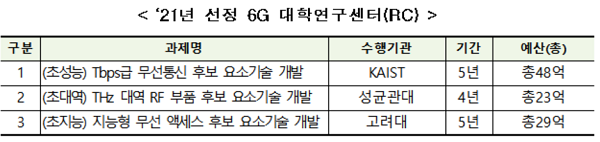
Finally, to build a robust research and industrial foundation, three university-based 6G research centers will be designated and operated this year to foster master's and doctoral-level talent. The participation of domestic small and medium-sized enterprises and universities/research institutes in joint R&D will be expanded to promote the enhancement of practical 6G capabilities.
The Ministry of Science and ICT plans to continue public-private cooperation activities through three subcommittees (Technology/Standardization, Satellite/Frequency, Global) to secure core 6G technologies and to steadily implement 6G R&D going forward.
© The Asia Business Daily(www.asiae.co.kr). All rights reserved.



















