Implementation of Phase 3 Emissions Trading System... Annual Corporate Allocation Decreases from 970,000t in Phase 2 to 760,000t in Phase 3
Carbon Neutrality Committee to Raise 2030 Greenhouse Gas Reduction Target (NDC) in October
"Concerns Over Low Industrial Share... Need for Realistic Goals and Measures"
[Sejong=Asia Economy Reporter Kwon Haeyoung] The steel industry, the largest carbon emitter sector in Korea, is set to actively secure carbon emission permits starting this year. The burden on the steel industry, including POSCO, the top carbon emitter company in Korea, which has been directly hit by carbon neutrality policies, is expected to increase from the second half of the year. In particular, following the implementation of the third phase of the carbon emissions trading system from this year, the government plans to further raise the Nationally Determined Contribution (NDC) in October, leading to forecasts of a sharp rise in emission permit prices in the second half of the year.
According to the steel industry on the 21st, POSCO and Hyundai Steel are coordinating the appropriate timing for purchasing carbon emission permits in the second half of this year. An industry official said, "Since the emission allocation has been reduced after the implementation of the emissions trading system, companies must either reduce carbon emissions further or purchase emission permits," adding, "Currently, purchasing emission permits is more realistic."
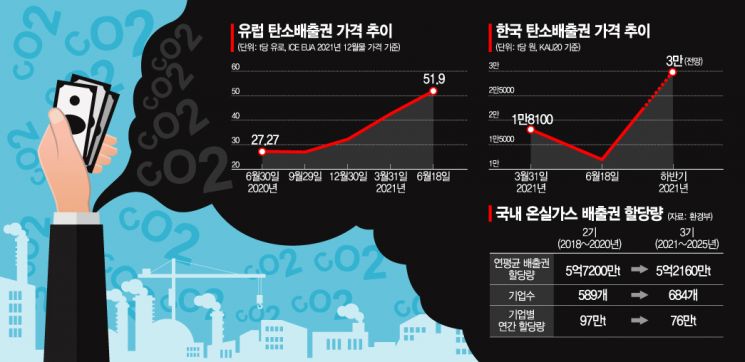
With the start of the third phase of the emissions trading system this year, the allocation of emission permits to companies has decreased compared to the second phase. The government-set average annual greenhouse gas emission permit allocation dropped from 572 million tons in phase 2 (2018?2020) to 521.6 million tons in phase 3 (2021?2025). Meanwhile, the number of allocated companies increased from 589 to 684. As a result, the annual allocation per company decreased from 970,000 tons to 760,000 tons. Additionally, the proportion of paid allocation, where companies must purchase emission permits, expanded from 3% in phase 2 to 10% in phase 3 for most sectors except steel. This increase in demand for emission permits among companies has created a structure where permit prices inevitably rise.
Fortunately, the current domestic carbon emission permit price, as of the closing price on the 18th, stands at 11,950 KRW per ton, less than half of the price a year ago (32,000 KRW per ton). This decline is due to economic contraction and reduced electricity usage caused by the COVID-19 pandemic. However, with the government's strengthened carbon emission regulations this year, it is expected that permit prices will soar beyond 30,000 KRW per ton in the second half of the year.
A senior official from the steel industry stated, "Both POSCO and Hyundai Steel must purchase emission permits starting this year," and warned, "If permit prices surge in the second half, there may be a situation where permits are unavailable due to shortages."
In Europe, where carbon emission regulations are tightening, emission permit prices have recently skyrocketed alongside economic recovery. The December contract for European carbon emission permits (ICE EUA) was priced at 51.9 euros per ton on the 18th, doubling from about 27 euros per ton a year ago.
The industry views the government's planned upward revision of the NDC as another variable that could shake the emission permit market. President Moon Jae-in announced at the World Climate Summit in April that the 2030 NDC would be further raised within the year. This means increasing the greenhouse gas reduction target from the current 24.4% compared to 2017. Currently, Song Young-gil, leader of the Democratic Party, demands at least a 40% increase, and some environmental groups are calling for up to 50%. The Presidential Committee on Carbon Neutrality, a public-private control tower for Korea's carbon neutrality policy, plans to announce specific figures in October, one month before the 26th Conference of the Parties to the United Nations Framework Convention on Climate Change (COP26) held in the UK in November.
The problem is that the Carbon Neutrality Committee has a low proportion of members from the industrial sector, such as corporate executives or heads of economic organizations, resulting in relatively weak voices from industry. According to the committee, out of 97 members, only 7 are from the industrial sector. Excluding 20 government officials, the rest are from pro-government climate and environmental civic groups and research institutes.
There are concerns that instead of gathering industry opinions to establish realistic carbon neutrality goals and implementation measures, the committee may hinder the 'over-speed carbon neutrality' policy that is being pushed unilaterally until the end of the administration.
The industry points out that since the third phase of the emissions trading system has started this year, the government should exercise 'speed control' regarding comprehensive carbon neutrality policies, including the 2030 NDC revision. They argue that greenhouse gas reduction targets should be set without damaging the competitiveness of Korean companies, and that carbon funds and other support mechanisms should be established to fully support corporate carbon neutrality efforts.
Although the European Union (EU) is also driving carbon neutrality with measures such as the introduction of a carbon border tax, there is growing opposition within the region. The EU announced plans to increase its 2030 greenhouse gas reduction target from 40% to 55% compared to 1990 levels, but Switzerland rejected this in a national referendum held this month.
An industry official said, "The industry agrees with the overall direction of carbon neutrality, but since it involves painful sacrifices, policy speed control and support are necessary," adding, "The government should set achievable goals and listen to the industry's voices to ensure implementation."
© The Asia Business Daily(www.asiae.co.kr). All rights reserved.