Over 15 Million First Doses Administered, Surpassing Target
357 Confirmed Cases... Increase Slows Down
6-Person Gatherings in Seoul Metropolitan Area to Accelerate Normalization from July
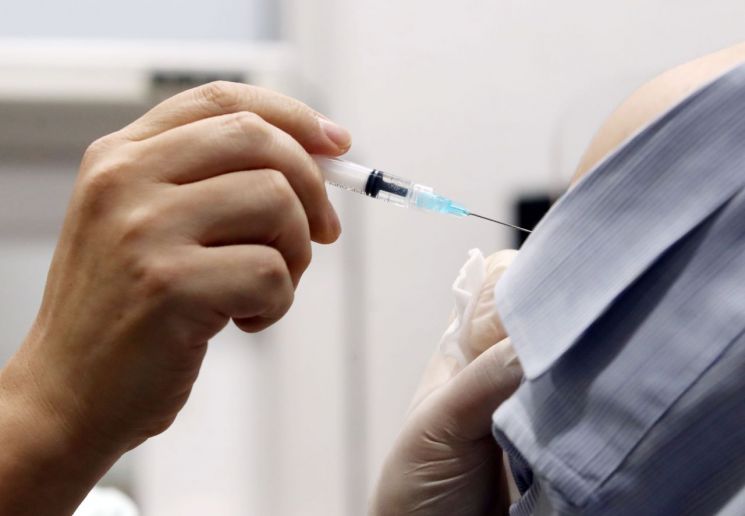
The first-dose COVID-19 vaccination rate in South Korea is approaching 30%. Having already achieved the early target of 14 million first doses in the first half of the year, the number surpassed 15 million on the 20th. The government plans to focus on second-dose vaccinations until the end of this month, considering vaccine supply conditions, but since initial shipments of the Moderna vaccine and others remain, there is speculation that reaching 30% in the first half is still possible.
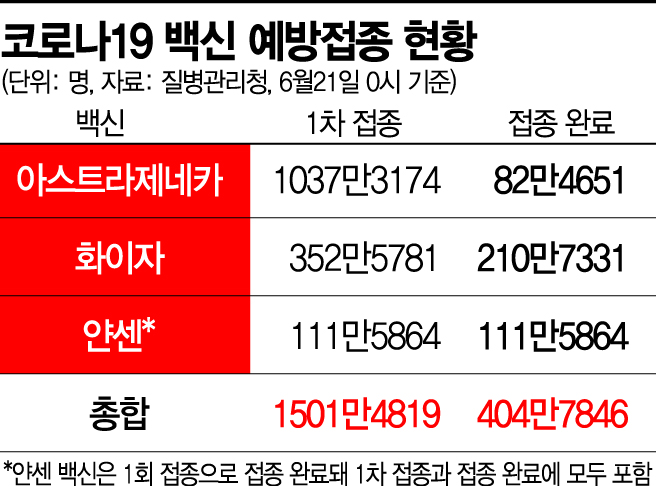
According to the COVID-19 Vaccination Response Promotion Team, as of midnight on the 21st, a total of 15,014,819 people have completed their first dose. With the first half's first-dose vaccinations entering the final stages as of the 19th, and combined with the weekend effect, only 505 new first-dose vaccinations were recorded on this day. The current first-dose vaccination rate against the total population stands at 29.2%. To reach 30% in the first half, about 400,000 more people need to receive their first dose in the remaining ten days. Including those vaccinated with the Janssen vaccine, the number of newly completed vaccinations increased by 1,038, totaling 4,047,846.
As of midnight the previous day, the remaining COVID-19 vaccine doses in South Korea are 431,000 AstraZeneca (AZ) doses, 1,317,700 Pfizer doses, 54,700 Moderna doses, and 15,500 Janssen doses, totaling 1,818,900 doses. First-dose vaccinations with the Pfizer vaccine are still ongoing for essential workers under 30, and since Moderna vaccinations are in the early stages, considering the use of remaining vaccines, it is possible to exceed 30% within this month.
As vaccinations gained momentum, the increase in confirmed cases has also slowed. On this day, the number of new domestic COVID-19 cases was 357, with 317 cases occurring locally. Since early April, daily confirmed cases had ranged between 400 and 700 for over two months, but recently, the pattern has stabilized to "around 300 on weekends and 500 on weekdays." Accordingly, the average daily number of new domestic cases, which had surged to the high 500s at the end of last month, decreased to 444.4 during the week of June 13?19. During the same period, the number of new cluster infections dropped significantly from around 60 to 10. Son Young-rae, head of the Social Strategy Division at the Central Disaster and Safety Countermeasures Headquarters, stated at the COVID-19 briefing that "the average number of patients has decreased by 9% and 15% over two consecutive weeks compared to the previous week, which can be interpreted as a downward trend," adding that "this is likely due to faster-than-expected vaccine rollout combined with seasonal factors reducing indoor activities."
In particular, the completion of vaccinations for high-risk groups, the biggest challenge in the first half, has eased the burden on quarantine efforts, which is a positive factor. As of midnight the previous day, about 80% of the vaccination target group aged 60?74 had received their first dose. The 60?64 age group, which started vaccinations about ten days later than the 65?74 group, has a first-dose rate of 76.6%, still in the 70% range, and all elderly aged 65 and above have completed their first dose at rates exceeding 80%. Among those aged 75 and older who received the Pfizer vaccine, 83.3% have had their first dose, and 54.2% have received their second dose. In nursing hospitals and care facilities, where cluster infections are a concern, the rates of people who have completed their second dose are 66.4% and 49.5%, respectively.
Meanwhile, once about 30% complete their first dose in the first half, vaccinations for the general adult population will begin in earnest, and efforts to restore daily life will also start. In July, those who missed their scheduled vaccinations this month, people in their 50s, university entrance exam candidates, and school staff will receive vaccines. From August, vaccines will be available to all age groups from 18 to 49. Correspondingly, quarantine measures will be eased, starting with the introduction of a new social distancing plan. If the current epidemic situation is maintained, under the new social distancing criteria, level 2 will apply to the metropolitan area, and level 1 to non-metropolitan areas. In the metropolitan area, private gatherings will be allowed up to six people next month, and most non-metropolitan regions will have no restrictions on the number of people in private gatherings.
© The Asia Business Daily(www.asiae.co.kr). All rights reserved.
!["I'd Rather Live as a Glamorous Fake Than as a Poor Real Me"...A Grotesque Success Story Shaking the Korean Psyche [Slate]](https://cwcontent.asiae.co.kr/asiaresize/183/2026021902243444107_1771435474.jpg)

















