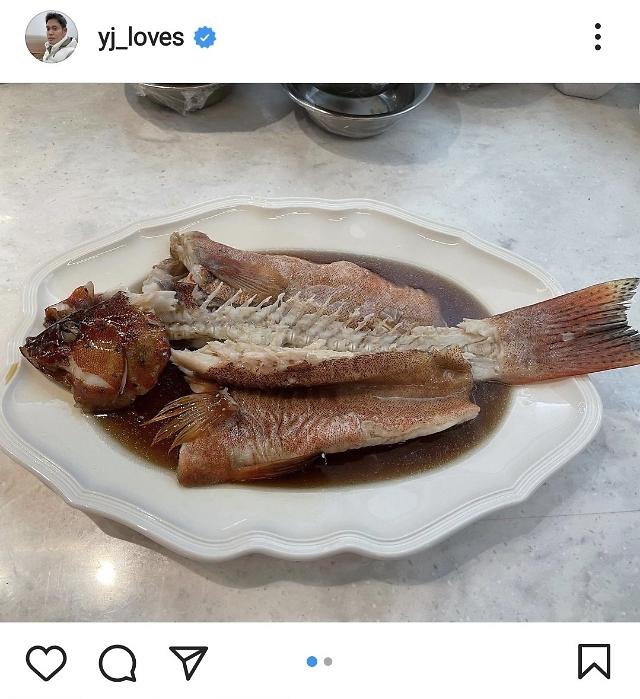
[Asia Economy Reporter Seoyoung Kwon] The mass production of 'Bulbbari,' which sparked controversy after being posted on the social media of Chung Yong-jin, Vice Chairman of Shinsegae Group, has been announced.
On the 4th, Chung Yong-jin, Vice Chairman of Shinsegae Group, posted a photo of Bulbbari cuisine on his SNS. At the time, his caption "Good bye 붉은 #Munibari sorry and thank you" caused controversy, and the post has since been deleted.
Bulbbari is a subtropical fish species belonging to the 'Bari' group, along with Dagumbari and Jabbari. Covered with red spots all over its body, it is also called 'Hongban.' Thanks to its chewy texture and mild flavor, it is very popular as sashimi. It was once frequently found near the coast of Jeju, but due to rising water temperatures, it has become very rare.
Bulbbari is classified as 'Endangered' on the IUCN Red List by the International Union for Conservation of Nature (IUCN). Its population is very low, and its price reaches 120,000 KRW per kilogram, earning it the nickname 'Emperor of the Sea.' At one point, a single slice of sashimi was worth 10,000 KRW, making headlines. Currently, to taste Bulbbari at sashimi restaurants in Jeju City, reservations are practically mandatory, and the price is at least 220,000 KRW per kilogram. However, farmed Bulbbari can be enjoyed at a lower price.
Recently, technology has been developed in Jeju to produce Bulbbari fertilized eggs and seeds year-round, raising expectations for its popularization. Bulbbari are all born female and some change sex to male after three years of age. Because of this, it was previously difficult to identify male individuals, making it challenging to secure fertilized eggs.
However, since 2013, the Jeju Aquaculture Fish Breeding and Evaluation Center and CR, a subsidiary of Jeju National University Technology Holdings, have been leading the industrialization of Bulbbari through the so-called 'Golden Seed Project.' They attach chips to each Bulbbari individual to monitor sex change and have developed technology to produce artificial fertilized eggs even in the non-spawning winter season through artificial environmental control. In other words, they shortened the breeding age of Bulbbari to one year and significantly increased fertilization and hatching rates.
CR succeeded in the mass production of Bulbbari fertilized eggs for the first time in Korea in 2015, and in 2017, they achieved complete aquaculture where Bulbbari born from fertilized eggs grew into broodstock and produced fry again. They also exported 100,000 seeds to Malaysia, among other achievements. Currently, they have built a heat pump breeding system using lava seawater as a heat source, developing technology to farm Bulbbari while saving energy costs.
© The Asia Business Daily(www.asiae.co.kr). All rights reserved.
![User Who Sold Erroneously Deposited Bitcoins to Repay Debt and Fund Entertainment... What Did the Supreme Court Decide in 2021? [Legal Issue Check]](https://cwcontent.asiae.co.kr/asiaresize/183/2026020910431234020_1770601391.png)















