Comprehensive Real Estate Tax, Official Price 900 Million Won → Top 2%
Democratic Party's Official Position Confirmed... Controversy Over Tax Cuts for the Wealthy
Securing Votes Ahead of Next Year's Presidential Election
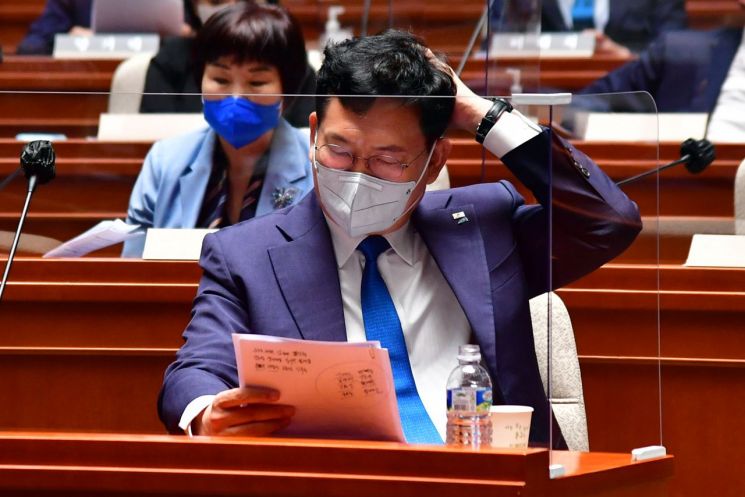 Song Young-gil, leader of the Democratic Party of Korea, is attending the policy members' meeting held at the National Assembly in Yeouido, Seoul on the 18th. [Image source=Yonhap News]
[Asia Economy Reporter Moon Jiwon] The Democratic Party of Korea has confirmed as party policy to change the comprehensive real estate tax (종합부동산세) imposition criteria from the current official appraisal price of 900 million KRW to the top 2%. This decision has sparked heated debate over its effects. The top 2% threshold for this year corresponds to an official appraisal price of about 1.1 billion KRW. If the law is revised as the ruling party intends, the number of single-homeowners paying the comprehensive real estate tax is estimated to decrease by about half, from 183,000 to 94,000.
Since the Moon Jae-in administration, the burden of the comprehensive real estate tax has increased due to rising real estate prices, raising expectations that this measure could ease the overall tax burden. However, some argue that the Democratic Party, which has long advocated for housing stability for ordinary citizens, has shifted direction toward 'tax cuts for the wealthy' ahead of next year’s presidential election, thereby undermining its existing real estate policy stance. In particular, if the target is set by percentage rather than amount, taxpayers will not know whether they are subject to the comprehensive real estate tax until the top 2% threshold is announced each year, raising concerns about 'blind taxation.'
According to political and industry sources on the 19th, the Democratic Party held a policy caucus at the National Assembly the previous afternoon and adopted the comprehensive real estate tax relief plan as party policy. First, the tax imposition criteria will be adjusted from the current 'official appraisal price of 900 million KRW or more' to 'top 2% of official appraisal prices or more.' For this year, the top 2% corresponds to about 1.1 to 1.2 billion KRW. Applying the relief plan means that single-homeowners with properties valued between 900 million KRW and about 1.1 billion KRW will no longer have to pay the comprehensive real estate tax starting this year. Those owning homes valued over 1.1 billion KRW will also see their tax burden reduced as the deduction threshold rises from 900 million KRW to about 1.1 billion KRW.
Despite controversy over 'tax cuts for the wealthy' both inside and outside the party, the Democratic Party’s decision to adopt this plan as party policy is interpreted as an effort to secure as many votes as possible ahead of next year’s presidential election. However, there is considerable criticism that the ruling party, which has pledged to prioritize housing stability for non-homeowners, has undermined policy credibility by shifting toward reducing the tax burden on owners of high-priced homes.
In fact, the Justice Party criticized the Democratic Party’s comprehensive real estate tax relief plan, stating, "It has reinforced the real estate invincibility myth that 'if house prices rise, taxes will be cut; if you hold on, you win.'" They strongly urged the immediate withdrawal of the party policy decision on tax cuts for real estate wealthy and called for stopping the regression in real estate policy. Even the People Power Party pointed out, "The Democratic Party still approaches real estate issues with a calculating attitude as if it were someone else’s problem."
There are also criticisms that imposing the comprehensive real estate tax on the top 2% of homes by official appraisal price is not suitable under the current tax law system. Setting the payment target by percentage rather than amount means that taxpayers cannot clearly know if they are subject to the tax until the government announces the deduction threshold each year. Former People Power Party lawmaker Yoo Seung-min explained on Facebook that "tax rates must be set by law for items measurable in currency such as income, assets, and prices," emphasizing that "this is the principle of taxation under the Constitution."
There are concerns that tax resistance could increase if homeowners must continue paying the comprehensive real estate tax as long as they remain in the top 2%, even if their property values fall. The Democratic Party’s comprehensive real estate tax relief plan will be finalized after consultations with the government. So far, the government has shown a somewhat negative stance, fearing that easing the comprehensive real estate tax could cause housing prices to rise again.
© The Asia Business Daily(www.asiae.co.kr). All rights reserved.

















