Major Foreign Media: "Defense Secretary Lloyd Austin Orders Withdrawal of Air Defense Assets and Troops from the Middle East"
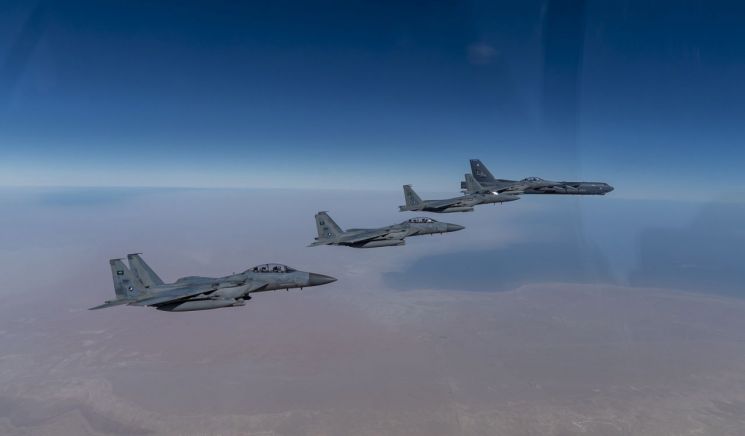 U.S. Air Force B-52 strategic bomber flying over the Middle East (right) and a formation of Saudi Arabian Air Force F-15s fighters escorting it
 [Image source=Yonhap News]
[Asia Economy Reporter Minyoung Cha] The United States is reducing its missile defense systems and troops in the Middle East, including Saudi Arabia. This move is seen as a reflection of the Biden administration's diplomatic and military strategy, which focuses its foreign strategy primarily on countering China.
On the 18th (local time), according to CNN and political magazine The Hill, Jessica McNulty, spokesperson for the U.S. Department of Defense, stated, "Secretary of Defense Lloyd Austin has ordered Central Command to withdraw some equipment and troops, including air defense assets, from the Middle East this summer."
This confirms the Wall Street Journal's (WSJ) report that the U.S. plans to downsize its missile defense systems in the Middle East. WSJ reported, citing officials, that "the Department of Defense plans to withdraw eight Patriot missile batteries from the Middle East, including Saudi Arabia, Iraq, Kuwait, and Jordan."
Accordingly, the Terminal High Altitude Area Defense (THAAD) system deployed in Saudi Arabia will also be withdrawn, and the fighter squadrons stationed in the Middle East will be reduced.
Spokesperson McNulty explained that the troop reduction was decided after close coordination with the host countries. In fact, Secretary Austin reportedly informed Saudi Crown Prince Mohammed bin Salman of the troop reduction during a phone call on the 2nd of this month.
The U.S. plans to keep the redeployment plans for the troops and equipment withdrawn from the Middle East confidential. McNulty said, "Out of respect for partner countries and to maintain operational security, we will not disclose the timing, schedule, or redeployment locations of the withdrawal of troops and equipment from the Middle East."
WSJ noted that "the Patriot missiles withdrawn from Saudi Arabia will not necessarily be redeployed to the Indo-Pacific region." There is also a possibility that the Patriot missiles, along with operational and security personnel, will be returned to the U.S. for maintenance.
Meanwhile, the U.S. is gradually reducing its troops stationed in the Middle East. It plans to complete the full withdrawal from Afghanistan by September 11 and began the withdrawal last month on the 1st.
The decision to reduce U.S. forces in the Middle East is based on the assessment that conflicts with Iran will not escalate. The Biden administration is pursuing the restoration of the Iran nuclear deal (JCPOA - Joint Comprehensive Plan of Action) and has indicated that sanctions on Iran could be lifted if consensus is reached.
The U.S. is currently reviewing global troop deployments to counter challenges from China and Russia. WSJ pointed out, "Although the review of U.S. troop deployments is expected to conclude next month, the Department of Defense is already taking steps to respond to China and Russia."
© The Asia Business Daily(www.asiae.co.kr). All rights reserved.
![Clutching a Stolen Dior Bag, Saying "I Hate Being Poor but Real"... The Grotesque Con of a "Human Knockoff" [Slate]](https://cwcontent.asiae.co.kr/asiaresize/183/2026021902243444107_1771435474.jpg)
















