Focus Shift from Preservation to Development
Over 20,000 Households to be Supplied by 2026
Redevelopment Path Opens in Urban Regeneration Zones
[Asia Economy Reporter Kim Hyemin] The paradigm of ‘O Se-hoon’s urban regeneration’ has been unveiled. It is characterized by shifting focus from the past approach centered on regional preservation to development and maintenance. The principle of housing supply has also been applied to urban regeneration, drawing attention as a potential strategy to increase supply within Seoul alongside reconstruction.
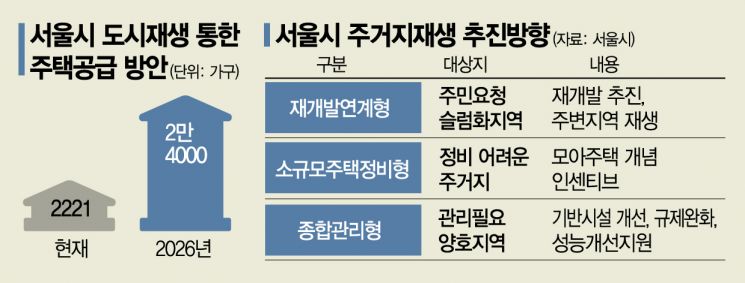
According to Seoul City on the 18th, since the Urban Regeneration Act was enacted in 2013, the total number of newly supplied households through urban regeneration has amounted to only 2,221 units. While efforts were concentrated on aesthetic improvements such as mural painting and home repairs, there were clear limitations in increasing the number of housing units. Because the projects were mainly focused on management and preservation, residents expressed dissatisfaction due to issues like narrow roads not being widened and outdated infrastructure not being improved.
The ‘2nd generation urban regeneration’ announced by Seoul City this time focuses on addressing these problems. Broadly, the four complex existing types of urban regeneration have been simplified into two: ‘residential area regeneration,’ which improves living conditions, and ‘specialized regeneration of central areas,’ which combines regional economic revitalization. The city announced plans to supply 24,000 households by 2026 through this approach.
The most eye-catching aspect is residential area regeneration. This is because it opens the door for redevelopment to be pursued even within urban regeneration areas. Previously, once an area was selected as an urban regeneration project site, redevelopment was practically impossible. Although redevelopment demands were strong?10 out of 70 candidates in last September’s public redevelopment candidate contest were urban regeneration districts?the city had been reluctant to promote redevelopment since budgets had already been invested in regeneration projects.
With the introduction of this ‘2nd generation urban regeneration,’ the possibility of private redevelopment has opened up in 32 residential regeneration-type urban regeneration districts, including Changsin and Sungin in Jongno-gu, Garibong-dong in Guro-gu, and Jangwi-dong in Seongbuk-gu. The city expects redevelopment to be promoted in two districts by next year. A Seoul city official explained, "Residents within urban regeneration districts are trying to promote redevelopment, and in a preliminary consent rate survey, the rate exceeded 50%, surpassing the legal consent threshold."
These districts will pursue private redevelopment under the relaxed aging criteria and public planning previously announced by Seoul City. The city plans to expand this to a total of 10 districts by adding 8 more by 2026. Professor Shim Gyo-eon of Konkuk University’s Department of Real Estate said, "This allows development in urban regeneration districts where development is necessary," adding, "It is positive from the perspective of housing supply."
However, there are also concerns that the redevelopment promotion areas will be limited. This is because redevelopment is likely to be promoted mainly in areas where public urban regeneration projects have been completed. The city still draws a line regarding public redevelopment, which grants resident consent rates and floor area ratio benefits. A Seoul city official said, "This measure is limited to private redevelopment," and added, "Public redevelopment requires further review."
© The Asia Business Daily(www.asiae.co.kr). All rights reserved.

















