Trade Association Introduces Expert Response Strategies at Online Seminar on the 18th
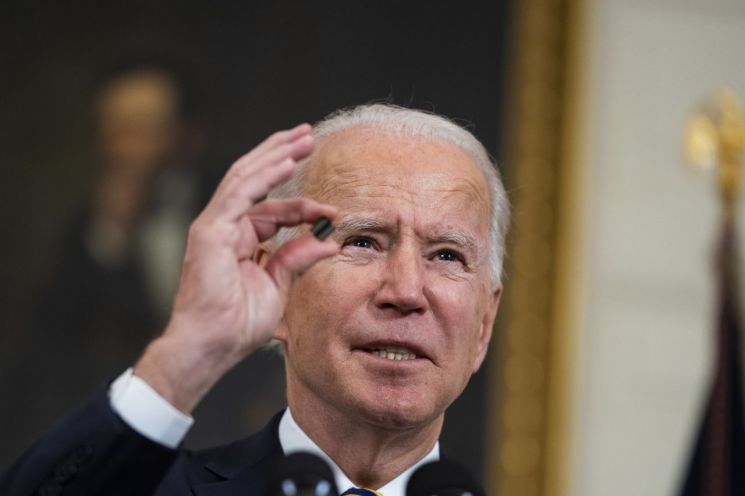 U.S. President Joe Biden is holding a semiconductor chip and explaining the purpose of the executive order before signing the order on building a semiconductor supply chain at the White House last February. (Washington EPA=Yonhap News)
[Asia Economy Reporter Kim Heung-soon] Experts have analyzed that the semiconductor and battery supply chain strengthening strategy recently announced by the United States could present opportunities for Korean companies.
The Korea International Trade Association (KITA) will hold an online seminar on the 18th titled "Key Contents and Prospects of the U.S. Supply Chain Strengthening Strategy." During the seminar, the focus will be on the semiconductor and battery sectors outlined in the White House's report published on the 8th, "Building Resilient Supply Chains, Revitalizing American Manufacturing, and Promoting Broad-Based Growth." The seminar will closely examine the main points and implications of the U.S. supply chain strategy and discuss response measures for domestic companies.
According to the seminar content first introduced by KITA, Kim Yang-peng, a senior researcher at the Korea Institute for Industrial Economics and Trade, stated, "The U.S. holds a 55% share of the global semiconductor market, but its market share in semiconductor manufacturing is only 12%." He added, "The U.S. aims to strengthen its domestic semiconductor manufacturing ecosystem and establish a stable semiconductor supply chain through technological cooperation with allied countries."
He also advised, "As cooperation with Korea, which has technological competitiveness in semiconductor manufacturing, is expected to expand and this process could enhance the competitiveness of our companies, both countries should seek cooperative measures that create a 'win-win' situation."
Kim Hyun-soo, a senior researcher at Hana Financial Investment, said, "The U.S. emphasized the importance of the midstream segment (raw material processing and cell production) in the battery supply chain, but in some minerals, the U.S. lacks processing and refining capabilities." He added, "To address this issue, the U.S. will strengthen investments and diplomatic efforts to enhance dominance in the upstream segment (raw material mining). This is positive as it increases the likelihood of mitigating risks related to raw material procurement that heavily depends on China."
Je Hyeon-jung, head of the Trade Support Center at KITA, emphasized, "Korea has strengths in the semiconductor and battery sectors and is an essential partner for the U.S. in strengthening its supply chain." She stressed, "Our companies should effectively utilize the U.S. supply chain strengthening strategy as an opportunity to expand into the North American market and secure competitiveness."
KITA plans to sequentially publish global supply chain reports on the four core sectors where the U.S. is promoting supply chain strengthening: semiconductors, batteries, pharmaceuticals, and rare earth elements. On the 23rd at 9 p.m., KITA will co-host a webinar with the U.S. Center for Strategic and International Studies (CSIS) to discuss directions for Korea-U.S. industrial cooperation to establish a stable supply chain in the U.S. semiconductor and battery industries.
© The Asia Business Daily(www.asiae.co.kr). All rights reserved.
![Clutching a Stolen Dior Bag, Saying "I Hate Being Poor but Real"... The Grotesque Con of a "Human Knockoff" [Slate]](https://cwcontent.asiae.co.kr/asiaresize/183/2026021902243444107_1771435474.jpg)
















