On the 18th, Won-Dollar Exchange Rate Starts Higher Compared to Previous Day
Volatility Expected to Increase Following Fed Monetary Policy News
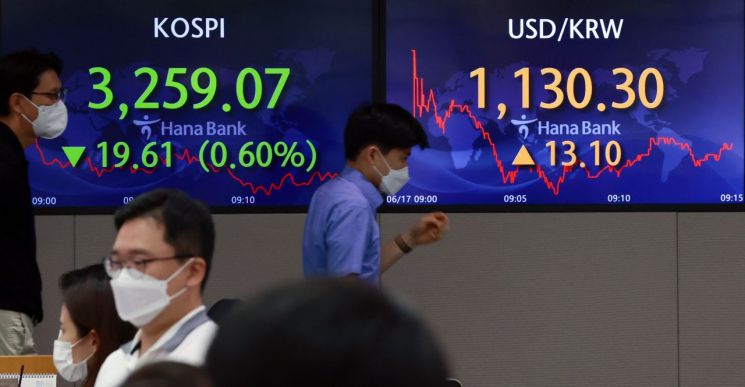
[Asia Economy Reporter Kim Eun-byeol] The won-dollar exchange rate, which surged sharply the previous day due to concerns over U.S. monetary tightening, has continued its upward trend for five consecutive days. Although the pace of increase has slowed compared to the previous day, creating a calming atmosphere, the pressure for dollar strength is expected to persist as the U.S. Federal Reserve (Fed) may withdraw the funds it injected in response to the COVID-19 crisis. There is also a possibility that the dollar's sharp fluctuations, depending on Fed's monetary policy, could negatively impact Korean export companies.
As of 9:40 a.m. on the 18th in the Seoul foreign exchange market, the won-dollar exchange rate was trading at 1,131.78 won, up 1.38 won from the previous day's closing price. The won-dollar exchange rate surged more than 13 won in a single day after Fed Federal Open Market Committee (FOMC) members projected the timing of interest rate hikes to be brought forward by one year. On the same day, the $60 billion Korea-U.S. currency swap was extended until the end of this year, but the dollar strengthened amid assessments that the FOMC results were more hawkish (favoring monetary tightening) than expected.
The dollar has shown strength as expectations grow that the Fed will tighten monetary policy. The Dollar Index, which measures the value of the dollar against six major currencies, rose to around 91.92 after the FOMC meeting results were announced. After U.S. President Joe Biden was elected last year, the index fell to the 80 level by the end of the year, but as the amount of newly issued dollars is expected to decrease, the Dollar Index is on an upward trend.
Experts believe that the current dollar strength does not immediately affect export companies. However, they caution that the won-dollar exchange rate could experience sharp fluctuations depending on monetary policy news. Exchange rates could fluctuate significantly depending on signals from events such as the August Jackson Hole meeting and the September FOMC. While large corporations have the capacity to manage exchange rate volatility, small and medium-sized enterprises may face significant shocks if their exchange rate forecasts in a particular direction prove incorrect.
Researcher Lee Seung-ho of the Korea Capital Market Institute stated, "Recently, the won-dollar exchange rate has been more sensitive to external factors such as changes in the value of the U.S. dollar and risk appetite in international financial markets, rather than domestic factors like foreign exchange supply and demand or economic fundamentals." He added, "Various external uncertainties remain, including whether U.S. Treasury yields will continue to rise, early changes in Fed monetary policy, and the possibility of renewed U.S.-China trade conflicts. Efforts to manage risks in response to short-term exchange rate volatility are important."
© The Asia Business Daily(www.asiae.co.kr). All rights reserved.

















