Portal Not Editing News and Considering Subscription Model Transition Plan
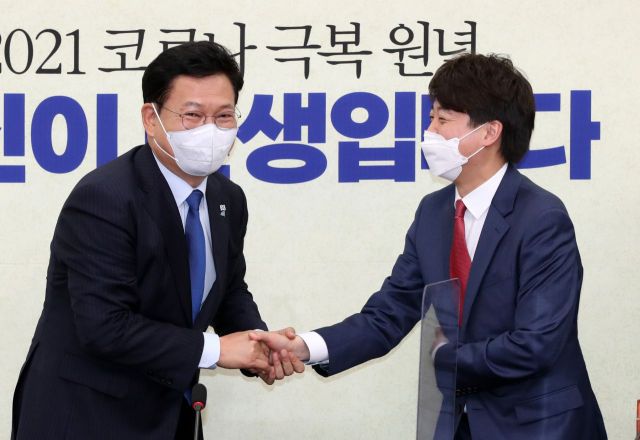
[Asia Economy Reporter Park Cheol-eung] The Democratic Party is pushing for a subscription-based system where portal sites do not arrange news but users select it themselves. For false reports, compensation of up to five times the damage amount will be required.
Kim Yong-min, chairman of the Democratic Party's Special Committee on Media Innovation, reported the interim activities of the committee on the 17th with these details.
Rep. Kim said, "The arrangement of news on portals should be decided directly by users, not by the portals themselves," adding, "News and media should be converted to a subscription system and change to a proper method where services are provided through clear user decision-making. News unilaterally edited and shown by portal sites is no different from the entire nation reading a single newspaper."
He stated that this has not guaranteed freedom of the press but rather resulted in restrictions and infringements on press freedom. He said they will institutionally prevent the supply of uniform information to all citizens for convenience.
Rep. Kim said, "Naver News has started transitioning to a user subscription system, and Kakao News is also preparing to switch to a subscription system. If social consensus is reached, news services decided by the people, not portals, will be provided."
He continued, "The media should not focus on headline grabbing to be selected by portals, nor be obsessed with click competition instead of fair competition. We will review and supplement the system so that the media can find their own competitiveness in the rapidly changing media environment."
As a countermeasure against so-called 'fake news' and false manipulated reports, he said, "In cases of emergency relief measures such as requests for corrections, the fact that such a request exists should be immediately indicated in the article, and victims can prevent the indiscriminate spread of false manipulated information through viewing block requests."
Rep. Kim also stated, "We will strengthen liability for damages to prevent irresponsible behavior that profits from false manipulated reports and spreads harm to the public. For false manipulated reports where it is difficult to calculate damages, the damage amount will be presumed to be between 30 million and 50 million KRW, and compensation will be required at three to five times the recognized damage amount to prevent unjust profits."
However, for political appointees or executives of large corporations, this compensation method will only apply in cases of malicious intent, and if sufficient verification procedures regarding the truthfulness are conducted, exemption will be granted to ensure that the press’s role in monitoring and checking power is not weakened. The number of members of the Korea Press Arbitration Commission will also be significantly increased to expedite the processing of media arbitration requests.
Rep. Kim added, "We will take the lead in breaking political patronage over public broadcasting. We will institutionally reform the recommendation system for the Broadcasting Culture Promotion Foundation directors, the major shareholders of KBS, EBS, and MBC, which have been traditionally recommended by political circles."
The special committee was launched at the end of last month and has held over ten meetings exchanging opinions with individual reporters, the National Union of Media Workers, portal operators, the Korea Internet Journalists Association, the Citizens’ Coalition for Democratic Media, the Korea Press Arbitration Commission, the Korea Internet Corporations Association, and the Barun Regional Media Alliance.
Song Young-gil, leader of the Democratic Party, said, "The ruling party will return the right to recommend candidates for public broadcasting presidents to the people to relinquish vested interests," adding, "We will adjust the portal news editing function so that news editing rights can be returned to the people and news from various media companies can be selected and read by consumers."
He continued, "We will enable the public to choose through a media voucher system," emphasizing, "In cases where false facts are deliberately and maliciously reported, simple civil law-based compensation for causation is insufficient, and a punitive damages system should be established to provide appropriate compensation."
He added, "Improving the media environment is not about the ruling party or government blocking media criticism functions. The opposition party can also be victims, and businesspeople, professionals, and all individuals can be harmed, so the media environment must be improved for the rights and interests of all citizens."
Leader Song also said, "Especially most journalists, though they cannot say it openly, seem to be at the mercy of portals and forced to endure portal tyranny. In fact, when someone else writes an article and it is edited, it is called plagiarism, but in cases like Naver and Daum, they are not even the creators of the articles but exercise editorial rights to influence content, which needs to be corrected."
© The Asia Business Daily(www.asiae.co.kr). All rights reserved.

















