Commissioner Kim Chang-ryong of the National Police Agency Holds Talks with Uzbekistan's Chief of Security
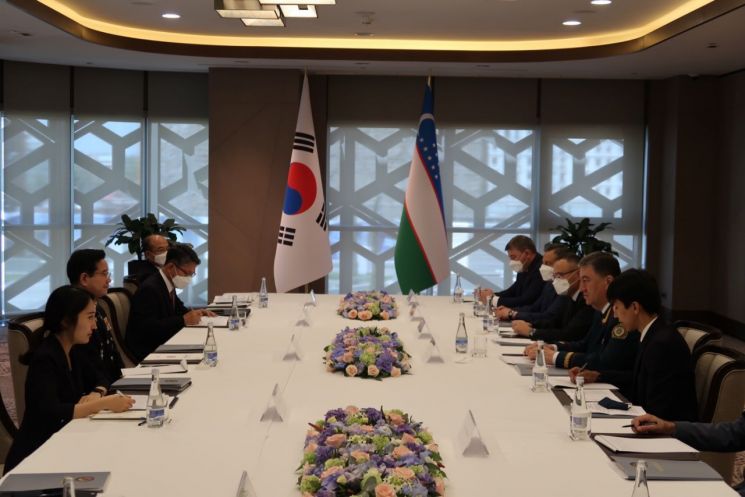 National Police Agency Commissioner Kim Chang-ryong is holding a security chief meeting with the Minister of Internal Affairs of Uzbekistan on the 17th.
 [Photo by National Police Agency]
[Asia Economy Reporter Lee Gwan-ju] The Korean police have pledged comprehensive security cooperation with Uzbekistan. This is expected to play a significant role not only in preventing international terrorism and protecting overseas nationals but also in spreading the "security Hallyu" wave.
On the 17th, the National Police Agency announced that following a summit between Commissioner General Kim Chang-ryong and Uzbekistan’s Minister of Internal Affairs Polat Bobojonov, a memorandum of understanding (MOU) was signed between the National Police Agency, Uzbekistan’s Ministry of Internal Affairs, and the National Guard.
Why Did the Police Commissioner Visit Uzbekistan?
Since establishing diplomatic relations in 1992, the relationship between Korea and Uzbekistan has grown increasingly important, being elevated to a "special strategic partnership" in 2019. Particularly, with Uzbek President Shavkat Mirziyoyev designating Korea as a model country for national development, cooperation has expanded across various fields including healthcare, education, and public administration.
Uzbekistan, currently pushing for intensive reforms in law enforcement, sent a high-level delegation of nine members last month, including Doniyo Kadirov, Deputy Secretary for Law Enforcement at the Presidential Office, to Korea. The delegation actively sought assistance from the Korean police to experience and adapt Korea’s cyber investigation techniques, highway patrol systems, 112 emergency call system, and educational institutions such as the Police University and Police Investigation Training Institute.
This visit by Commissioner General Kim was also made at Uzbekistan’s strong request for enhanced cooperation in the security sector. Invited officially by the Uzbek Minister of Internal Affairs, Kim visited Uzbekistan from the 16th to the 21st of this month, signing MOUs with four police institutions including the Police University and the Public Safety University under the National Guard affiliated with the Uzbek Ministry of Internal Affairs.
Triple Benefits: Protecting Overseas Nationals, Preventing Terrorism, and Ensuring Security Stability through Cooperation
This agreement is expected to elevate the security cooperation between the two countries to a new level. It plans to develop new security-related official development assistance (ODA) projects such as the 112 emergency call system and traffic systems for Uzbek police agencies, transferring Korea’s excellent security infrastructure and capabilities. It will also promote exchanges and academic research between police educational institutions of both countries, including dispatching experts in cyber investigation and digital forensics and inviting trainees.
Such security cooperation will play a major role in protecting Uzbek nationals abroad and maintaining domestic security. Approximately 180,000 Koryo-saram (ethnic Koreans) reside in Uzbekistan, which is also one of Korea’s major trade surplus countries. With 896 Korean companies operating locally, the demand for protecting overseas nationals is increasing. Additionally, about 75,000 Uzbeks reside in Korea, ranking fifth among foreign nationalities in the country. Recently, incidents involving group assaults and illegal drug distribution involving Uzbeks and other foreigners have occurred domestically, increasing the likelihood of close cooperation between the police agencies of both countries in addressing such crimes.
Counterterrorism is also a critical agenda. In January 2019, the UN released a report stating that Uzbek terrorist group followers linked to Al-Qaeda in Syria were hoping to travel to Korea. Last year, extremist Uzbeks residing in Korea were caught sending terrorist funds to terrorist organizations and were deported. At the security summit, Commissioner Kim agreed to strengthen cooperation by preemptively blocking the entry of terrorist suspects and sharing information on extremist followers residing in Korea.
A National Police Agency official said, "This is the first visit by a police commissioner to Uzbekistan," and evaluated that "by expanding security exchanges with Uzbekistan, a key country in the New Northern Policy, an environment has been created for joint solidarity against international crimes such as terrorism and drugs with neighboring CIS countries like Kazakhstan." He added, "This will greatly contribute to making the Republic of Korea safer from such international crimes and protecting the rights and interests of our nationals and Koryo-saram residing locally."
© The Asia Business Daily(www.asiae.co.kr). All rights reserved.

















