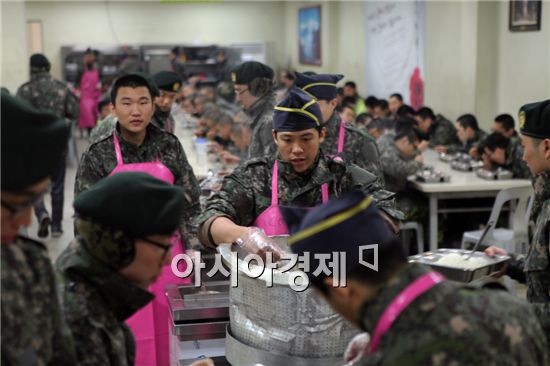
[Asia Economy Yang Nak-gyu, Military Specialist Reporter]The military authorities have decided to increase the number of cooking soldiers by about 1,000 to address the issue of poor-quality meals.
According to the Ministry of National Defense on the 17th, to reduce the increased workload caused by supporting meals for soldiers quarantined as a preventive measure against the novel coronavirus infection (COVID-19) and to improve meal quality, about 1,000 cooking soldiers will be additionally deployed to the Army and Marine Corps. To this end, from the second half of the year, administrative support personnel, excluding essential personnel such as situation and communications staff for each military branch, will be actively reduced and converted into cooking soldiers.
In the second half of this year, civilian cooks will be promptly hired and deployed to weekday breakfast shifts, which are vulnerable to cooking shortages, next year. Currently, the number of cooking soldiers per kitchen with more than 80 personnel will be increased from one to two, and working hours will be divided into 6 a.m. to 3 p.m. and 10 a.m. to 7 p.m.
Modernized cooking equipment will also be supplied to military dining halls. Ovens (large, medium, and small) capable of preparing various types of dishes such as grilling and steaming, and improving food quality, will be installed in all kitchens by the end of the year. The distribution of 'vegetable cutters' to facilitate vegetable preparation will be expanded, and 'high-pressure cleaning machines' necessary for kitchen cleaning will continue to be supplied.
Additionally, pilot units will be selected to provide a 'simple buffet-style' menu preferred by MZ generation soldiers (those born from the 1980s to early 2000s) for breakfast. On weekends and holidays, 'ready meals' (such as stews, instant rice, and side dishes) preferred by soldiers will be provided. The Ministry of National Defense expects that these measures, combined with ongoing meal innovation projects such as delivery food and brunch, will reduce the cooking burden on Saturdays and Sundays, which occur 24 times a month, by about one-third.
The civilian consignment pilot project currently operating in one dining hall at the Army Non-Commissioned Officer Academy will be expanded to about 10 units from the second half of this year.
The Ministry of National Defense plans to raise the quality of meals to a level comparable to school meals.
To this end, frontline units will reorganize the meal management system from the current corps-level to division-level units, and the school meal electronic procurement system (eaT) will be gradually applied. In the second half of the year, units with nutritionists will be selected to pilot the 'eaT system.' The 'eaT system' is a system used by schools to select and contract food suppliers and has been in operation since 2010. Contracting companies are decided through a competitive process.
The Ministry of National Defense stated, "If the meal system changes in this direction, it will be possible to organize menus prioritizing soldiers' preferences rather than the current method of composing menus based on already procured ingredients."
© The Asia Business Daily(www.asiae.co.kr). All rights reserved.
![User Who Sold Erroneously Deposited Bitcoins to Repay Debt and Fund Entertainment... What Did the Supreme Court Decide in 2021? [Legal Issue Check]](https://cwcontent.asiae.co.kr/asiaresize/183/2026020910431234020_1770601391.png)















