Ruling Party and Government Promote Card Cashback... Get Cash Back When Using Cards More
Experts Say "Not Helpful for Long-Term Economic Revitalization"
 A citizen is making a card payment. The photo is unrelated to specific expressions in the article. [Image source=Yonhap News]
[Asia Economy Reporter Heo Midam] The ruling party and the government are pushing to introduce a 'credit card cashback' system that returns a certain amount of money equivalent to the amount spent when using credit cards frequently. The purpose is to revitalize the economy, which has been sluggish due to the impact of COVID-19, and anyone who uses credit cards can benefit from it.
Public reactions to this plan are mixed. Some believe that if consumption is stimulated as planned by the ruling party and government, it could contribute to revitalizing the domestic economy. On the other hand, there are concerns that releasing taxes to boost consumption amid rising inflation is inappropriate. Experts predict that such a plan will not help long-term economic revitalization.
Song Young-gil, leader of the Democratic Party of Korea, stated in his first National Assembly negotiation group representative speech on the 16th after taking office, "The ruling party and government will prepare a supplementary budget centered on a 'three-package' including additional support for small business owners, disaster relief payments for all citizens, and credit card cashback."
Among these, the credit card cashback plan involves returning a certain portion of the increase in card usage compared to a certain period as card points. Since card points can be used like cash, it is effectively equivalent to cash support.
Currently, a likely method is to refund about 10% of the amount if the card usage in the third quarter (July to September) exceeds that of the second quarter (April to June).
For example, if a person spent an average of 1 million KRW per month on credit cards in the second quarter and 2 million KRW per month in the third quarter, the increased amount of 1 million KRW would be refunded as cashback at a certain rate. If the cashback rate is 10%, they would receive 100,000 KRW back. However, it is expected that there will be an upper limit on the cashback amount.
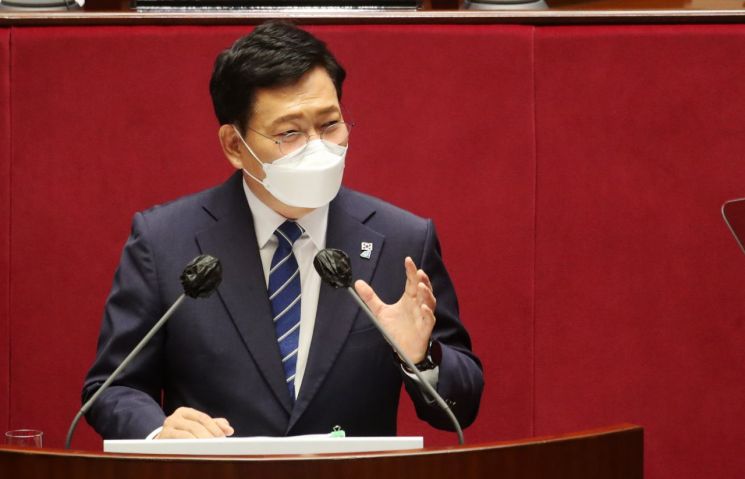 Song Young-gil, leader of the Democratic Party of Korea, is delivering a negotiation group representative speech at the plenary session held at the National Assembly in Yeouido, Seoul on the 16th. [Image source=Yonhap News]
Some citizens support this system, arguing that it will increase consumption and help revitalize the domestic economy.
Office worker Kim (27) said, "If the cashback plan is implemented, people's consumption will inevitably increase. Providing this kind of support to citizens exhausted by COVID-19 is a good thing," adding, "It could also have a positive impact on self-employed people struggling due to poor business. Also, many people who have been hesitating to buy expensive items might take this opportunity to make purchases."
On the other hand, there are many who oppose the credit card cashback plan due to concerns about national debt. Another office worker Oh (28) expressed, "Isn't tax money the people's money? Articles about the increasing national debt come out almost daily, but the ruling party and government only think about handing out money, which is frustrating." He added, "I suspect they are continuously giving money to the people with the next year's presidential election in mind."
In this regard, South Korea's national debt is rapidly increasing. In 1997, the national debt was only 60.3 trillion KRW. Since then, it increased to ▲111.2 trillion KRW in 2000 ▲392.2 trillion KRW in 2010 ▲591.5 trillion KRW in 2015, and the speed of debt increase accelerated after the Moon Jae-in administration took office.
According to estimates by the Ministry of Economy and Finance last year, the national debt rose from 660.2 trillion KRW in 2017, when the Moon Jae-in administration began, to 1,070.3 trillion KRW in 2022, its final year in power.
As a result, opposition parties have voiced opinions that national bonds should be repaid. Kim Ye-ryeong, spokesperson for the People Power Party, said in a statement on the 9th, "The national debt increased by a whopping 410 trillion KRW under this administration alone. How can they easily talk about releasing money with additional tax revenue while facing a snowballing debt?" She pointed out, "If more taxes are collected, it is common sense to repay the debt for the sake of future generations."
Meanwhile, there is also controversy over fairness, as benefits depend on whether one uses credit cards. One netizen pointed out, "What about those who only use debit cards and not credit cards? They pay taxes but do not receive benefits. Vulnerable groups such as those with poor credit also do not receive benefits."
Experts judged that the credit card cashback system would not significantly help economic revitalization. Kim Tae-gi, a professor of economics at Dankook University, said, "There may be short-term effects, but it will not lead to long-term effects. Given the current consumption polarization, high-income groups already consume a lot. Therefore, even if the cashback system is implemented, its effect on them will be small."
He continued, "There may be effects on low-income groups, but since their income is not high and their employment status is often unstable, they tend to save money rather than spend it. Ultimately, economic stagnation is a structural problem. The problem is that the ruling party and government mistake it for a temporary cyclical issue and propose various alternatives," he added.
© The Asia Business Daily(www.asiae.co.kr). All rights reserved.
![Clutching a Stolen Dior Bag, Saying "I Hate Being Poor but Real"... The Grotesque Con of a "Human Knockoff" [Slate]](https://cwcontent.asiae.co.kr/asiaresize/183/2026021902243444107_1771435474.jpg)

















