Subdivision of Regeneration Types to Enable Development and Maintenance in Urban Regeneration Focused on Preservation
Inducing Redevelopment and Private Development
Adjustment of Project Plans in Currently Ongoing Regeneration Areas
[Asia Economy Reporter Kim Hyemin] Seoul City is linking redevelopment to urban regeneration, which had previously focused on 'preservation.' In terms of project scope, it plans to move away from the existing public-led approach and encourage private development in urban regeneration projects.
On the 17th, Seoul City announced the launch of the '2nd generation urban regeneration,' a major shift toward including development and maintenance in urban regeneration.
So far, urban regeneration projects have revitalized declining areas and boosted local economies, but the city explained that in the case of aging low-rise residential areas, the focus on preservation led to insufficient improvements in housing supply and infrastructure. This has caused growing dissatisfaction among citizens. A Seoul city official said, "Also, since projects were driven solely by the public sector, private participation was low, limiting the ripple effects of regeneration."
Accordingly, Seoul City restructured urban regeneration into two types: 'residential regeneration' aimed at improving aging residential environments, and 'central area specialized regeneration' directly linked to the local economy, creating six detailed implementation methods. They plan to actively introduce various project techniques by distinguishing between areas for development and those requiring management.
For residential regeneration, redevelopment can be introduced based on a comprehensive assessment of infrastructure conditions and resident conflicts. Where residents want redevelopment but it is not feasible, small-scale housing maintenance will be pursued. The 'Moahouse' pledged by Mayor Oh Se-hoon will also be applied. Moahouse is a concept where landowners with small plots gather an area of 500㎡ or more, sufficient to secure underground parking, to build multi-family housing and receive incentives. In Hanok-dense areas and height-restricted zones where redevelopment is difficult from an urban planning perspective, comprehensive regeneration supporting infrastructure and housing performance improvements will be introduced.
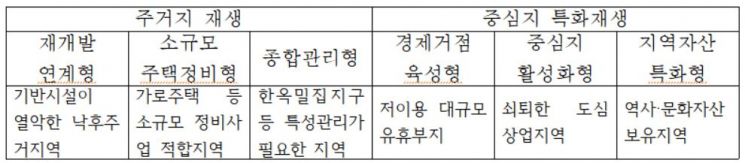
Central area specialized regeneration, which had focused on creating hub spaces and community revitalization projects, will now emphasize activating private development, targeting underutilized large sites and declining urban areas within the city. The plan is to develop private-led hubs linked to five regional hubs such as Changdong-Sanggye and Magok, creating new projects and jobs by integrating urban regeneration. Existing industries will be upgraded, and local assets will be turned into landmarks.
As a starting point, the city plans to induce private development on the available 430,000㎡ site within Gimpo Airport (currently used as parking lots and warehouses) to create a specialized future industry zone in the southwest area centered on new aviation-related industries. The goal is to create more than 35,000 jobs and revitalize the surrounding residential areas in Gonghang-dong.
For the existing 15 central urban regeneration project areas, including Yongsan Electronics Market, the city will prepare and present development guidelines to induce private development while continuing existing projects through stakeholder consultations.
Seoul City will establish a plan within the year regarding the restructuring direction of ongoing urban regeneration areas, presenting specific methods and details. New area designations will be minimized under the principle of stable completion of existing projects, but areas wishing for regeneration will be newly designated after carefully considering residents' opinions.
With this '2nd generation urban regeneration,' the goal is to supply 24,000 housing units and create 8,400 direct and indirect jobs by 2026. Over six years, a total of 7.09 trillion KRW (including 730 billion KRW in city and national funds and 6.36 trillion KRW in private investment) will be invested.
Initially, efforts will focus on areas where implementation is possible within one year. Residential regeneration will be pursued in two sites linked to redevelopment and 30 small-scale housing maintenance management areas.
Yang Yongtaek, Acting Director of the Urban Regeneration Office, said, "This reflects the demands of citizens who want development and overcomes the limitations of urban regeneration pointed out so far. We will carry out practical urban regeneration projects that improve aging residential areas and revive livelihoods and the economy."
© The Asia Business Daily(www.asiae.co.kr). All rights reserved.


















