UNIST Professor Kyungduk Park's Team First in the World to Integrate Adaptive Optics Technology into Tip-Enhanced Nanoscopy
Enables Various Analyses through Near-Field Polarization Control and Infrared Signal Detection... Published in Nature Commun.
Observes Different Samples Such as Semiconductors, Chemicals, and Viruses with a Single Microscope
[Asia Economy Reporter Kim Bong-su] An optical analysis technology that can freely change the observation method depending on the target, like a chameleon, has been developed. It can selectively observe molecules bent in a specific direction or switch modes to detect optical signals of various substances. It is attracting attention as it can analyze the characteristics of different types of ultra-fine particles such as biological viruses, chemical single molecules, and semiconductor particles with a single microscope.
Ulsan National Institute of Science and Technology (UNIST) announced on the 17th that Professor Kyungduk Park’s team in the Department of Physics developed a new optical analysis technology by applying adaptive optics technology to a tip-enhanced nano-microscope.
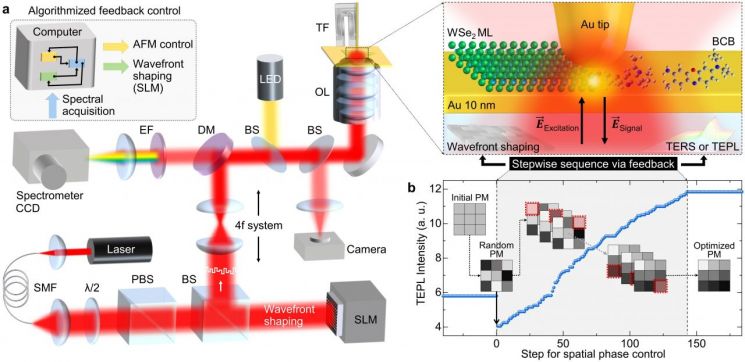
The tip-enhanced nano-microscope is a self-developed device that scans a sample with a sharp tip to obtain shape information while simultaneously analyzing the optical properties of the sample by irradiating light gathered on the tip onto the sample. The existing tip-enhanced nano-microscope could not control the polarization of light delivered from the tip to the sample, but this problem was solved by integrating adaptive optics technology. Adaptive optics is a technology that adjusts the wavefront of light to compensate for wavefront distortions caused by scattering and other factors.
The gold tip of the tip-enhanced nano-microscope acts as an antenna that collects an external laser beam. The light (near-field) gathered at the tip is irradiated onto the sample to identify various optical properties. Each sample reacts differently to light. Since the tip can also read shape information, it is possible to simultaneously read the three-dimensional shape of bent proteins like prions and changes in the chemical bonds of proteins.
However, the existing tip-enhanced nano-microscope had a chronic problem where the polarization (directionality) of light was fixed only in the vertical direction on the gold tip surface, making polarization control impossible. Because of this, it was difficult to selectively observe the molecular alignment direction (orientation). Even the same molecule can have different chemical properties depending on whether it is lying down or standing, so it is necessary to distinguish these.
The research team solved this problem by applying an adaptive optics method that creates a customized laser beam using a computer algorithm. Unlike the existing technology where the wavefront of the laser beam irradiated onto the tip is fixed, this technology adjusts the wavefront according to the shape of the tip. With this technology, the polarization direction could be freely controlled with a resolution of 15 nanometers (10^-9 m), and the technology was verified by distinguishing and measuring single molecules with different orientations.
Another advantage is that infrared absorption spectroscopy signals can be obtained even though visible light band laser beams are used. This phenomenon is possible because the gradient of the electromagnetic field changes sharply in a very small space. By applying this, the developed device can selectively obtain Raman spectroscopy signals using visible light and infrared absorption spectroscopy signals depending on the purpose. Without expensive infrared lasers and detectors, various types of fine particles can be studied with a visible light nano-microscope.
Professor Kyungduk Park said, “This research presents a new convergent nano-microscope model by combining adaptive optics, near-field optics, and computational imaging,” and added, “This study, which first integrated adaptive optics and near-field optics that were independently researched, is expected to actively introduce adaptive optics into the near-field optics field.”
Also, by using adaptive optics technology to increase the efficiency of the laser beam gathered on the tip, the detection signal could be increased by more than 200%. Since the light generated in a space of about 10 nanometers is very weak, increasing the detection signal is important in nano-microscopy.
Professor Park said, “Just as the development of telescopes has led to advances in astrophysics, the development of new measurement equipment leads to pioneering new research fields,” and added, “I want to utilize the developed device for research on biomolecules such as the coronavirus and proteins.”
The research results were published on the 8th in the international journal Nature Communications. The core technology related to the adaptive tip-enhanced nano-microscope has been filed for domestic and European patents (PCT).
© The Asia Business Daily(www.asiae.co.kr). All rights reserved.
![Clutching a Stolen Dior Bag, Saying "I Hate Being Poor but Real"... The Grotesque Con of a "Human Knockoff" [Slate]](https://cwcontent.asiae.co.kr/asiaresize/183/2026021902243444107_1771435474.jpg)
















