Discussion on Preparing for the Future of the Automotive Industry
Industry Proposes Expansion of Charging Infrastructure and Support for Parts Suppliers' Business Transition
[Asia Economy Reporter Hwang Yoon-joo] "The pace of change in the automotive industry, including electric vehicles, hydrogen vehicles, autonomous vehicles, and connected cars, is alarmingly fast. However, the improvement of regulatory environments that restrict technology development and industrial structure transformation is too slow. I am afraid that we might be left behind in global competition."
"Automotive parts manufacturers also need to prepare to transition from internal combustion engine parts to future vehicle parts, but developing a single part takes an average of 4 to 5 years and costs over 1 billion KRW. Considering the fragile state of the parts industry, government support is urgently needed."
The Korea Chamber of Commerce and Industry (KCCI) held the '5th Future Industry Forum' on the 17th to review the digital transformation and carbon neutrality status of the domestic automotive industry and requested bold policy support and regulatory relaxation from the government.
At the forum attended by Woo Tae-hee, Executive Vice Chairman of KCCI, Kang Kyung-sung, Director of Industrial Policy at the Ministry of Trade, Industry and Energy, Yoon Seok-hyun, Executive Director of Hyundai Motor Company, and about 10 experts from related organizations and industries, many opinions were expressed that the systems, policies, and infrastructure necessary to support the automotive industry's efforts toward digital transformation and carbon neutrality are severely lacking.
In fact, Tesla provides services that improve vehicle performance and fix system errors wirelessly through OTA (Over-The-Air) updates, but in Korea, maintenance outside designated locations is illegal, making such services impossible. Fortunately, temporary approval was granted last year through the regulatory sandbox system, but unless the system is fundamentally improved, regulations will inevitably be imposed again.
Digital Transformation: "Korea is at Stage 2; Needs Industry Ecosystem-Level Approach"
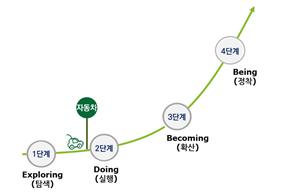
Lee Je-won, Partner at Deloitte Consulting, who gave the first presentation, discussed the current status and strategy of digital transformation in the domestic automotive industry. Korea's automotive digital transformation is at the execution (Doing) stage, which is the second of four stages: preparation, execution, diffusion, and settlement. Due to the structural characteristic of the domestic automotive industry, where development, production, and sales are vertically integrated, there are limitations in quickly responding to rapid technological changes and convergence across industries.
Recently, the global automotive market has officially entered an era of paradigm shift represented by 'CASE (Connected, Autonomous, Shared, Electric)' vehicles. The partner emphasized, "It is time to proactively create a new automotive industry ecosystem that provides comprehensive services beyond transportation through collaboration with global IT companies."
Carbon Neutrality: Focus on Expanding the Adoption of 'Eco-Friendly Vehicles'
Jeong Eun-mi, Director at the Korea Institute for Industrial Economics and Trade, who presented on greenhouse gas emissions and carbon neutrality in the automotive industry, said, "Since greenhouse gases emitted during vehicle operation account for 10% of the country's total emissions, the adoption and expansion of eco-friendly vehicles are of utmost importance," adding, "Along with a phased approach to transition internal combustion engine vehicles to eco-friendly vehicles such as electric and hydrogen vehicles, efforts should also be made to improve the driving efficiency of existing internal combustion engine vehicles."
Jang Seok-in, Chair Professor at the Korea University of Technology and Education, emphasized the expansion of infrastructure and the relaxation of labor market rigidity to secure competitiveness in future vehicles. Professor Jang said, "Currently, most electric vehicle charging infrastructure is concentrated in public and tourist facilities and highway rest areas, and the penetration rate of residential private chargers is only 25.1%, which is far behind advanced countries," adding, "It is necessary to shift the charging infrastructure policy from focusing on public places to areas more accessible to general consumers, such as apartments."
He continued, "Labor laws such as the Labor Standards Act and Dispatch Act are excessively rigid, making proactive structural transformation in the automotive industry difficult," and pointed out, "It is time for labor, management, and the government to jointly consider solutions for the sustainable development of the automotive industry and job creation."
Industry: "Expand Charging Infrastructure and Support Parts Manufacturers' Business Transition"
During the subsequent open discussion, opinions from the automotive and electric vehicle industries were heard regarding the presentations.
Kim Jun-gyu, Operating Committee Chairman of the Korea Automobile Manufacturers Association, said, "Although the automotive industry is rapidly transitioning to future mobility, most automotive parts companies are small and medium-sized enterprises that find it difficult to respond individually," and mentioned, "Customized R&D support and long-term low-interest financial support programs are needed for small and medium parts companies pursuing business structure transformation centered on future vehicles."
Lee Jae-kwan, Director at the Korea Automotive Technology Institute, said, "Autonomous driving is a product completed by the convergence of technologies from various industries such as finished vehicles, parts, platform services, and communications," and pointed out, "Demonstration projects are important to evaluate completeness, and urgent improvements in regulations and infrastructure are needed to strengthen domestic demonstration project capabilities."
© The Asia Business Daily(www.asiae.co.kr). All rights reserved.
![Clutching a Stolen Dior Bag, Saying "I Hate Being Poor but Real"... The Grotesque Con of a "Human Knockoff" [Slate]](https://cwcontent.asiae.co.kr/asiaresize/183/2026021902243444107_1771435474.jpg)
















