1st Anniversary Online Meeting
"We Understand the Difficult Times for Businesses... But Cannot Compromise on Accounting Reform"
[Asia Economy Reporter Park Ji-hwan] "Under no circumstances can the principle of proper auditing be compromised."
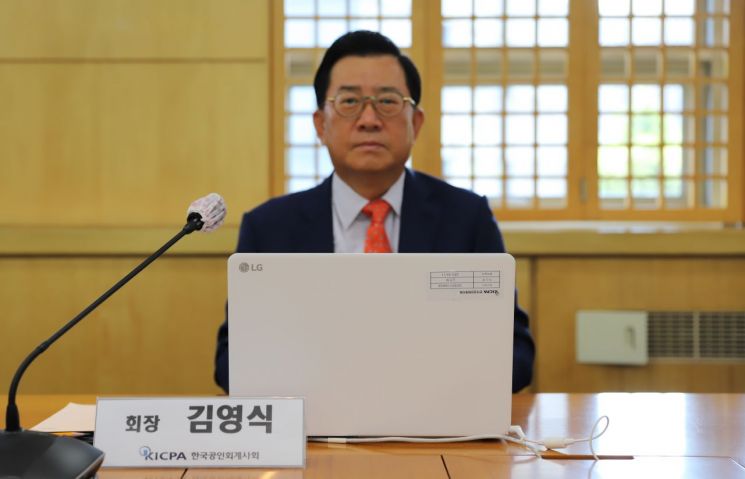
Kim Young-sik, Chairman of the Korean Institute of Certified Public Accountants (photo), held an online press conference on the 16th to mark the first anniversary of his inauguration and addressed concerns that ongoing accounting reform efforts are increasing the burden on companies.
Since the introduction of the new External Audit Act, which includes provisions such as standard audit hours, internal accounting control system audits, and periodic designated audits, there has been significant backlash from companies facing increased accounting-related costs. Especially for small and medium-sized enterprises (SMEs) and mid-sized companies, already struggling due to the COVID-19 situation, additional expenses such as outsourcing fees and hiring related personnel to comply with the new accounting system have led to continuous complaints about excessive cost burdens. While companies agree with the goal of enhancing accounting transparency, they are requesting a reconsideration of the timing for implementing accounting reforms and more relaxed application of the system, taking into account the increased management burdens caused by the special circumstances of COVID-19.
However, Chairman Kim drew a clear line, stating that accounting reform is a matter that cannot be compromised despite companies’ difficulties. He emphasized, "Now is the time to remember the saying, ‘In difficult times, adhere to the right path.’ We should pay close attention to how global accounting firms are taking measures such as allocating more audit hours to ensure no gaps in audits during the COVID-19 environment." He pointed out, "Currently, Samsung Electronics has over 5 million minority shareholders. The number of stakeholders watching the company has increased significantly, and their demands have grown. Considering the economic effects of accounting reforms such as the periodic designation system and the rise in national credibility, I believe the increased costs borne by companies can be sufficiently covered."
The actual effects of the accounting reform efforts are also gradually becoming apparent. Since the accounting reform work began in 2018, the reliability of Korean corporate accounting has shown a clear upward trend. In the International Institute for Management Development (IMD) World Competitiveness Ranking, among 63 surveyed countries, Korea’s corporate accounting transparency ranked 63rd in 2017, 62nd in 2018, and 61st in 2019, remaining in the lower tier. However, following the implementation of the new External Audit Act and the full-scale accounting reform starting in 2019, Korea’s ranking surged to 46th last year.
Regarding the adjustment of the number of certified public accountant (CPA) exam passers, Chairman Kim said, "Financial authorities are likely to propose increasing the number of successful candidates as the number of first-stage exam applicants has increased by 24% compared to last year." However, he personally believes that the current number of CPA passers is in an overflow state.
On the litigation dispute involving Kyobo Life Insurance and some accounting firms, he commented, "I understand that this situation arose from the put-option contract between Kyobo Life Insurance Chairman Shin Chang-jae and financial investors (FIs). At this point, it does not seem appropriate to say who is ‘right’ or ‘wrong’ between Kyobo Life Insurance and the accounting firms."
Furthermore, Chairman Kim plans to accelerate efforts to foster win-win cooperation between large and small accounting firms. Upon his inauguration last year, he launched the ‘Win-Win Cooperation Committee’ for the accounting industry and operates a ‘Knowledge Sharing Platform’ for the accounting sector. The platform shares various advanced ‘work tools’ owned by the Big 4 accounting firms?Samjong, Samil, Anjin, and Han Young?free of charge with mid-sized and small accounting firms.
This initiative aims to bridge technological gaps between accounting firms and elevate work quality to the next level. Chairman Kim stated, "We have uploaded ‘Internal Accounting Control System Audit Workpapers’ and ‘Industry-Specialized Database’ to the knowledge sharing platform, and we will continue to add tools such as ‘Private Equity Fund Audit Workpapers’ and ‘PA (Private Accountant) Service Activation.’"
The Korean Institute of Certified Public Accountants plans to operate the ‘ESG Committee’ robustly to research ESG (Environmental, Social, and Governance) issues and respond to current challenges, aiming to establish measures for ESG external certification, market activation, and ESG expert training. Additionally, Chairman Kim emphasized leading change by developing and providing education on audit techniques utilizing computerized system audits, forensic services, artificial intelligence (AI), and big data in preparation for the future accounting environment in the era of the Fourth Industrial Revolution.
Chairman Kim stated, "Accounting reforms for the nonprofit public sector, such as the 4+2 periodic designation system for school corporations and the appointment of external auditors for apartment complexes, are actively being promoted under the leadership of the National Assembly. As I enter the second year of my term, I will continue to prepare for the future of the accounting industry and pursue improvements in laws and systems."
© The Asia Business Daily(www.asiae.co.kr). All rights reserved.
![User Who Sold Erroneously Deposited Bitcoins to Repay Debt and Fund Entertainment... What Did the Supreme Court Decide in 2021? [Legal Issue Check]](https://cwcontent.asiae.co.kr/asiaresize/183/2026020910431234020_1770601391.png)















