SK Hynix Announces Triple-Digit Hiring for New and Experienced Positions Until the 25th
Samsung Electronics Increases Workforce by About 2,000 in 1Q This Year
Over 1,000 Expected to Be Hired in the Second Half, Forecasting Four-Digit Recruitment
Industry Faces Chronic Labor Shortage Despite Hiring Expansion Expectations
[Asia Economy Reporter Su-yeon Woo] Amid rising expectations for a semiconductor supercycle, semiconductor companies are expected to conduct record-breaking recruitment in the second half of this year. With a clear trend of increased investment, the industry as a whole is anticipating four-digit hiring numbers in just the second half of the year.
According to the industry on the 16th, SK Hynix, which recently posted recruitment announcements for the second half, is accepting applications for new graduates and junior talents (with less than 3 years of experience) until the 25th. The scale of recruitment is in the triple digits and covers 25 job categories including semiconductor design and devices, R&D processes, mass production technology and management, marketing, and IR. Notably, to secure young talent, they introduced a new 'Junior Talent' track for those with less than 3 years of experience alongside new hires, drawing attention.
Earlier, SK Hynix confirmed this year's wage increase rate at an industry-leading 8.07%. As a result, the starting salary for new university graduates has surpassed 50 million KRW, and including various bonuses and productivity incentives, it is expected to reach up to 80 million KRW. This bold offer to attract young talent appears to reflect a sense of urgency that failing to secure talent proactively could lead to a loss of competitiveness.
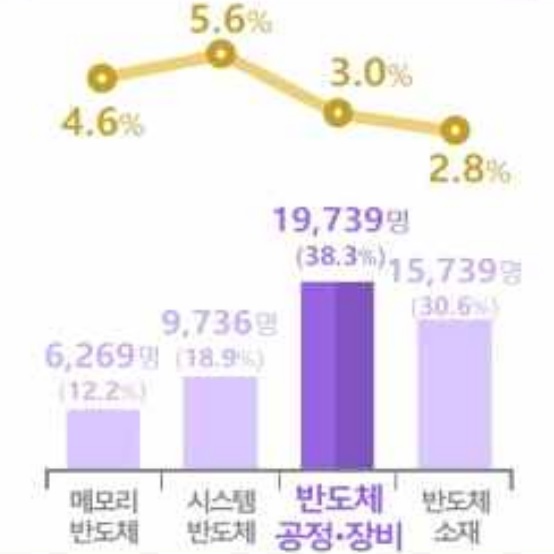 2029 Semiconductor Workforce Demand Forecast by Sector / Source: Ministry of Trade, Industry and Energy
Samsung Electronics is also actively engaging in talent acquisition by increasing hiring not only for new employees but also for experienced professionals. Samsung Electronics, the only one among the top five conglomerates to conduct open recruitment for new graduates, has been carrying out recruitment for new hires since March this year and is currently awaiting the final announcement of results.
The open recruitment schedule for the second half is expected to start in September, with particularly large-scale hiring anticipated in the semiconductor division. This is due to the full-scale operation of the P2 line in Pyeongtaek in the second half and the need for workforce for the P3 line, scheduled for completion in 2022.
The industry expects that since the DS division increased its workforce by about 2,000 employees in the first quarter of this year, at least four-digit new hires exceeding 1,000 people will be made in the second half as well. According to Samsung Electronics' quarterly report, the DS division's workforce increased by 2,104 in the first quarter alone, and a record 3,248 hires were made in the second half of last year. This figure combines new graduate recruitment and experienced hires, and even conservatively assuming one-third are new graduates, it suggests the possibility of over 1,000 new hires.
In addition, domestic mid-sized semiconductor companies such as DB Hitek and Silicon Works are also increasing their recruitment of experienced professionals on a rolling basis. DB Hitek has been recruiting experienced professionals in eight job categories since May and is currently conducting the selection process, while Silicon Works is recruiting experienced employees in seven job categories excluding R&D until the 20th.
Meanwhile, in the field, there are ongoing concerns that although companies want to increase hiring, the chronic shortage of specialized semiconductor personnel is a major obstacle to expanding employment. As of 2019, the number of semiconductor specialists was about 36,000, with an annual shortage of more than 1,500 reported. Although the government has announced plans to produce about 36,000 specialized personnel over the next 10 years through various talent development policies, it is expected to take considerable time. An industry official said, "Even if additional majors are trained from now on, it takes at least 4 years for a bachelor's degree and 6 years or more for master's and doctoral degrees," adding, "Until the policy effectiveness is realized, short-term difficulties due to personnel shortages will continue."
© The Asia Business Daily(www.asiae.co.kr). All rights reserved.
![Clutching a Stolen Dior Bag, Saying "I Hate Being Poor but Real"... The Grotesque Con of a "Human Knockoff" [Slate]](https://cwcontent.asiae.co.kr/asiaresize/183/2026021902243444107_1771435474.jpg)
















