US Santa Barbara California State University Achieves 6.2Gbps Speed in 140GHz Band
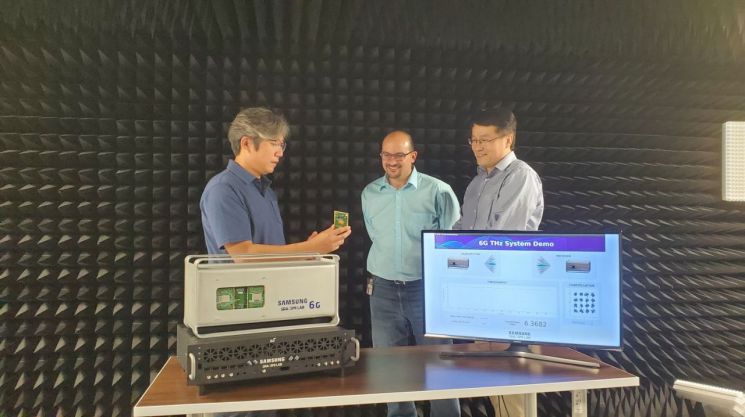 Samsung Electronics researchers are demonstrating a 140 GHz communication system at the Samsung Research America (SRA) laboratory of Samsung Electronics.
[Asia Economy Reporter Eunmo Koo] Samsung Electronics announced on the 16th that it has succeeded in demonstrating a communication system in the 6G terahertz (THz) band in collaboration with the University of California, Santa Barbara (UCSB), verifying the potential use of terahertz band for 6G mobile communications.
The terahertz band refers to the frequency range between 100 gigahertz (GHz) and 10 THz. As the frequency band increases, a wider communication bandwidth can be used, making it a candidate frequency band for 6G communication, which aims for speeds up to 1 Tbps (1 trillion bits per second), up to 50 times faster than 5G.
However, higher frequency bands face challenges such as greater path loss and shorter signal reach due to propagation characteristics, requiring advanced beamforming technology that integrates numerous antennas within the communication system to transmit and receive signals in specific directions. Additionally, technical challenges such as the fabrication of fine radio frequency integrated circuits (RFICs) are necessary for ultra-high-speed communication.
At the recent IEEE International Conference on Communications (ICC 2021) Terahertz Communication Workshop, Samsung Research, Samsung Research America (SRA), and UCSB researchers jointly demonstrated a data transmission speed of 6.2 Gbps (gigabits per second) over a distance of 15 meters using the 140 GHz terahertz band.
Previous demonstrations in the terahertz band used only measurement equipment functioning as RFICs or modems and antennas to transmit data. However, Samsung Electronics and UCSB researchers integrated RFIC, antennas, and baseband modems to successfully demonstrate real-time transmission. This represents a significant advancement in overcoming technical challenges such as high path loss and low power efficiency in the terahertz band, which must be resolved for 6G commercialization.
In particular, the demonstration was successful by configuring a transmitter and receiver module with 128 antenna elements driven by RFICs based on complementary metal-oxide-semiconductor (CMOS) processes widely used in LTE and 5G, along with a modem supporting real-time high-performance beamforming.
Choi Sung-hyun, Executive Vice President and Head of the Next Generation Communication Research Center at Samsung Research, stated, "We expect the terahertz band to be a major frequency band for 6G," adding, "This demonstration is an important milestone showing the feasibility of its commercialization." Professor Mark Rodwell of UCSB also emphasized the importance of collaboration, saying, "UCSB has expertise in terahertz frequencies above 100 GHz, while Samsung has expertise in wireless systems and communication networks."
Once 6G is commercialized, improvements in communication performance will enable new services such as immersive extended reality (XR) and holograms to be supported on mobile devices, and the application of mobile communication technology is expected to expand to satellite communications and urban air mobility.
© The Asia Business Daily(www.asiae.co.kr). All rights reserved.
![Clutching a Stolen Dior Bag, Saying "I Hate Being Poor but Real"... The Grotesque Con of a "Human Knockoff" [Slate]](https://cwcontent.asiae.co.kr/asiaresize/183/2026021902243444107_1771435474.jpg)
















