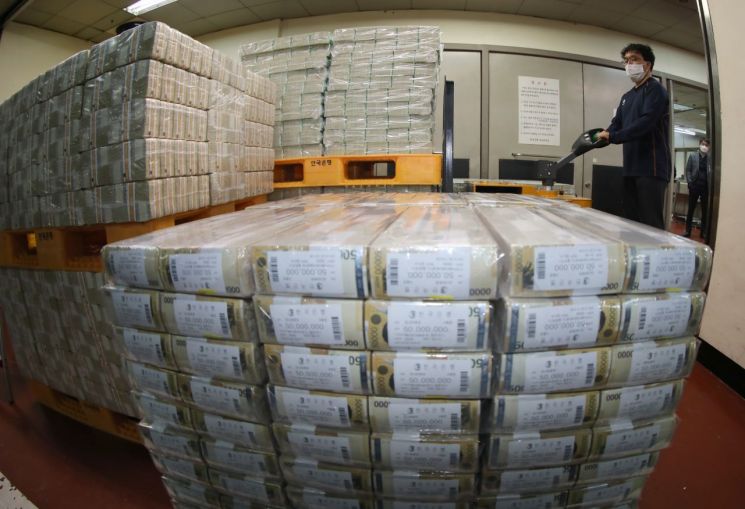
[Asia Economy Reporter Eunbyeol Kim] Amid the continuation of a low interest rate environment for over a year since the COVID-19 pandemic, market liquidity surged by more than 50 trillion won in April. This was influenced by funds borrowed for investments such as the SK IE Technology (SKIET) public offering subscription by the general public and cryptocurrency investments.
According to the Bank of Korea's announcement on the 15th regarding 'April Monetary and Liquidity,' the broad money supply (M2 basis) reached 3,363.7 trillion won in April, an increase of 50.6 trillion won (1.5%) compared to the previous month. The increase is the largest since the statistics compilation began in 2002, and the growth rate is also the highest since February 2009 (2.0%). Compared to a year ago (April last year), the current absolute scale of M2 has grown by 11.4%.
The broad money supply indicator M2 includes cash, demand deposits, and checking deposits (all part of M1), as well as short-term financial products that can be quickly converted into cash such as MMFs (Money Market Funds), fixed deposits and savings deposits under two years, beneficiary certificates, CDs (Certificates of Deposit), RPs (Repurchase Agreements), financial bonds under two years, and money trusts under two years.
M2 has been on a high growth trend since last year. This year, the year-on-year growth rate of M2 has recorded double digits for four consecutive months.
By economic agents, households and non-profit organizations increased by 9.9 trillion won. This is explained by the continued demand for housing loan funds and a significant increase in funds related to the SKIET public offering subscription. Other financial institutions such as securities companies also saw liquidity increase by 16.9 trillion won due to the inflow of public offering subscription funds. Corporate liquidity increased by 15.7 trillion won, influenced by fund inflows from policy financial institutions mainly supporting small and medium-sized enterprises.
A Bank of Korea official explained the background of the increase in money supply, stating, "The demand for funds such as housing loans continues, and the demand for funds related to the SKIET public offering subscription has increased to the extent that subscription deposits reached 80.9 trillion won, along with an increase in loans related to cryptocurrency investments." He added, "The increase in money supply in other financial institutions is also due to the large-scale inflow of public offering subscription funds centered on securities companies."
When households borrow loans for public offering subscriptions or cryptocurrency investments and deposit them in financial institutions, these are recorded as checking deposits, which correspond to M2, resulting in an increase in M2. When these loans are used to pay subscription funds to securities companies, this portion is counted as money supply in other financial institutions such as securities companies until the funds are returned. He added, "Regarding the corporate sector's money supply, funds have flowed into small and medium-sized enterprises due to financial support from policy financial institutions."
© The Asia Business Daily(www.asiae.co.kr). All rights reserved.
![Clutching a Stolen Dior Bag, Saying "I Hate Being Poor but Real"... The Grotesque Con of a "Human Knockoff" [Slate]](https://cwcontent.asiae.co.kr/asiaresize/183/2026021902243444107_1771435474.jpg)
















