Ministry of Health and Welfare's 'Elder Abuse Status Report'
Perpetrators: Sons 34%, Spouses 32%
Police 112 Reports Up 27% in 3 Years
Increase Expected Due to Reduced Outings from COVID-19
Government Distributes Reporting App 'Nabisagim'
Seoul Expands Protection Agencies
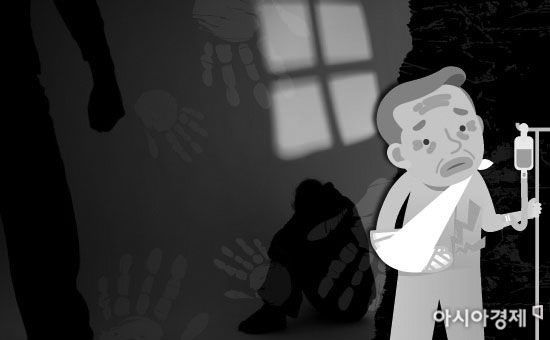
[Asia Economy Reporters Lim Cheol-young, Lee Kwan-joo, Lee Chun-hee] Various statistics released on the 15th, marking ‘Elder Abuse Prevention Day,’ revealed that elder abuse is on the rise every year, with most cases occurring within the home and perpetrated by immediate family members.
According to the ‘2020 Elder Abuse Status Report’ announced by the Ministry of Health and Welfare on this day, the number of elder abuse reports last year was 16,973, up 5.6% from 16,071 the previous year, and the number of confirmed abuse cases was 6,259, up 19.4% from 5,243 the previous year. This is based on an analysis of reports and counseling cases received last year by 34 Elder Protection Specialized Agencies nationwide. By type of abuse, emotional abuse was the most common at 42.7%, followed by physical abuse at 40.0%, and neglect at 7.8%. By location, abuse within the home accounted for 88.0%, making up the majority. Abuse in residential facilities such as nursing homes also accounted for 8.3%. Family members were the most common perpetrators, including sons (34.2%), spouses (31.7%), and daughters (8.8%). Institutional staff such as facility workers and medical personnel accounted for 13.0%.
Reports of elder abuse are also rapidly increasing. According to the National Police Agency, the number of 112 emergency calls reporting elder abuse rose from 7,662 in 2018 to 8,545 in 2019, and 9,707 last year, an increase of 26.7% over three years. Due to the COVID-19 pandemic, as more elderly people stayed at home, the proportion of elder abuse by family members made up the majority. An analysis by the Seoul Metropolitan Police Agency of 1,800 elder abuse cases reported in Seoul last year found that abuse by family and relatives accounted for 98.3% (spouses 46.9%, children 50.1%, relatives 1.3%). Among the types of abuse subject to legal action, physical abuse was the most common at 85.9%, followed by emotional abuse at 8.4%, and neglect at 0.4%.
Incidents of elderly parents being assaulted and ending up behind bars continue to occur. In August last year, in Geumsan-gun, Chungbuk Province, a man in his 50s was arrested by police for verbally abusing and physically assaulting his parents in their 80s until their bodies were bruised, claiming they did not take care of him. The man was sentenced to 1 year and 6 months in prison in the first trial. In March this year, in Chilgok-gun, Gyeongbuk Province, a man in his 40s was also arrested for assaulting his mother in her 80s and father in his 70s, resulting in the mother’s death and the father’s critical condition.
The government authorities have decided to strengthen measures for early detection of elder abuse and protection of elderly victims. The Ministry of Health and Welfare began distributing the elder abuse reporting app ‘Nabi Saegim (Elder Guardian)’ from this day. Nabi Saegim allows attachments such as photos and videos, making it easier to secure direct evidence of abuse, and reports can be made after identity verification without separate membership registration. Developed as a location-based app, it automatically connects reports to the nearest regional Elder Protection Specialized Agency based on the location of the abuse. The police will collaborate with 36 central and regional Elder Protection Specialized Agencies nationwide to educate elder-related facilities and mandatory reporters, and conduct both online and offline publicity. Seoul City currently has three Elder Protection Specialized Agencies, one each in the southern, northern, and western districts, and plans to add one in the eastern district in the second half of the year. Seoul City expects that with the opening of the eastern agency, the number of districts per agency will decrease from 8?9 to 5?7, enabling more thorough management. With the enforcement of the revised Elder Welfare Act on the 30th, Elder Protection Specialized Agencies will provide counseling, education, and psychological treatment to perpetrators of abuse, and even after abuse cases are closed, they will strengthen follow-up management such as checking for recurrence of abuse and providing counseling and education to victims, guardians, and families as needed.
The United Nations (UN) and the International Network for the Prevention of Elder Abuse (INPEA) have designated June 15th as ‘World Elder Abuse Awareness Day’ annually since 2006, and South Korea has also designated this day as Elder Abuse Prevention Day to raise awareness and interest in elder abuse.
© The Asia Business Daily(www.asiae.co.kr). All rights reserved.
















