Employment Information Service 'Analysis of Labor Market Changes by Industry Due to Aging' Report
Average '40 and Over' Industries Surge from 7 in 2010 to 15 After 10 Years
Real Estate Industry Has Highest Average Age at 54
Concerns Over Labor Shortage as Youth Entry Declines

[Sejong=Asia Economy Reporter Moon Chaeseok] As the aging process accelerates, the age group of workers in industries has also risen sharply. While aging had previously been limited to issues in industrial sites such as manufacturing, it is now expanding to sectors including hospitals and welfare services. It was also confirmed that industries with faster aging face greater difficulties in workforce supply. Concerns are emerging that labor shortages will worsen as the baby boomer generation (born 1946?1964) ages in earnest.
According to the Employment Information Service's report titled "Analysis of Aging Wage Workers and Labor Market Changes by Industry" released on the 14th, the number of industries with an average worker age exceeding 40 years, based on the 10th revision of the Korean Standard Industrial Classification, has more than doubled in the past decade. Excluding four categories with employment shares below 0.5% (agriculture, mining, international, and own consumption production), the number of industries with an average age over 40 increased from 7 in 2010 to 15 in 2019 among the remaining 17 industries. The real estate industry had the highest average age at 54.6 years, followed by water supply, sewage, and waste treatment at 48.1 years. High-income industries often referred to as "quality jobs," such as information and communication (37.4 years) and finance and insurance (40.2 years), had average ages below the overall average of 43.3 years.
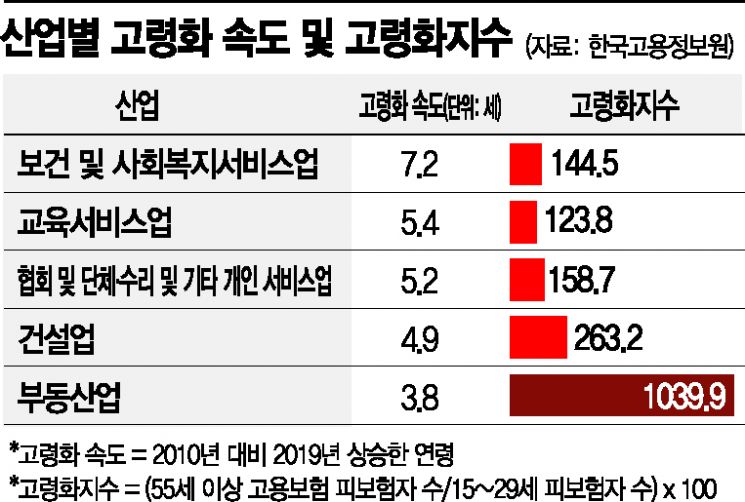
The industry with the fastest aging is the health and social welfare services sector, which includes medical workers and elderly caregivers, where the average age rose by 7.2 years over the past decade. The education services sector saw an increase of 5.4 years in average age. Although the core manufacturing industry of our economy is not immediately facing aging concerns, it was diagnosed that youth entry is decreasing in manufacturing related to chemicals, medical, and machinery and electrical equipment.
The acceleration of aging by industry is largely influenced by changes in population structure such as low birth rates. However, the Employment Information Service's analysis indicates that if youth inflow into industries is low, workforce shortages may worsen. The report stated, "Industries with declining youth entry are expected to see increased demand in the future," adding, "Problems caused by workforce shortages could become serious."
Park Sejung, a senior researcher at the Employment Information Service who authored the report, emphasized, "The health and social welfare services sector has high demand for young workers, but it is not popular among them," and added, "To increase youth inflow into the health industry, the quality of employment, such as wage levels and working hours, must be improved."
© The Asia Business Daily(www.asiae.co.kr). All rights reserved.