[Asia Economy Reporter Yujin Cho] The Israeli parliament has approved the formation of a new government composed of eight parties. The long-term rule of Benjamin Netanyahu, the longest-serving prime minister in history, has come to an end after about 12 years due to a coordinated effort by eight opposition parties. However, concerns have been raised that Israel's political situation could become chaotic again at any time due to the vastly diverse ideological tendencies of the parties participating in the coalition.
On the 13th (local time), the Israeli Knesset (parliament) approved the formation of a new coalition government from the anti-Netanyahu camp with 60 votes in favor and 59 against out of 120 members during a special session. As a result, Netanyahu, who served as prime minister for a total of 15 years and 2 months, including 3 years from 1996 and 12 years and 2 months from 2009, stepped down from power.
The 36th government of Israel, which will lead the country for four years, was formed as a "Rainbow Coalition" uniting eight opposition parties solely aiming for Netanyahu's resignation. Centered around the centrist Yesh Atid party, the new government includes left-wing, right-wing, and Arab parties with diverse political orientations, leading to forecasts that internal cohesion on policies and diplomacy will be difficult.
The Wall Street Journal (WSJ) evaluated that the biggest challenge for the new government is to build bonds that can connect the diverse parties. Gideon Rahat, a senior researcher at the Israel Democracy Institute, said, "This is the most heterogeneous government in Israel's history," adding, "The biggest challenge for the new government is to endure."
During the first half of the next government's term until August 2023, the prime minister will be Naftali Bennett, leader of the far-right party Yamina. Yair Lapid, leader of Yesh Atid, will serve as foreign minister and succeed the prime ministership after two years.
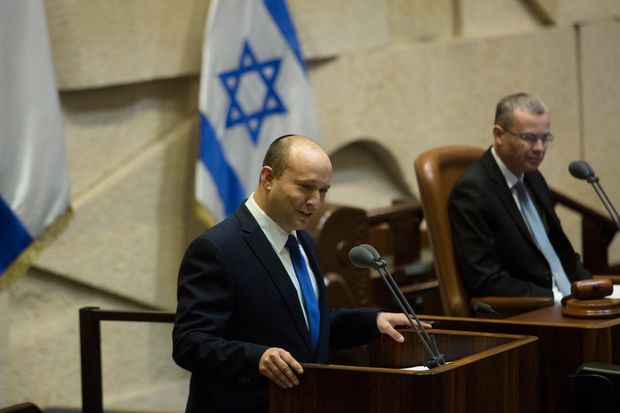
In his speech just before the confidence vote, the new prime minister Bennett said, "I have taken on this role at a very important moment," and added, "Now it is time for other leaders and people from various fields to stop the madness of political division."
He clearly opposed the restoration of the Iran nuclear deal, which the United States and Iran are negotiating. He assessed, "Iran's nuclear project, the greatest threat to Israel, has reached a critical point." He further emphasized, "Since Israel is not a party to the nuclear deal, we have the freedom to act. Therefore, we will not allow Iran to have nuclear weapons," and called the U.S. attempt to restore the nuclear deal a mistake.
U.S. President Joe Biden congratulated the formation of Bennett's government and promised that the United States would continue to be involved in Israel's security and work together with the new government.
Meanwhile, the ousted Netanyahu expressed his determination to make a comeback. Netanyahu said, "I will continue the mission to ensure Israel's security," adding, "If it is fate to be in the opposition, I will stand tall, overturn this dangerous government, and lead us on our path. I will return soon," reaffirming his intention to regain power.
However, his political career is expected to be precarious due to ongoing trials on charges including bribery, breach of trust, and fraud during his term, as well as challenges within his party.
Amid the chaos of coalition formation, Israel has held four general elections in the past two years. Although the launch of this "Rainbow Coalition" has averted a fifth early election, foreign media pointed out that the political turmoil remains severe and that disruptions could recur at any time due to disagreements over the Palestinian issue.
© The Asia Business Daily(www.asiae.co.kr). All rights reserved.

















