Research and investigation over 7 years → Designated as Nationally Designated Cultural Heritage (Historic Site No. 558) last year → Cultural heritage maintenance promoted
Preserving in original location and condition to coexist with the city, becoming a landmark where historical traces can be experienced
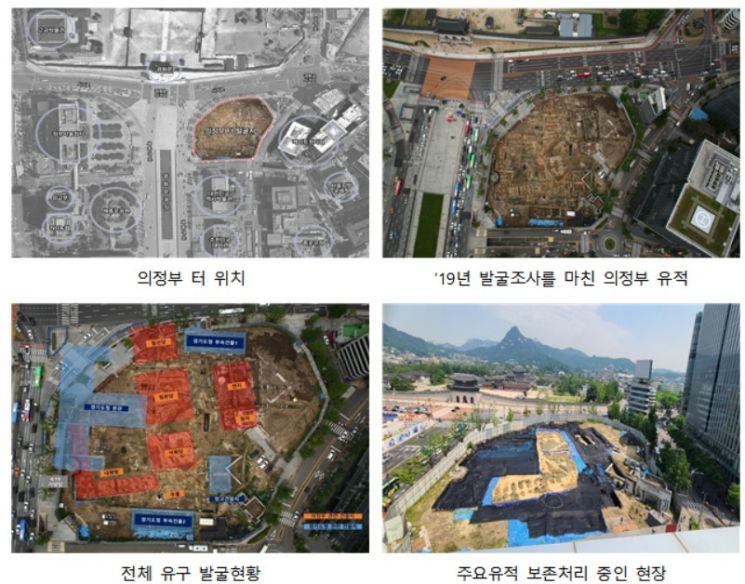
[Asia Economy Reporter Lim Cheol-young] Seoul City will open the remains of the Joseon Dynasty's highest administrative institution, the Uijeongbu (議政府), which was designated as a Nationally Designated Cultural Property (Historic Site No. 558) on September 24 last year after more than seven years of academic research and excavation surveys.
On the 14th, Seoul City announced that it will open part of the Uijeongbu site, an important cultural property located in the core area around Gwanghwamun, so that citizens can directly see the site being maintained. Seoul City first confirmed the Uijeongbu site in 2013 and conducted excavation surveys from 2016 to 2019. It was designated as a Nationally Designated Cultural Property last September.
Seoul City plans to preserve the building sites and foundation stones excavated from the Uijeongbu site (11,300㎡), build protective facilities to safely preserve the remains in their original location and current state, and create parks around the area to transform it into a historical and cultural space in the city center accessible to all citizens. The design and construction will proceed after review by the Cultural Heritage Committee of the Cultural Heritage Administration.
The Uijeongbu site public opening program will be held three times from the 21st to the 23rd. Applications will be accepted through advance reservations via the ‘Seoul City Public Service Reservation System’ starting from the 15th. Participation is free, and 20 people will be accepted on a first-come, first-served basis for each session.
Visitors will be able to gauge the layout, scale, and formality of the Joseon Dynasty government offices through major remains such as Jeongbongdang (workplace of Yeonguijeong, Jwauijeong, Uuijeong), Hyupseondang (workplace of officials ranked Jong 1-pum and Jeong 2-pum), and Seokhoekdang (residence of the ministers) within the Uijeongbu site.
The preservation process of the Uijeongbu remains will also be revealed for the first time. Visitors can closely observe the cultural heritage preservation process, which is usually difficult for the general public to see, such as the professional cleaning and conservation hardening treatment of stone building materials. They can also hear vivid excavation stories from the curator who led the excavation survey at the Uijeongbu site for four years.
A lecture by palace expert Professor Hong Soon-min of Myongji University will be held as well. The program includes exploring not only Uijeongbu but also nearby areas such as Junghakcheon, Cheongjin-dong, and Yukjo Street, examining traces of history in the city center (cases of remains preservation). It offers an opportunity to view the entire process of Uijeongbu’s establishment to disappearance (1400?1907) from a macro perspective alongside the urban historical changes of Seoul.
Once the Uijeongbu site is maintained, the remains, which had only been estimated through historical records until now, are expected to be reborn as a landmark where any citizen can visit and experience traces of history. Before the excavation, it was only known that Uijeongbu was located in front of Gyeongbokgung Palace, and the layout and scale of the buildings were roughly estimated through maps or literature.
In addition, Seoul City aims to highlight the historical value and significance of the Gwanghwamun area, including Uijeongbu, by preparing various contents that illuminate Yukjo Street (the Joseon Dynasty government office district), such as the Samgunbu and Saheonbu sites, which were extensively excavated during the construction of Gwanghwamun Plaza last May.
Recent excavations in Sejong-ro confirmed the locations and building foundations of major Joseon Dynasty government offices such as Samgunbu (overseeing military affairs) and Saheonbu (officials’ inspection), which faced Uijeongbu. The principle of the Joseon Dynasty’s Yukjo Street formation, ‘Dongmun Seomu (東文西武)’?placing civil offices (Mun, 文) in the east and military offices (Mu, 武) in the west?was actually confirmed through these remains.
© The Asia Business Daily(www.asiae.co.kr). All rights reserved.

















