Responding to the 4th Industrial Revolution, Establishing a Pan-Government Network-Based Environment
[Asia Economy Reporter Lim Cheol-young] The government is integrating the communication networks of individual government ministries into a ‘National Convergence Network’ to respond to increasing communication demands.
On the 14th, the Ministry of the Interior and Safety announced that it completed the construction of the backbone network for the ‘National Convergence Network,’ which integrates the individual communication networks of 48 government ministries and the National Information Communication Network (K-net), in April, and will launch the National Convergence Network service starting with the National Human Rights Commission on the 15th.
The National Convergence Network is a nationwide government communication network that integrates the information and communication networks individually built and operated by each ministry. Once established, it is expected to enable better response to communication demands, stable operation, and improved efficiency.
First, it is expected to flexibly respond to increasing usage of big data, cloud services, and more in each ministry. Additionally, in urgent situations such as disasters, it will be possible to provide a stable national communication network without interruption. Through this, it is also expected to achieve budget savings on communication costs by preventing redundant investments and consolidating duplicate lines among ministries.
The Ministry of the Interior and Safety’s National Information Management Agency started the National Convergence Network project in September 2020 and completed the network construction in April 2021. The transition of 48 national institutions and the National Information Communication Network (K-Net) will be promoted in three phases by 2022.
The first phase, currently underway, will have 22 institutions including the National Human Rights Commission use the National Convergence Network. The second phase, scheduled for the second half of this year, will involve 11 institutions including the Ministry of Science and ICT, and the third phase, planned for next year, will include 15 institutions such as the Ministry of Employment and Labor, all transitioning to and utilizing the National Convergence Network service.
The National Convergence Network was built with dual communication providers to ensure a secure communication network, establishing two backbone networks (Network 1: SK Broadband, Network 2: LG Uplus). Network 1 connects 38 nodes nationwide centered on provinces and cities, while Network 2 connects 21 nodes nationwide centered on government buildings, configured in a mesh network style. Redundancy of nodes, lines, and equipment was implemented to enhance stability.
Additionally, a Network Operation Center (NOC) for the National Convergence Network was established to support rapid fault detection and response through 24/7 network monitoring throughout the year. Transmission network management information is received from communication providers to visualize various network statuses, provide customized network control services for each ministry, and support operations through cross-monitoring among government ministries. Real-time line status monitoring enables quick identification of fault sections in case of failures, reducing recovery time.
The Ministry of the Interior and Safety plans to complete the phased transition of 48 national institutions to the National Convergence Network by 2022 and continuously discover and expand new technologies such as building a more secure communication network applying quantum cryptography communication.
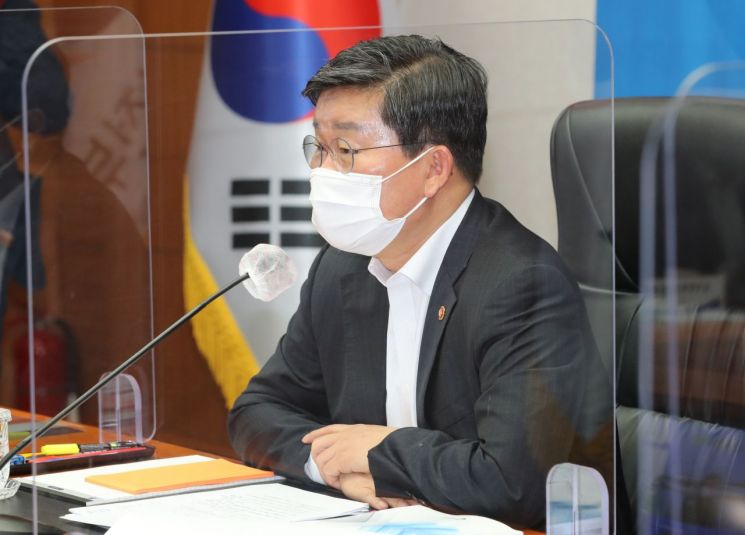
Minister Jeon Hae-cheol stated, “With the establishment of the National Convergence Network, a government-wide network infrastructure capable of responding to the Fourth Industrial Revolution has been created,” adding, “Based on this, we will provide high-quality administrative services that meet the expectations of the public and ensure the successful completion of the National Convergence Network through all three phases.”
© The Asia Business Daily(www.asiae.co.kr). All rights reserved.

















