[Asia Economy Reporter Jeong Hyunjin] An analysis has emerged suggesting that if the level of political, social, and administrative instability in Korea were reduced to that of New Zealand, the per capita gross domestic product (GDP) growth rate could improve by up to 0.7 percentage points. It was found that Korea has relatively high political, social, and administrative instability among OECD countries over the past five years, prompting calls for policies to address this issue.
The Korea Economic Research Institute under the Federation of Korean Industries announced this on the 13th through a report titled "The Impact of Political, Social, and Administrative Instability on Per Capita GDP Growth and Its Implications." To estimate the effect of political, social, and administrative instability on economic growth, the institute used the Political Stability Index and Government Effectiveness Index, which are components of the World Governance Indicators (WGI) published annually by the World Bank (WB), to calculate the average "Political, Social, and Administrative Instability Index" over the recent five years (2015?2019).
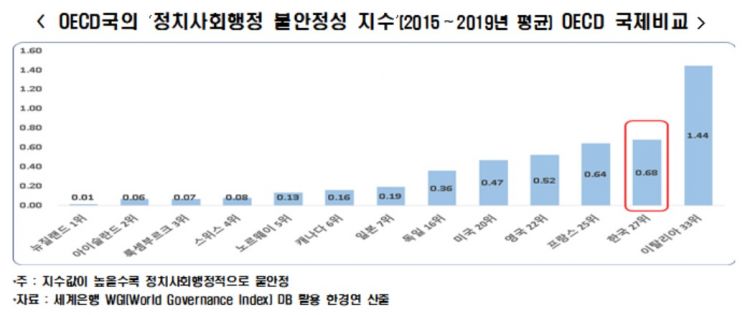
As a result, among 34 OECD countries excluding Turkey, Colombia, and Mexico due to difficulties in applying some indices, Korea ranked 27th with a score of 0.68. A higher index value indicates greater political, social, and administrative instability, with New Zealand ranking first at 0.01, significantly lower than Korea. Major advanced countries such as Japan (7th, 0.19), Germany (16th, 0.36), the United States (20th, 0.47), the United Kingdom (22nd, 0.52), and France (25th, 0.64) mostly ranked better than Korea. Korea’s Political Stability Index was 0.3, ranking 30th, and its Government Effectiveness Index was 1.1, ranking 22nd.
The Korea Economic Research Institute also estimated the impact of political, social, and administrative instability on per capita GDP growth using data from 34 OECD countries between 2011 and 2019. They measured how much the per capita GDP growth rate would increase if Korea’s instability level improved over the recent five years. The institute explained that their analysis was based on the premise that for every one-unit increase in the Political, Social, and Administrative Instability Index, the per capita GDP growth rate decreases by 1 percentage point.
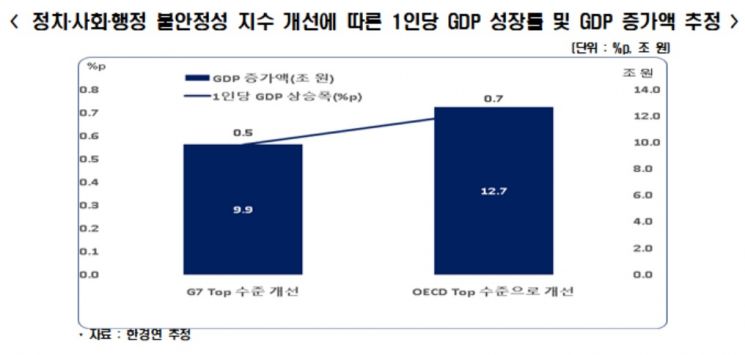
The calculation showed that if Korea’s instability level dropped to that of New Zealand, the per capita GDP growth rate would improve by 0.7 percentage points. When converted into monetary terms, the total GDP growth amount as of last year was estimated to be up to 12.7 trillion won, according to the institute. If Korea’s instability improved to the level of Canada, the top country among the G7, the per capita GDP growth rate would increase by 0.5 percentage points, and the total GDP growth amount would reach approximately 9.9 trillion won.
The institute assessed that, aside from the fundamental risk factors stemming from the division of the Korean Peninsula, there are considerable instability factors due to domestic political and social conflicts, and government efficiency in mitigating these is not high. Examples of political and social conflicts cited include disputes related to the nuclear phase-out and expansion of renewable energy supply, conflicts over the deployment of the Terminal High Altitude Area Defense (THAAD) system, conflicts arising from the selection process for alternative landfill sites following the scheduled closure of existing metropolitan landfills in 2025, and opposition to apartment supply plans on the Gwacheon government complex site.
Choo Kwang-ho, Director of Economic Policy at the Korea Economic Research Institute, said, "It is necessary to supplement legal and institutional measures to effectively prevent and manage social and regional conflicts related to the implementation of public policy projects. For important public services, measures should be established to ensure independence from politics so that they do not change abruptly according to political winds, and efforts should be made to improve the qualitative level of public services."
© The Asia Business Daily(www.asiae.co.kr). All rights reserved.


















