 The industry's smallest pixel size image sensor of 0.64㎛, ISOCELL JN1, released by Samsung Electronics
Photo by Samsung Electronics
[Asia Economy Reporter Kim Heung-soon] Samsung Electronics is accelerating its efforts to secure technological leadership that surpasses competitors in the system semiconductor sector.
According to industry sources on the 13th, Samsung Electronics recently launched a 50-megapixel image sensor with the world's smallest pixel size of 0.64μm (micrometers). An image sensor is an electronic component installed in smartphone cameras or compact imaging devices that converts light entering the camera lens into digital signals to display images, and is a type of system semiconductor.
Launch of the World's Smallest Pixel Image Sensor
The new product, called 'ISOCELL JN1,' has a size smaller than the existing 1/2.8 inch, measuring 1/2.76 inch. The pixel size of 0.64μm means that the area of one pixel is about 16% smaller than the 0.7μm pixel image sensors previously available. As a result, the module height is reduced by about 10%, minimizing the camera protrusion phenomenon in smartphones and other devices.
In the image sensor field, Japan's Sony holds about half of the global market share. According to market research firm Omdia, Sony's market share was 47.9% as of last year. However, Samsung Electronics is chasing Sony by continuously releasing high-resolution products with ultra-small pixels. Samsung's market share in this sector was 19.6% last year, ranking second overall. The gap with Sony has narrowed from 35.1% in 2019 to 28.3%.
Previously, Samsung Electronics was the first in the industry to launch 1.0μm pixels in 2015, 0.9μm pixels in 2017, and 0.7μm pixels in 2019. At the same time, it also introduced big pixel-based products over 1.0μm, expanding options for mobile device manufacturers. Thanks to this technological leadership, image sensor sales reached $3.342 billion (approximately 3.73 trillion KRW) last year, a 22.3% increase compared to 2019.
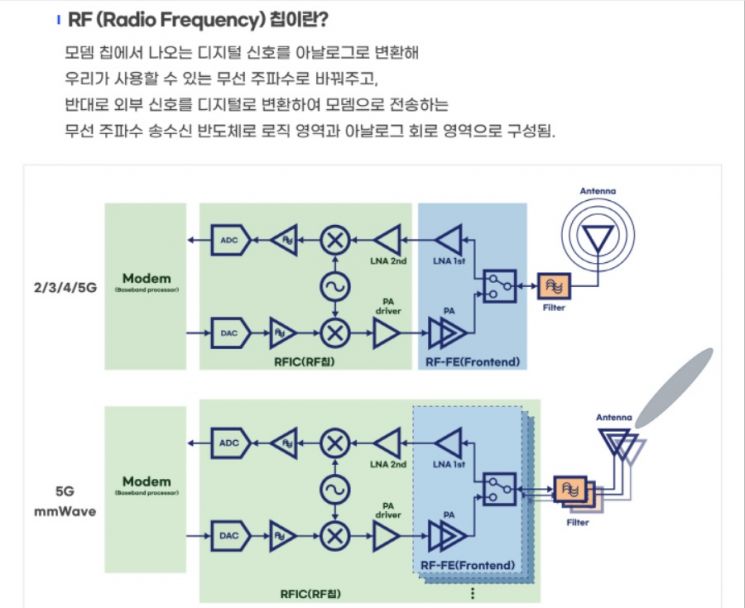
Efficiency Up 35%... Securing 5G Wireless Communication Semiconductor Process Technology
Another recent achievement by Samsung Electronics in the system semiconductor field is the new foundry process technology for 5th generation (5G) mobile communication semiconductors used in smartphones and tablet PCs. The company has secured the capability to produce finer 8nm (nanometer; 1nm = one billionth of a meter) based radio frequency (RF) chips than before.
RF chips convert digital signals from modem chips into analog signals that can be used as radio frequencies, and conversely convert external signals into digital signals to transmit to the modem chip. According to Samsung Electronics, the newly secured 8nm RF process is a finer process than the previous 14nm, enabling mass production of products with about 35% smaller RF chip area and about 35% improved power efficiency.
With the advent of 5G, the frequencies, communication standards, and communication methods used have diversified, and mobile devices supporting wireless communication are becoming smaller and lighter. Battery usage time is also increasing. Samsung Electronics explained that due to this, demand for RF chips that pack more functions into a smaller area while maintaining high power efficiency is increasing.
In the RF foundry market, Samsung Electronics competes with Taiwan's TSMC and the US's GlobalFoundries. Samsung has solidified its position through technological leadership in this field as well. After starting 28nm 12-inch RF process services in 2015, it became the first in the industry to mass-produce 14nm process-based RF chips in 2017. Since then, it has strengthened competitiveness by shipping over 500 million mobile RF chips, mainly for premium smartphones.
Samsung Electronics has expressed its determination to accelerate the achievement of its 'Semiconductor Vision 2030,' which aims to become the world's number one system semiconductor company by 2030 through image sensors, ultra-fine process technology, stable mass production systems, and expansion of the foundry ecosystem.
© The Asia Business Daily(www.asiae.co.kr). All rights reserved.
![Clutching a Stolen Dior Bag, Saying "I Hate Being Poor but Real"... The Grotesque Con of a "Human Knockoff" [Slate]](https://cwcontent.asiae.co.kr/asiaresize/183/2026021902243444107_1771435474.jpg)

















