Lee Ju-yeol, Governor of the Bank of Korea, 'Founding Anniversary Address'
Emphasizes Normalization of Monetary Policy
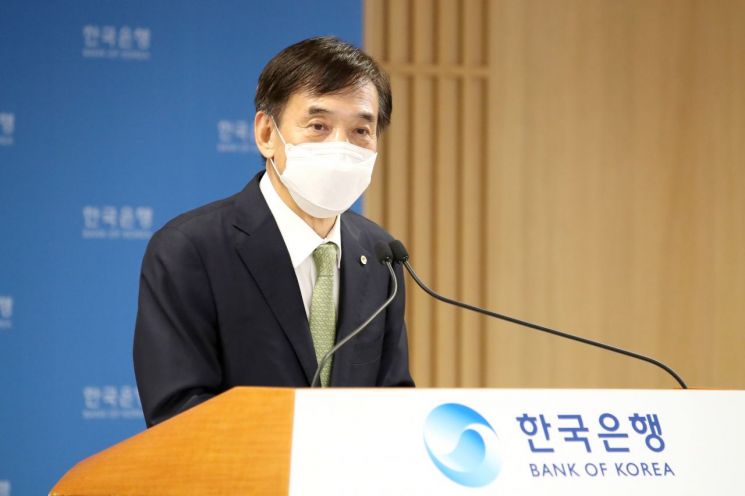
[Asia Economy Reporter Jang Sehee] Lee Ju-yeol, Governor of the Bank of Korea, sent a signal to the market about raising the base interest rate within the year after two weeks. In particular, he expressed that the imbalances such as overheating in the asset market can no longer be left unchecked, increasing the possibility that Korea will raise interest rates before the United States.
In his '71st Anniversary Commemorative Speech' on the 11th, Governor Lee stated, "If our economy is expected to continue a solid recovery, the current accommodative monetary policy should be orderly normalized from an appropriate time in the future. This is a priority to be pursued in the second half of the year." He added, "Unprecedented bold economic stimulus measures greatly helped overcome the sudden crisis," but emphasized, "However, it is also true that imbalances between sectors and classes have expanded during this process."
Governor Lee cited the COVID-19 situation and household debt as variables to determine the timing of raising the base interest rate, which is currently at 0.5%. Recently, as investment flows into asset markets such as stocks and Bitcoin have strengthened, household debt in the first quarter swelled to a record high of 1,765 trillion won.
Accordingly, with four Financial Monetary Policy Committee meetings scheduled in the second half of the year in July, August, October, and November, the market expects that after achieving herd immunity by November as per the government's vaccination target, the Bank of Korea is likely to raise interest rates.
It is also possible for the Bank of Korea to raise rates before the United States. At last month's Monetary Policy Committee press conference, Governor Lee said, "There have been cases where we adjusted rates before the U.S., and cases where the opposite happened," adding, "If we adjust monetary policy first according to domestic conditions, we have more room to control the pace." He further stated, "We consider the U.S. Federal Reserve's monetary policy considerably, but we do not maintain monetary policy by directly matching it one-to-one."
Professor Ahn Dong-hyun of Seoul National University’s Department of Economics said, "Usually, when lowering rates, we follow the Fed, but when raising rates, it can be done depending on the situation." If the U.S. falls into a recession, most countries are affected and market vitality may decline, but the speed of recovery varies. He added, "Once COVID-19 herd immunity is achieved and the economy gradually recovers, it is possible to raise rates before the Fed."
© The Asia Business Daily(www.asiae.co.kr). All rights reserved.

















