Profitability Pressure from Soaring Core Component Prices
Global LCD TV Prices Up 12% YoY in 1Q This Year
Samsung, LG Increase Premium Product Sales Share
Maintaining High-End Demand Crucial Amid Raw Material Price Rise
[Asia Economy Reporter Suyeon Woo] Due to the shortage of components such as semiconductors and LCD (liquid crystal display), the TV industry's premium strategy for finished products is accelerating. As the prices of key components rise due to supply and demand issues, set manufacturers are facing increased profitability burdens and are responding by expanding their premium product strategies.
According to market research firm Omdia on the 14th, the global average selling price (ASP) of LCD TVs (4K standard) in the first quarter of this year recorded $680.4, up 12% compared to the same period last year. The global LCD TV ASP showed a double-digit decline until the second quarter of last year but reversed to an increase from the fourth quarter of last year, recovering to the $680 level for the first time in over two years in the first quarter of this year. For domestic brands, Samsung Electronics' global TV ASP rose 13% year-on-year in the first quarter, and LG Electronics also increased by about 10.8%.
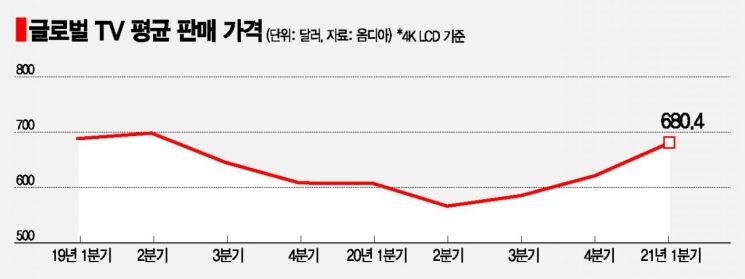
This rise in the global TV market ASP was mainly due to an increase in the sales proportion of premium TVs that are extra-large and high-definition. In the global market in the first quarter of this year, Samsung Electronics held a 40.8% market share and LG Electronics 27.8% in the premium TV market priced above $2,000 (approximately 2.23 million KRW), with domestic brands accounting for about two-thirds of the premium market.
In particular, recently, as the prices of key components such as semiconductors and LCDs have surged, domestic TV companies are competitively increasing the proportion of premium products. They are defending against profitability deterioration caused by soaring component prices through product mix improvement. According to the industry, major semiconductors for electronic products such as MCU (Microcontroller Unit) and DDI (Display Driver IC) have surged more than 20% in price since the beginning of this year, and the price of TV LCD panels (4K 55-inch standard), which began rising since the second half of last year, reached the highest level in six years this month, continuing its upward trend.
Going forward, domestic companies plan to overcome such raw material price increases by expanding their premium strategies. Samsung Electronics expects to surpass 10 million units in global QLED TV sales this year, fueled by the popularity of its new Neo QLED products, and is anticipated to officially enter the premium OLED TV market by launching QD (Quantum Dot) OLED TVs as early as the first half of next year.
LG Electronics recently extended the free warranty period for OLED TV panels sold in the United States and the United Kingdom to five years. This is to solidify its position in the fiercely competitive North American and European premium TV markets through aggressive marketing. This free warranty program, targeting customers who purchase flagship models G1 and Z1, offers free parts and labor costs related to repairs in the first year of purchase, and free parts only from the second to fifth years.
Hwang Minseong, a researcher at Samsung Securities, said, "TV companies are delaying profitability deterioration caused by raw material price increases through mix improvement and high-end strategies, making the maintenance of demand for high-end products more important than raw material prices," adding, "High-priced product sales are expected to continue in the second half of the year."
© The Asia Business Daily(www.asiae.co.kr). All rights reserved.

















