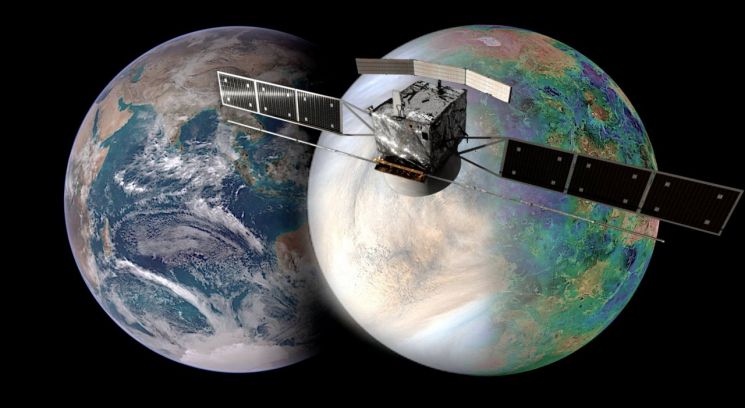
 The European Space Agency (ESA)'s new Venus exploration mission, EnVision project. Photo by ESA website.
[Asia Economy Reporter Kim Bong-su] The European Space Agency (ESA) announced a new Venus exploration project on the 10th (local time). Following last year's confirmation of the possibility of life on Venus and the recent announcement by the United States to resume exploration after more than 30 years, competition has ignited for the title of 'the first discovery of extraterrestrial life.'
On the same day, ESA held a science program committee meeting and adopted a plan to launch a new Venus orbiter named 'EnVision' to investigate why Earth and Venus evolved differently, as well as to explore the key components of Venus's atmosphere and its upper layers. This plan is ESA's fifth medium-class space exploration project and is scheduled to be executed in the early 2030s.
According to ESA, EnVision will be launched aboard an Ariane 6 rocket as early as 2031, or at the latest between 2032 and 2033. It will take about 15 months to reach Venus, after which it will enter orbit at an altitude of 220 to 540 km above Venus for 16 months to carry out its primary mission.
ESA aims to study why Venus, Earth's closest neighboring planet with similar size and density, has become a 'hell' with surface temperatures reaching 500 degrees Celsius due to an extreme greenhouse effect, toxic atmosphere, and sulfuric acid clouds, unlike Earth which supports human habitation. The mission will also investigate whether Venus's crust is still active and whether there was ever an environment with oceans and life.
To this end, ESA plans to equip EnVision with instruments it has developed, including a seismometer to probe Venus's crust and spectrometers to observe the atmosphere and surface. In particular, the spectrometers will analyze the gas components in Venus's atmosphere and monitor signs of volcanic activity by examining the surface composition.
The orbiter will also carry a high-resolution radar (VenSAR) developed by NASA, which will provide detailed images and topographic maps of the surface. NASA will support communication between ESA and EnVision through its Deep Space Network.
Previously, from 2005 to 2014, ESA successfully conducted the 'Venus Express' project focused on studying Venus's atmosphere, during which it identified high-temperature spots on the surface suggesting possible volcanic activity.
G?nther Hasinger, ESA's Director of Science, stated, "EnVision will strengthen Europe's role in solar system exploration and provide us and future generations with the maximum knowledge about how Earth's neighboring planets operate."
Venus has been a primary exploration target since the early days of space development due to its proximity to Earth. However, interest waned as its surface temperature was found to be around 470 degrees Celsius, making it inhospitable for humans or life. The former Soviet Union launched the Venera 1 probe to Venus in 1961 but failed, while the United States launched Mariner 2 in 1962, confirming Venus's surface temperature. Between 1990 and 1994, the Magellan probe mapped 98% of Venus's surface using radar. Currently, Japan Aerospace Exploration Agency (JAXA)'s Akatsuki is the only spacecraft orbiting Venus, having entered orbit on December 7, 2015, and continues exploration.
However, recent research suggesting the possibility of life on Venus has led to renewed exploration projects. Last year, an international research team led by Cardiff University in the UK announced the discovery of phosphine (H₃P), a hydrogen compound, in Venus's atmospheric clouds. Phosphine is produced by anaerobic microorganisms decomposing organic matter in oxygen-free environments or through industrial processes.
In response, NASA announced on the 2nd that it will resume Venus exploration after 32 years. Two programs, DAVINCI+ and VERITAS, will each receive $500 million (approximately 550 billion KRW) and are scheduled for launch around 2028 to 2030. NASA's exploration objectives align with ESA's EnVision: measuring the composition of Venus's atmosphere and confirming whether oceans once existed. They will capture high-resolution images of Venus's unique crustal formations called 'tesserae' to determine if it has plate tectonics similar to Earth. They will also map the surface to understand why Venus's geology differs from Earth's, create 3D maps, and investigate volcanic activity.
© The Asia Business Daily(www.asiae.co.kr). All rights reserved.

















