Monitoring Domestic and International Trends on Therapeutics
"Vaccines Needed Next Year as Well... Comprehensive Review of Safety and Efficacy"
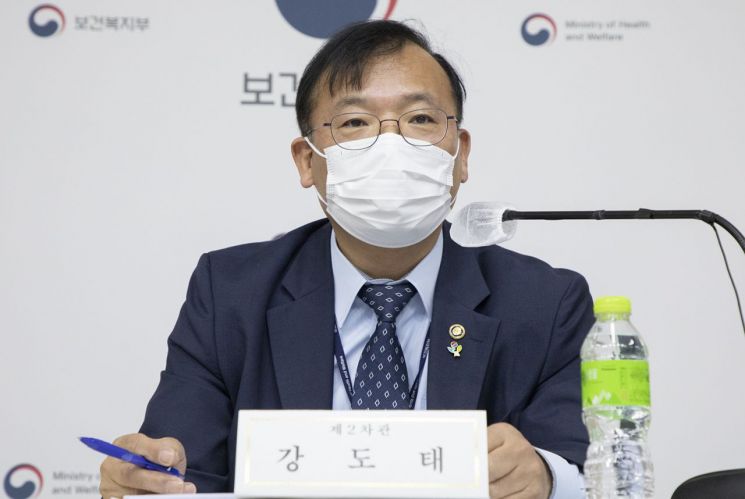
[Asia Economy Reporter Kim Ji-hee] Kang Do-tae, the 2nd Vice Minister of the Ministry of Health and Welfare, reiterated his stance on continuing support not only for COVID-19 vaccines but also for treatments. The government has already confirmed the procurement of 100 million doses of COVID-19 vaccines this year and is reviewing next year’s vaccine procurement by comprehensively considering vaccine safety, efficacy, and research results related to variants.
At a press briefing held at the Government Complex Sejong on the 10th, Kang Do-tae said, “Domestic COVID-19 treatments are being developed through various methods such as drug repositioning, but visible results have not yet been achieved,” adding, “The government considers both treatments and vaccines important and is continuously supporting them while monitoring global development trends.”
Currently, in South Korea, Celltrion’s antibody treatment Regkirona received conditional approval in early February. By the end of April, Phase 3 clinical trial registration was completed, aiming to apply for approval in the second half of the year. Nine clinical trials are underway, including Daewoong Pharmaceutical’s Hoistar tablets, which are being developed as COVID-19 treatments through drug repositioning.
Regarding earlier reports that the government was negotiating the advance purchase of the COVID-19 treatment 'Molnupiravir' developed by multinational pharmaceutical company MSD (Merck), Vice Minister Kang responded, “We are monitoring treatments developed overseas and conducting comprehensive reviews on various options.”
Support for domestic vaccine development will continue alongside treatments. Especially as vaccination expansion recently has made recruiting clinical trial participants more difficult, the government plans to focus on related support. Vice Minister Kang explained, “The biggest challenge in vaccine development is recruiting clinical trial participants, which is becoming increasingly difficult. We are supporting participant recruitment through domestic clinical support centers or foundations and actively considering additional support for costs through R&D budgets.”
Meanwhile, South Korea has secured 100 million doses of COVID-19 vaccines for vaccination within this year. Although this amount is twice the population, voices are emerging that vaccines for next year should be secured as the possibility of COVID-19 becoming endemic gains weight. Vice Minister Kang cautiously stated, “We are preparing thoroughly regarding next year’s vaccine procurement, but it is difficult to specify how many doses will be procured.”
However, he added, “Experts predict that vaccines will still be needed next year as the epidemic continues to some extent and various variant viruses spread. Based on the premise of what the variant-adapted vaccines are, whether they have sufficient effectiveness against variants, and whether the entire population can be adequately vaccinated, we are comprehensively reviewing vaccine safety, efficacy, and variant research trends.”
© The Asia Business Daily(www.asiae.co.kr). All rights reserved.
![Clutching a Stolen Dior Bag, Saying "I Hate Being Poor but Real"... The Grotesque Con of a "Human Knockoff" [Slate]](https://cwcontent.asiae.co.kr/asiaresize/183/2026021902243444107_1771435474.jpg)
















