Official Launch of Hydrogen Companies Consortium in September
Each Company's Head Serves as Chair to Strengthen Efforts
Long-term Commitment to Stable Business
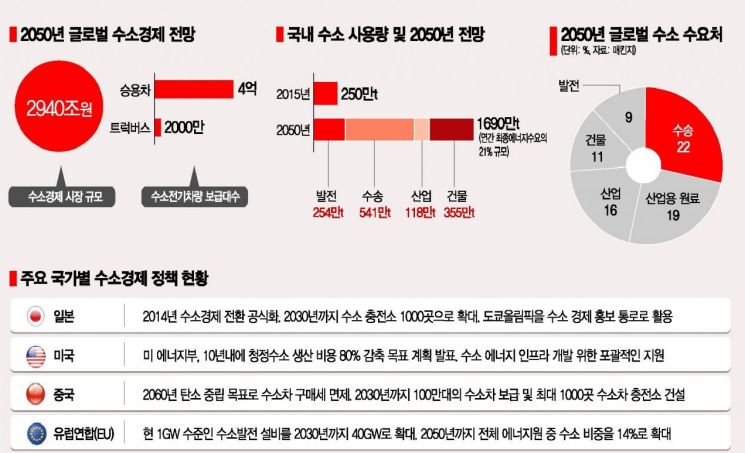
[Asia Economy Reporters Choi Dae-yeol and Lee Chang-hwan] The reason why leading conglomerates such as Hyundai Motor Company, SK, POSCO, and Hyosung have joined hands for the hydrogen business is that they judged private sector collaboration to be paramount in the process of creating a market that has never existed before. Since the hydrogen energy ecosystem is just beginning to take shape not only in Korea but globally, early market capture is expected to be crucial.
Rather than pursuing new businesses individually, if each company fills in their gaps and pools their strengths in areas where they excel, they are likely to exert considerable influence in the global energy market. The fact that the heads of these companies are directly chairing the initiative is interpreted as a commitment to grow the business in the mid-to-long term, even if immediate profits are not forthcoming.
Joining Hands from Hydrogen Production to Transportation and Consumption
Synergy Formed by the Alliance of Four Major Groups
Hydrogen is widely recognized as the next-generation energy source due to its better accessibility and environmental friendliness compared to conventional fossil fuels. In countries like Korea, which heavily depend on external resources, energy resources carry significant industrial and security implications, drawing high interest. The challenge is that the market is still immature, making it difficult for private capital to participate.
The hydrogen economy encompasses the entire value chain from the production stage of hydrogen as an energy source, through storage and distribution, to consumption tailored to various uses. In the production stage, research and development to reduce input costs and emissions is essential; in the storage and distribution stage, infrastructure investments such as storage facilities and pipelines are necessary. For the consumption stage to be activated, demand sectors like fuel cells and hydrogen vehicles must be supported, but these are still in their infancy.
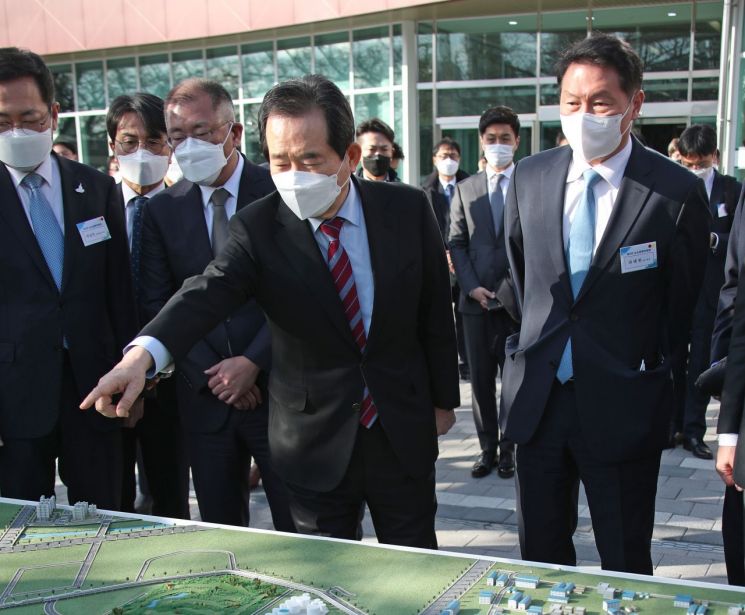 In March, then Prime Minister Chung Sye-kyun visited the planned site of SK Incheon Petrochem's liquefied hydrogen project to check the progress of the liquefied hydrogen plant with Chung Eui-sun, Chairman of Hyundai Motor Group (third from the left), and Chey Tae-won, Chairman of SK Group (right).
 The hydrogen business council, officially launching this September, is meaningful in that companies playing key roles in the hydrogen economy value chain will directly participate and collaborate. SK and POSCO plan to begin full-scale production of by-product hydrogen this year or next, and from 2025, they will produce eco-friendly hydrogen. SK announced in March its plan to supply 30,000 tons of liquefied hydrogen linked to the cluster project promoted by Incheon City starting in 2023. Considering that the current top producer of by-product hydrogen produces about 30 tons per day, this means SK aims to have about three times that production capacity.
POSCO also plans to establish a production system of 2 million tons by 2040, focusing on blue and green hydrogen, which are considered eco-friendly. Hyosung Group is set to build a liquefied hydrogen plant in Ulsan from 2023 through a joint venture with the global industrial gas company Linde. Choi Jeong-woo, Chairman of POSCO Group, said, "The hydrogen economy is a task that cannot be accomplished by POSCO alone. For the transition to a hydrogen economy, policies and systems must support it, and the industry must unite to contribute to carbon neutrality and national development."
Hydrogen Ecosystem Establishment Centered on Vehicles
Expected to Increase Influence in the Global Energy Market
Since the transportation sector is expected to be the largest user of hydrogen now and in the future, Hyundai Motor Company’s hydrogen vehicles, developed through accumulated R&D capabilities, will play an important role. Hyundai early on identified hydrogen vehicles as the future of mobility and has devoted itself to technology development. The launch of the world’s first hydrogen passenger and commercial vehicles was based on this vision. Chairman Chung Eui-sun’s leadership in establishing this private council also reflects the significant role automobiles will play in expanding hydrogen applications.
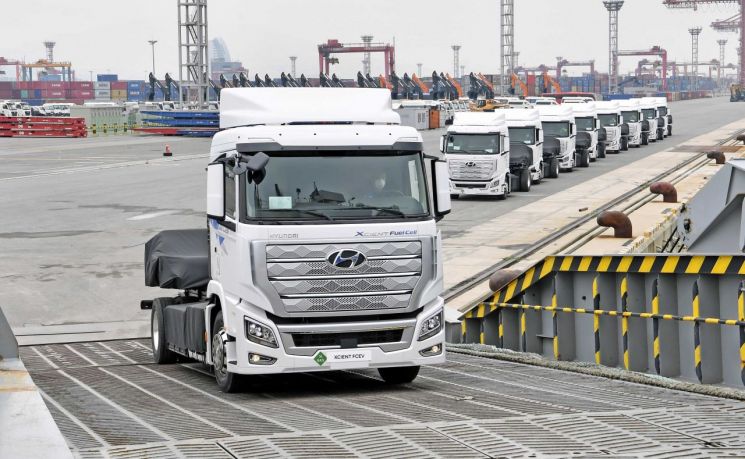
Hydrogen is expected to be used across all social sectors including transportation, power generation, industry, and buildings, with the transportation sector centered on trucks showing high growth potential. While electric vehicles are expected to expand in the passenger car segment, hydrogen is more efficient than batteries for trucks and buses that require high output and large amounts of energy.
For long-distance operation, large trucks running on electric power would require batteries weighing an estimated 10 tons. In contrast, the powertrain of a hydrogen truck weighs about 7 tons, lighter than the existing diesel trucks at 7.5 tons. Fast refueling is another advantage. Hyosung Group plans to establish about 30 hydrogen refueling stations nationwide in line with the operation of its liquefied hydrogen plant.
Cho Hyun-joon, Chairman of Hyosung Group, said, "Through continuous research and development, we will actively participate in domestic production of hydrogen refueling and supply facilities to build an efficient and economical hydrogen value chain."
© The Asia Business Daily(www.asiae.co.kr). All rights reserved.



















