Dr. Yoonjin Lee's Collaborative Research Team at Korea Institute of Radiological & Medical Sciences Identifies Mechanism and Specific Substances for Prevention
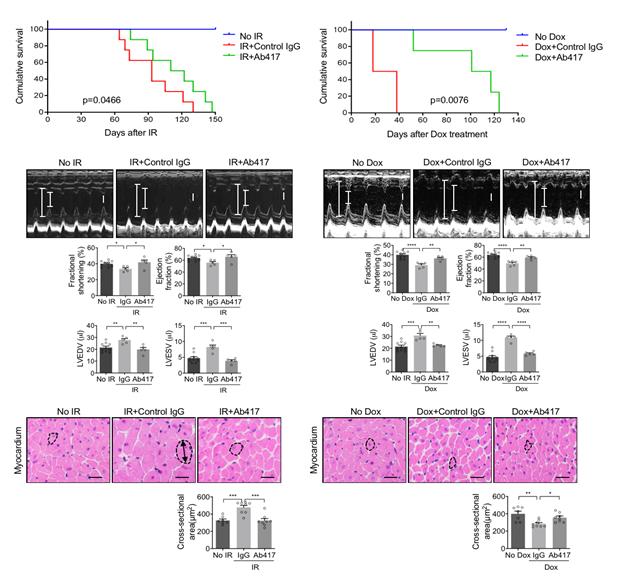
A mouse model of radiation- and doxorubicin-induced cardiac injury was created, and cardiac damage was observed through echocardiography. It was confirmed that Ab417 inhibited radiation- and doxorubicin-induced cardiac injury and increased survival rates. Additionally, it was confirmed that the deformation of cardiomyocytes caused by radiation and doxorubicin was inhibited by Ab417. Photo by Korea Institute of Radiological & Medical Sciences
[Asia Economy Reporter Kim Bong-su] Domestic researchers have developed a method to reduce cardiotoxic heart damage that can occur during cancer treatment using the anticancer drug doxorubicin and thoracic radiation therapy.
The Korea Institute of Radiological & Medical Sciences announced that Dr. Lee Yoon-jin and Professor Hong Hyo-jung from Kangwon National University College of Biomedical Science jointly confirmed the mechanism causing heart disease due to cardiotoxicity during treatment with the anticancer drug doxorubicin and thoracic radiation therapy, identified a specific substance that can prevent cardiotoxicity, and demonstrated its efficacy.
Doxorubicin and thoracic radiation therapy are cancer treatments prescribed for various types of cancer patients such as breast cancer and lymphoma. However, they have cardiotoxicity that can cause heart disease, and since there are no fundamental preventive measures or treatments yet, they pose an obstacle to cancer treatment.
The research team confirmed through experiments on rats that doxorubicin and radiation cause DNA damage in cardiac vascular cells, and the continuous damage of unrepaired DNA leads to cell mutations, causing fibrosis that hardens the blood vessels, ultimately resulting in a rapid decline in the function of cardiac muscle cells. During this process, they observed that the DNA damage in cardiac vascular cells caused by doxorubicin and radiation led to increased expression of L1 cell adhesion molecules.
In particular, when an antibody substance known to specifically bind to L1 cell adhesion molecules was injected into rats with heart damage caused by doxorubicin and radiation, and cardiac ultrasound was performed, it was confirmed that this antibody prevented continuous DNA damage in cardiac vascular cells, reduced cardiotoxic side effects, and increased survival rates by about 50%.
The research team explained, "We discovered a specific antibody that reduces DNA damage and cardiotoxicity occurring during commonly used anticancer drugs and radiation therapy for cancer treatment, enhancing the effectiveness of cancer treatment and suggesting the possibility of developing clinical drugs to control anticancer drug cardiotoxicity."
The results of this study were published in the online edition of Nature Communications, a sister journal of Nature, on the 2nd.
© The Asia Business Daily(www.asiae.co.kr). All rights reserved.

















