Experts: "Universal Basic Income Has No Income Redistribution Effect"
Securing Sufficient Funding May Be Difficult Under Specific Purpose Tax Theory
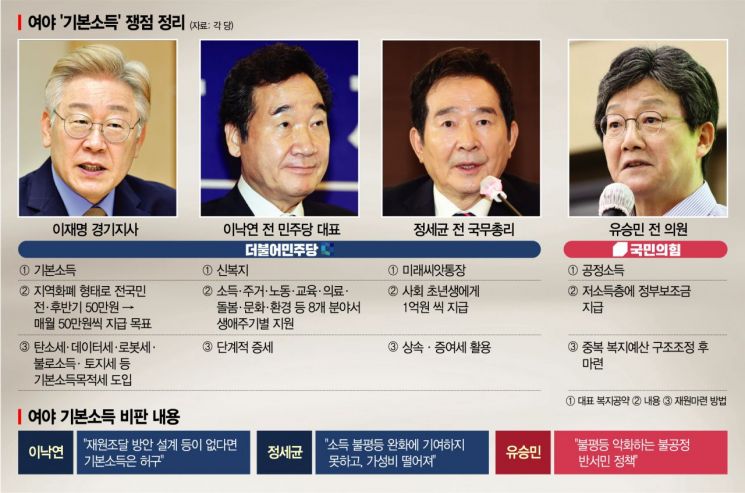
[Asia Economy Reporters Joo-yeon Oh, Se-hee Jang] The debate over ‘basic income’ is heating up in the political arena. It is gaining more attention as a leading presidential candidate has brought it up and other candidates have criticized it. Although each candidate proposes a similar type of basic income as a campaign promise, there are differing evaluations regarding the accuracy of the polarization diagnosis, feasibility, funding methods, and the sincerity of the solutions. The debate is expected to intensify further once the political sphere officially enters the presidential election phase in the second half of the year.
◆ "Universal or Selective?" = The multifaceted basic income debate is active within the ruling party. Former Democratic Party leader Lee Nak-yeon proposes a ‘new welfare system,’ while former Prime Minister Chung Sye-kyun advocates for a ‘Seed Account.’ However, the basic income plan of Gyeonggi Province Governor Lee Jae-myung, who tops public opinion polls, is at the center of the debate. The opposition party argues for providing subsidies limited to low-income groups.
Lee’s proposed basic income involves giving a fixed amount to all citizens regardless of property size, income, or employment status. The plan is to start with 500,000 KRW annually in the short term, increase to 1 million KRW in the medium term, and eventually provide 6 million KRW annually in the long term. However, paying 500,000 KRW per month to all 52 million citizens would require an annual budget of 312 trillion KRW, posing a significant challenge in securing funding. This amount would consume more than half of this year’s budget (558 trillion KRW). Lee plans to reduce the budget in the short term and cut tax exemptions by 2.5 trillion KRW in the medium term. He also intends to introduce ‘basic income purpose taxes’ such as carbon tax, data tax, robot tax, and unearned income land tax. He argues that as the GDP grows to 3,000?4,000 trillion KRW and the national budget expands, securing funds will become easier. While critics point out that it currently requires more than half of the budget, Lee insists the timing of payments should be considered.
Presidential rivals Lee Nak-yeon and Chung Sye-kyun are jointly criticizing Lee Jae-myung. They argue that basic income is unrealistic given fiscal constraints and that its economic effects are limited. Lee Nak-yeon’s ‘new welfare system’ divides life into eight areas?income, housing, labor, education, healthcare, care, culture, and environment?and proposes guaranteeing minimum living standards in each area as a policy vision. While it shares the same spirit as Lee Jae-myung’s basic income, it is more comprehensive by addressing welfare across life cycles. For example, it focuses on ‘customized welfare’ such as providing child allowances until age 18 and mandatory education from age 5, which differs from Lee Jae-myung’s approach.
Chung Sye-kyun’s ‘Seed Account’ pledge is similar. It proposes that the state supports 100 million KRW in a 20-year savings plan when a child is born, which is also close to customized welfare. Both Lee Nak-yeon and Chung Sye-kyun aim to provide more substantial support to those in need within the existing welfare framework. They believe Lee Jae-myung’s basic income cannot replace the current welfare system.
In the opposition camp, former lawmaker Yoo Seung-min has proposed ‘fair income.’ Fair income is a selective welfare policy where the government provides subsidies to low-income groups, unlike universal basic income. He argues that giving the funds allocated for basic income to the bottom 50% income group would allow twice the amount to be distributed, thus having a greater effect on reducing polarization and inequality.
◆ "Labor Supply Decline Leads to GDP Drop... Securing Tax Revenue Also Difficult" = Experts generally view that universal basic income lacks income redistribution effects, thus not helping to resolve inequality, and that securing funding would be difficult.
Professor Park Ki-sung of Sungshin Women’s University’s Department of Economics said, “For a four-person household, it means receiving about 24 million KRW annually,” adding, “If labor supply decreases due to reduced work motivation, the overall GDP could collapse.” He emphasized that “even if cash support is provided, it is preferable to differentiate support according to income brackets.”
Professor Hong Woo-hyung of Hansung University’s Department of Economics said, “Because the same amount is distributed equally to everyone, there is no income redistribution effect,” and added, “Welfare benefits are difficult to reduce once increased, so implementation should consider fiscal capacity.” In fact, this year’s national debt reaches 965 trillion KRW, and the debt-to-GDP ratio is approaching the 50% threshold. Regarding funding methods, he said, “To implement universal welfare like basic income, newly introduced purpose taxes must collect more revenue than income tax,” but questioned, “Purpose taxes require clear taxable targets, so it is doubtful whether sufficient tax revenue can actually be secured.” According to the National Tax Service, income tax revenue last year was 98.2 trillion KRW, accounting for 35.2% of total tax revenue.
Professor Lee Jong-hwa of Korea University’s Department of Economics said, “We are maintaining a medium burden and medium welfare system, so it is necessary to consider whether basic income is the most suitable welfare paradigm relative to Korea’s GDP,” and added, “When discussing basic income, there should be prior discussions on the overall welfare paradigm change and funding methods.”
© The Asia Business Daily(www.asiae.co.kr). All rights reserved.
![User Who Sold Erroneously Deposited Bitcoins to Repay Debt and Fund Entertainment... What Did the Supreme Court Decide in 2021? [Legal Issue Check]](https://cwcontent.asiae.co.kr/asiaresize/183/2026020910431234020_1770601391.png)















