Government to Hold National Space Committee Meeting on the Afternoon of the 9th
Developing Concrete Strategies Based on the ROK-US Summit Agreement
Detailing Korean GPS Strategy and Launching 14 Small Communication Satellites for 6G by 2031
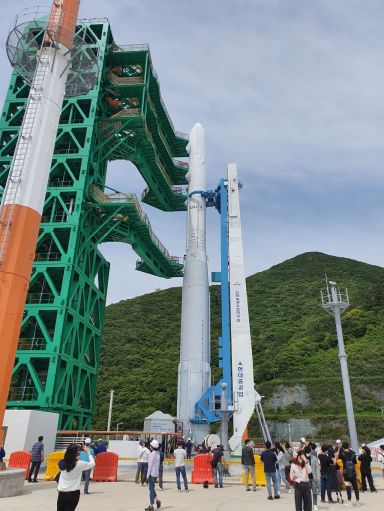
[Asia Economy Reporter Kim Bong-su] The government will develop a small solid-fuel-based space launch vehicle led by private companies within the next three years. It has also finalized a concrete plan to complete the Korean Positioning System (KPS) by 2035. As a follow-up to the Korea-US summit held on the 21st of last month (US time), this is expected to stimulate the domestic private space industry.
On the afternoon of the 9th, the government held the 19th National Space Committee at the Korea Science and Technology Center in Seoul, chaired by Minister Lim Hye-sook of the Ministry of Science and ICT, where it reviewed and approved three agenda items, including the revised basic plan of the 3rd Space Development Promotion Plan. In this regard, the Korea-US leaders agreed to abolish missile guidelines and strengthen cooperation related to the establishment of KPS.
The government will first promote the development and launch of a small launch vehicle using solid fuel by 2024. It will provide solid propellant technology accumulated by the government to private companies such as Hanwha Aerospace and Korea Aerospace Industries (KAI) to lead the development. The government plans to develop solid-fuel small launch vehicles to meet the launch demand for low Earth orbit small satellites and microsatellites. Solid-fuel launch vehicles have simple structures and launch facilities, allowing for fast and simple launches. However, due to propulsion limitations, liquid fuel is more suitable for high orbit or heavy launch vehicles.
To this end, the government will build a launch pad at the Naro Space Center located on Oenarodo, Goheung, Jeollanam-do, which private companies can utilize. Initially, only the solid-fuel launch vehicle infrastructure will be established, with plans to expand it later to accommodate various launch vehicles such as liquid-fuel types. A kick motor using solid fuel will also be developed. Installed at the top of the launch vehicle, it allows fine adjustments in the final stage and can increase the weight of the payload satellites and space probes. This means more equipment can be loaded to perform additional missions during lunar and asteroid space exploration.
The plan to build the independent satellite positioning system, KPS, has also been specified. The government will begin the project in earnest next year after completing the preliminary feasibility study in the first half of this year, launching about 10 satellites including the first satellite in 2027, starting pilot services in 2034, and completing the system by 2035. Especially, following the Korea-US summit agreement, KPS will coexist and interoperate with the US GPS, providing services with up to centimeter-level accuracy and search and rescue services, establishing it as a national infrastructure for the 4th Industrial Revolution.
Some major schedules in the 3rd basic plan have also been adjusted. The first launch of Nuriho has been postponed from February to October this year, and the second launch from October this year to May next year, reflecting previous changes. Accordingly, Multipurpose Satellite 6 was changed from 2020 to 2022, Multipurpose Satellite 7 from 2021 to 2022, and Next-generation Medium Satellite 2 from 2020 to 2022. The weight of the lunar exploration orbiter (KLPS), scheduled for launch in August next year, was changed from 550kg to 678kg, and the project period extended from December last year to July 2022.
The roadmap for microsatellite development has also been finalized. The government plans to develop and launch numerous microsatellites for national security, space radio environment observation, AI-based autonomous swarm operation technology, space debris removal technology, and deep space exploration project technology development. In particular, to maintain leadership in the next-generation ultra-high-speed mobile communication market, 6G, following 5G, a dedicated satellite communication pilot network will be established. By 2031, 14 satellites will be launched to verify core technologies and secure product heritage.
Minister Lim Hye-sook said, "The space-related measures achieved through the Korea-US summit are an opportunity to take Korea's space development capabilities to the next level," adding, "Going forward, space development centered on the public sector will expand to the private sector, and traditional space technologies such as launch vehicles and satellites will converge with new technologies like artificial intelligence and big data to create new markets through innovation, which we will support through policy."
© The Asia Business Daily(www.asiae.co.kr). All rights reserved.

















