Customer Sent Empty Bowl After Receiving Replacement Food for Complaint
"I'm COVID-positive and will spit in the store" - Insults and Threats
Expert: "Review Bombing Is Not a Consumer's Legitimate Right"
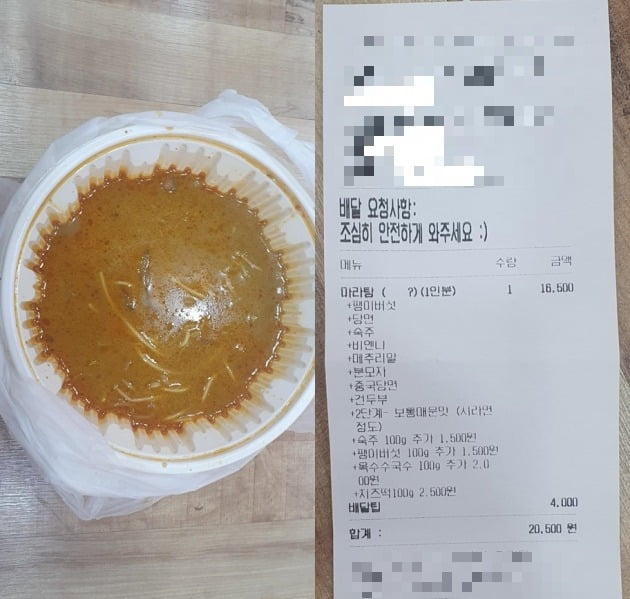 A hot pot restaurant owner in Goyang City sent new food in response to a customer's complaint and posted a photo claiming it was the returned dishware.
 Photo by Online Community Capture
[Asia Economy Reporter Kang Juhee] As the demand for delivery food has significantly increased recently, self-employed business owners are facing growing distress due to malicious consumer behaviors occurring during the delivery process.
Some consumers complain about issues with the food but return empty dishes after finishing the meal, while others blame the business owner for not receiving the food because they fell asleep after placing an order. Such 'Black Consumer' abusive behaviors are becoming more serious. Experts suggest that measures should be established to protect self-employed business owners from black consumers.
On the 7th, a post titled "I was victimized by a delivery freeloader" by Mr. A, the owner of a Malatang restaurant, was uploaded on an online community. Mr. A, who runs a store in Ilsandong-gu, Goyang City, shared a story about how he redelivered new food after a customer complained about a problem with the food, only to receive back a delivery container that was almost empty.
He wrote, "I received an order through a delivery app at 8:10 PM on the 6th," and added, "I set the delivery time to 50 minutes and delivered the food on time." However, the customer who received the food later complained that "the corn noodles included in the Malatang were all soggy, and the spiciness was weak."
Although Mr. A followed the delivery time and cooking method, he reluctantly repackaged the contents and broth separately and redelivered them at the customer's request. For confirmation, he asked the customer to send back the partially eaten food to the delivery driver. The customer said they had "slightly eaten the food," but Mr. A said, "Since they said they only ate a little, I told them it was okay."
However, the container Mr. A received back was almost empty. The order included various ingredients such as enoki mushrooms, glass noodles, bean sprouts, and quail eggs, but only broth remained in the container.
Mr. A said, "I called the delivery app customer center to explain the situation, but they said there was nothing they could do since I had already taken action (redelivery)." He also mentioned that the counselor called the customer, but the call was rejected. Mr. A expressed his disbelief, saying, "This is what I had only seen in the news as delivery freeloaders. How can a person do such a thing?"
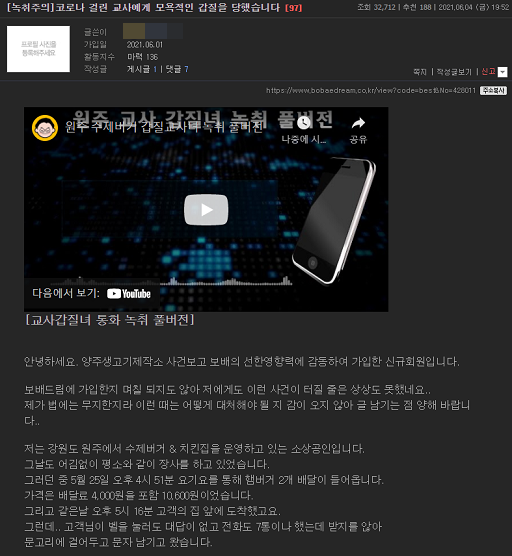 A business owner who released a recorded phone conversation with a consumer, claiming to have been mistreated by the consumer who ordered delivery food. Photo by Online Community Capture
Meanwhile, there was a recent case where a consumer took out their frustration on a business owner after falling asleep and missing a delivery. Mr. B, who runs a handmade burger shop in Wonju, received an order for two hamburgers through a delivery app at around 4:51 PM on the 25th of last month. About 30 minutes later, he arrived at the customer's house and rang the doorbell, but no one answered.
Mr. B explained, "I called seven times, but no one answered, so I hung the hamburgers on the door handle and left a message before leaving." He added, "When I explained this situation to the delivery app, they told me to dispose of the food if the customer did not contact us within three hours, so I followed their instructions."
However, at 5 AM the next day, Mr. B received threatening messages from the customer, Mr. C, who identified himself as a teacher and a COVID-19 patient. According to Mr. B, Mr. C claimed, "I live alone with my dog, and when I order delivery food, I always write a note asking not to knock on the door because the dogs might bark, and to leave the food at the door with a message." However, no such note was included in the order Mr. B received.
Mr. B explained the delivery app’s policy to Mr. C, but Mr. C continued to demand a refund. When Mr. B refused, Mr. C even threatened him with abusive language such as "Should I take off my mask and cough there since I have corona?", "Wait and see, I will spit all over your store," and more. Mr. B said, "I was anxious that Mr. C might come to the store, so I reported it to the police, but the police response was indifferent."
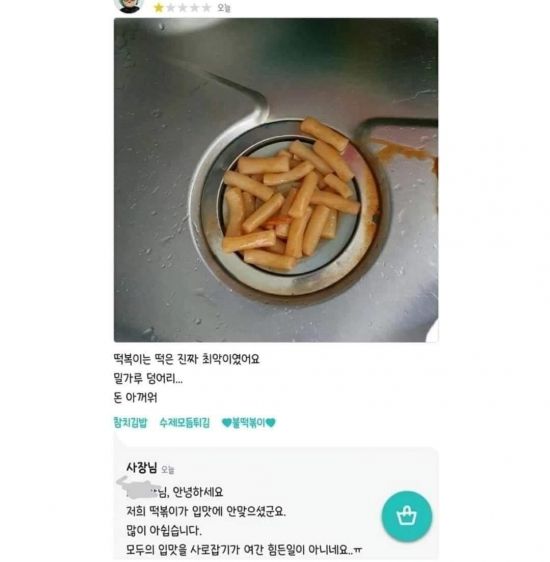
After these incidents became known, netizens expressed outrage toward the abusive consumers. One netizen said, "It seems like these people have no basic manners. The requests keep increasing, and business owners inevitably suffer from consumers whenever they fail to meet all these demands," adding, "They might call it consumer demands, but there should be limits."
Another netizen pointed out, "When consumers complain, business owners cannot refuse such demands because they might receive malicious reviews, which would seriously damage their business. Black consumers seem to take advantage of this. There is also a structural problem with these platforms."
Experts emphasized the need for institutional measures to deal with black consumers.
Professor Lee Eunhee of Inha University’s Department of Consumer Studies said, "Relevant associations and government agencies need to step in to categorize types of black consumers and discuss countermeasures. It is difficult for individual business owners to respond to such behaviors. Warnings should be issued for malicious reviews or excessive demands, and repeated offenses should result in fines," she stressed.
She added, "Star rating attacks are not a consumer’s rightful claim. In the current delivery culture, these black consumers ultimately cause harm even to other honest consumers."
© The Asia Business Daily(www.asiae.co.kr). All rights reserved.



















