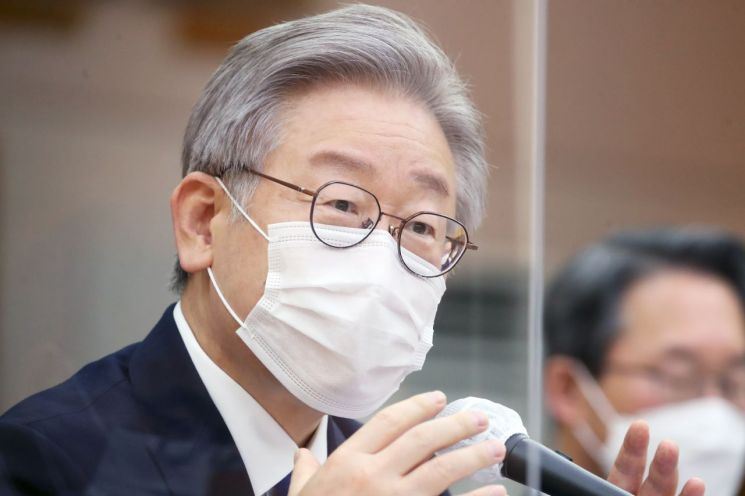
[Asia Economy (Suwon) = Reporter Lee Young-gyu] Lee Jae-myung, Governor of Gyeonggi Province, recently stated regarding criticism of basic income within the ruling party, "Constructive criticism and debate, rather than emotional condemnation or political strife, always help enhance policy completeness and are therefore welcome."
On the 9th, Lee posted a lengthy three-page A4 statement titled "Rebuttal to Criticism of Basic Income" on Facebook, beginning with, "Since many criticisms of basic income have been raised not only by the opposition but also within the ruling party, it is my duty to respond."
He then addressed each presidential candidate within his party who criticized basic income, systematically rebutting their points on funding plans and implementation strategies.
Lee first said, "There was a remark from former party leader Lee Nak-yeon that basic income without a funding plan is fiction and that '300 trillion won annually is half the national budget,' making it unrealistic," adding, "That is why I have proposed introducing purpose taxes for basic income such as carbon tax, data tax, and robot tax."
He explained the payment plan, stating, "In the short term, we will secure 25 trillion won annually through budget cuts and pay 500,000 won per person divided into two installments," and "In the long term, based on public consent for a basic income tax, we aim for a monthly 500,000 won per person, equivalent to the basic living allowance, aligned with a GDP of 3,000 to 4,000 trillion won and a national budget increase of several hundred trillion to 1,000 trillion won."
Furthermore, Lee said, "Former Prime Minister Jeong Sye-kyun and candidate Lee Kwang-jae convert the short-term target amount of 500,000 won annually to 40,000 won monthly and criticize it as too small," rebutting, "For most citizens, 2 million or 4 million won annually for a four-person household is a significant amount that can be a matter of life and death."
He added, "You cannot be full from the first spoonful," and "If the amount is an issue, there is also the method of expanding from specific sectors or age groups to all ages and areas."
In particular, he expressed agreement with Lee Kwang-jae's point that "full implementation of basic income is risky and should be piloted," saying, "Depending on public opinion, a flexible expansion process such as 'from small amounts to large amounts for all citizens' or 'from large amounts in specific ages or regions to the entire area,' or a combination of both, is a good approach."
Lee also rebutted Seoul Mayor Oh Se-hoon's selective cash support plan called Anshim Income, calling it "Discriminatory Meal Season 2" and stating, "Basic income is better."
He argued, "Whether it is Anshim Income or expansion of traditional welfare, the funding ultimately comes from taxes, and if it becomes a 'separate soup for taxpayers and beneficiaries,' tax resistance is inevitable from higher-income earners who say, 'Why should I pay taxes that benefit the poor when I receive no benefits?'" He added, "If a four-person household not working receives 30 million won, even if they earn 2 million won monthly (24 million won annually), Anshim Income decreases by 12 million won, so working only increases income by 1 million won, which also creates an incentive to avoid labor."
He concluded, "As a member of the (Democratic) Party pursuing universal welfare, I ask for interest in the opposition's selective welfare policy, Anshim Income," and "Through debate, I hope Anshim Income will be supplemented with detailed designs to resolve labor avoidance and realistic funding measures, and that its economic utility will be enhanced beyond that of regional currency-type basic income."
© The Asia Business Daily(www.asiae.co.kr). All rights reserved.

















