Ministry of Agriculture, Food and Rural Affairs, Ministry of Education, MFDS, and Ministry of Oceans and Fisheries Sign Business Agreement on the 9th
[Sejong=Asia Economy Reporter Moon Chaeseok] The government has decided to integrate databases to solve the problem of food nutrition information being scattered across various government ministries, which has prevented its proper use in public, private, and educational sectors.
The Ministry of Agriculture, Food and Rural Affairs, Ministry of Education, Ministry of Oceans and Fisheries, and Ministry of Food and Drug Safety announced on the 9th at 2 p.m. that they signed a "Business Agreement for the Construction and Utilization of a Food Nutrition Information Database (DB)" at the Sejong City Hotel in Osong, Cheongju, Chungcheongbuk-do.
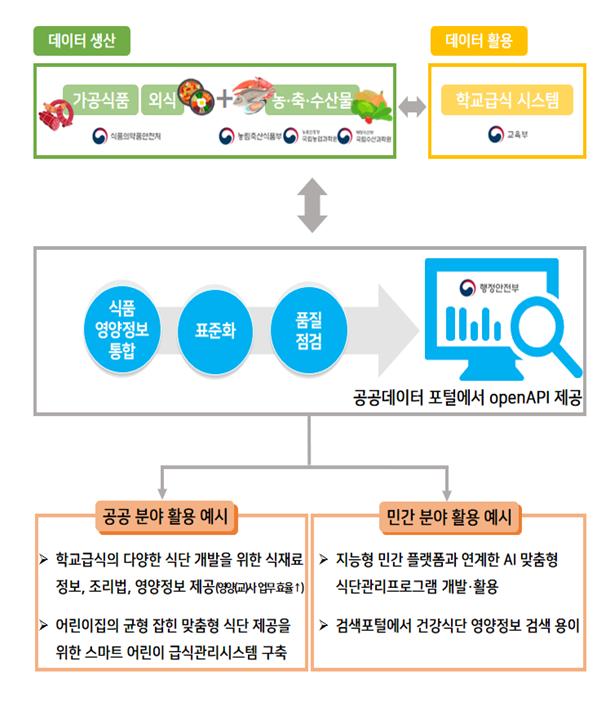
Once the DB is established, information scattered across ministries will be standardized to efficiently create information, and it will be available for use not only in public sectors such as schools but also in the private sector through the Public Data Portal.
The main areas of cooperation include ▲establishing Standard Operating Procedures (SOP) for standardization and quality management of food nutrition information ▲expanding the integrated annual disclosure of food items and nutrition information ▲supporting the use of food nutrition information in public and private services.
First, each ministry will standardize the information they hold and provide it through the Public Data Portal of the Ministry of the Interior and Safety. Systematic standard codes will be assigned to agricultural, livestock, fishery products, and processed foods to unify the labeling methods of food information and nutrition content information and manage duplicate information. SOPs will be prepared to increase DB openness among ministries so that various information can be automatically linked. The combined information will be provided to the public and companies via open API on the Public Data Portal.
Each ministry will increase the food and nutrition information disclosed annually through the DB. The Ministry of Agriculture, Food and Rural Affairs (Rural Development Administration) will increase the food DB from 2,540 cases this year to 3,000 cases next year and 4,000 cases in 2025. The Ministry of Food and Drug Safety will increase the processed food and prepared food (dining out) DB from 44,846 cases this year to 60,000 cases next year and 100,000 cases in 2025. The number of nutrition analysis items for dining out will expand from 80 to 108. The Ministry of Oceans and Fisheries (National Institute of Fisheries Science) will increase the survey targets for nutrition information of traditional fishery products. The Ministry of Education will link and support each ministry’s DB to the "4th generation NEIS (National Education Information System) school meal system," which will be launched in 2023 for use in schools.
Furthermore, the government expects that "one-stop services" will become possible, including school meal menu development, real-time health management for parents and students, new business discovery by intelligent platform operating companies, and consumer information provision.
Officials from the four ministries who participated in the agreement ceremony said, "We have joined forces among ministries to find ways to strengthen the use of public data in the food nutrition and safety fields for the common goal of promoting public health." They added, "By standardizing the food nutrition information DB, we have laid the foundation to combine information scattered across ministries, and we will do our best to provide accurate information to the public and manage public health, dietary nutrition, and safety."
© The Asia Business Daily(www.asiae.co.kr). All rights reserved.

![Clutching a Stolen Dior Bag, Saying "I Hate Being Poor but Real"... The Grotesque Con of a "Human Knockoff" [Slate]](https://cwcontent.asiae.co.kr/asiaresize/183/2026021902243444107_1771435474.jpg)
















