Specialized Design Knowledge Industry Center Enhancing Work Efficiency... Move-in Burden Down with Up to 70-80% Loans
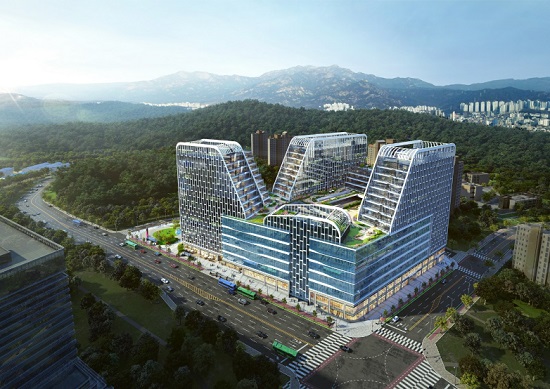
Knowledge industry centers are showcasing various specialized designs to captivate companies. As comfortable working environments have emerged as a way to enhance employees' work efficiency, corporate attention is focusing on knowledge industry centers that incorporate specialized designs. This trend of specialized design is spreading further as the recent 52-hour workweek reduces working hours, making environments that maximize efficiency within limited time increasingly important.
A knowledge industry center refers to a collective building of three or more floors above ground where urban manufacturing, knowledge-based industries, information and communication-related companies, and support facilities can reside. It is characterized by restrictions on tenant industries, allowing similar industries to work together, thereby facilitating active business exchanges and synergy effects. While it used to be limited to simple office facility configurations and designs, recently it has gained attention by introducing specialized designs tailored to the convenience and diverse preferences of tenants.
Knowledge industry centers with integrated specialized designs provide conveniences that were difficult to enjoy in existing complexes, and their competitiveness is highly evaluated. Recently, most of these centers are located on self-sufficient facility sites equipped with convenient transportation and amenities, and as locational advantages have become diluted, such specialized design complexes are gaining more attention.
Another reason these centers attract companies is that, as a product, knowledge industry centers impose less burden on tenants compared to other products. Unlike apartments or officetels restricted by real estate policies, knowledge industry centers are relatively free from regulations such as resale restrictions on pre-sale rights and can receive financial support (loans) up to 70-80%.
As knowledge industry centers differentiated by specialized designs gain popularity among companies, attention is also turning to newly launched complexes. In the Hyangdong District of Goyang, which is emerging as a new business belt in the northwest metropolitan area, ‘Hyundai Terra Tower DMC’ is scheduled for sale.
‘Hyundai Terra Tower DMC,’ located in Hyangdong District, Goyang City, Gyeonggi Province, will be built with a total floor area of 139,447m², spanning from two basement levels to 15 floors above ground. It plans to feature innovative space designs and community facilities. Additionally, with Hyundai Engineering’s construction, a highly satisfactory outcome is anticipated.
Knowledge industry centers are divided into office-type and manufacturing-type. Some office-type units offer terrace spaces with a stepped structure that maximizes natural light and spatial openness. These terraces can be used diversely according to tenant needs, such as employee rest areas or mini gardens, and are expected to provide a more comfortable working environment with ample usable space.
The manufacturing-type knowledge industry center, spanning from two basement levels to six floors above ground (some units), incorporates a drive-in system allowing vehicle access directly to the unit entrance.
Various community facilities such as a fitness center, shared lounges, floor-specific rest areas, and small meeting rooms are also planned. On the 7th floor, a ‘Work-Life Balance Rooftop’ space will be designed, featuring approximately 140 meters of jogging track, landscaping, rest facilities, and a cafeteria, allowing relaxation in harmony with nature. Additionally, a ‘Kids & Eco Park’ with a fountain plaza, walking paths, and a kids’ park will be provided on the first floor, and a ‘Sky Park’ with rest areas and stretching decks will be located on the rooftop of the 11th floor.
The location conditions are also favorable. The Gangbyeonbuk-ro entrance is nearby, and road networks connecting to various parts of Seoul, including Jayuro and Olympic-daero, are accessible. A new subway station is also planned, enabling quick access not only to the adjacent Sangam District but also to Magok District, Yeouido, and Jongno.
First, the Goyang Line Hyangdong District Station (scheduled to open in 2029, approximately 900m away according to Naver), which connects to the Western Line (planned to open in 2028), will be located near the complex, significantly enhancing accessibility. Additionally, the Hyangdong Station on the Gyeongui-Jungang Line (scheduled to open in 2023, approximately 2.2km away according to Naver) and Changneung Station on the GTX-A Line (scheduled to open in 2026, approximately 2km away according to Naver) are also planned.
With the development of the nearby Changneung New Town and Susaek Station area, corporate demand is expected to gradually expand, increasing investment value. The approximately 220,000㎡ Susaek Station area will include office spaces, commercial facilities, and cultural tourism facilities, likely generating active synergy effects with the Hyangdong District.
The model house for ‘Hyundai Terra Tower DMC’ will be located in Eunpyeong-gu, Seoul, near Susaek Station on the Gyeongui-Jungang Line.
© The Asia Business Daily(www.asiae.co.kr). All rights reserved.

















