White House Releases Report on Supply Chain Improvements for Semiconductors, Batteries, and Rare Earths
Emphasizes Korea-US Partnership... US Congress Passes 280 Trillion Won China Containment Bill
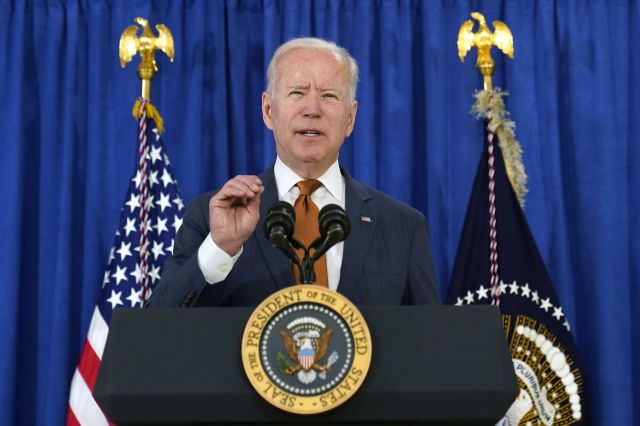
[Asia Economy New York=Correspondent Baek Jong-min] The U.S. administration and Congress have begun to actively take steps to strengthen domestic supply chains and industrial competitiveness while containing China. In this process, the role of U.S. allies and partner countries, including South Korea, is expected to significantly increase.
On the 8th (local time), the White House released a review report aimed at improving supply chains for semiconductors, batteries, pharmaceuticals, and rare earth elements. This move follows President Biden's directive in February to improve supply chains after pointing out the impact of vehicle production halts caused by semiconductor shortages on the U.S. economy.
Words related to China mentioned 566 times
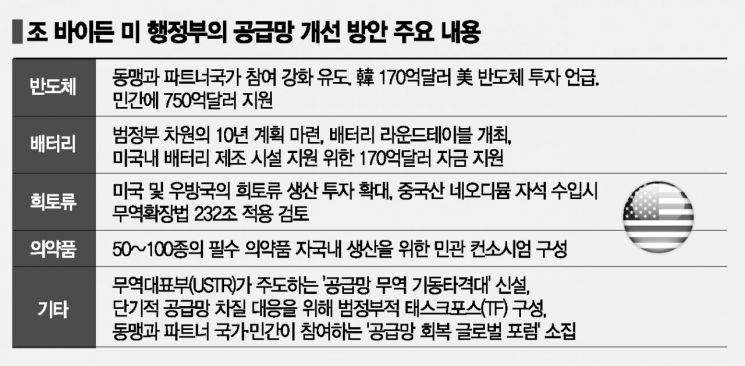
The report includes plans to expand supply chains within the U.S., but it clearly expresses a strong intention to win the competition against China. The words ‘China’ and ‘Chinese’ were mentioned 458 times and 108 times respectively in the report. This indicates that the core of the supply chain strengthening strategy is to get ahead in the competition with China.
The review report also includes measures targeting China. The Department of Commerce decided to consider applying Section 232 of the Trade Expansion Act to investigate imports of neodymium magnets, a rare earth element mostly imported from China, which are necessary for semiconductor and smartphone production as well as defense materials.
Section 232 of the Trade Expansion Act allows the president to impose high tariffs without congressional approval when national security is threatened.
This is interpreted as a signal that the Biden administration may impose tariffs as former President Donald Trump attempted. The U.S. also plans to invest in expanding production of rare earth elements, which China has virtually monopolized, within the U.S. and partner countries.
A strategy was also devised to establish a ‘Supply Chain Trade Task Force’ led by the U.S. Trade Representative (USTR) to respond to China’s unfair trade practices.
The White House directly mentioned allies to confront China. South Korea, a powerhouse in semiconductor and battery production, was mentioned 74 times. Taiwan and Japan were mentioned 84 and 85 times respectively.
This emphasizes that the governments of South Korea, Taiwan, and Japan, as well as related companies, are expected to contribute to stabilizing the U.S. supply chain, and also implies demands for expanding production facilities within the U.S.
‘Samsung’s 19 trillion won investment’ mentioned, emphasizing "private sector at the center"
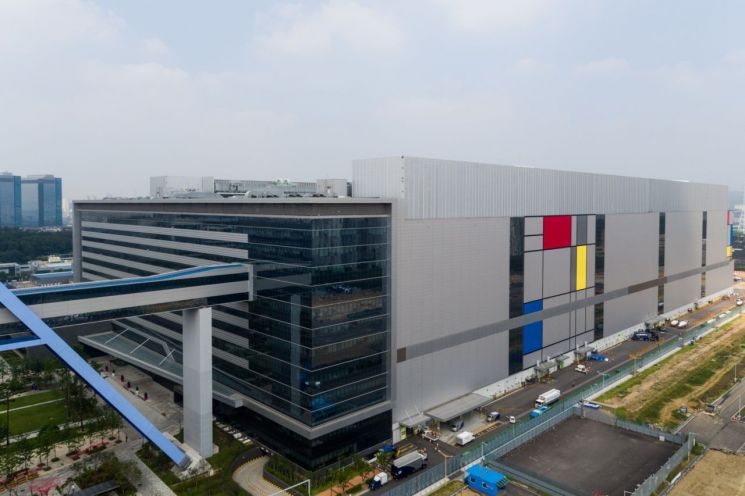
The White House highlighted the necessity of cooperation with allies and partners to strengthen the semiconductor supply chain, emphasizing the importance of investments by both U.S. and foreign companies in the U.S.
In particular, the White House mentioned Samsung Electronics’ $17 billion (approximately 19 trillion won) investment in the U.S. semiconductor sector, stating, "We will strengthen relationships with allies and partners to ensure fair semiconductor chip allocation, increase production, and promote investment."
Commerce Secretary Gina Raimondo also issued a statement saying, "The government cannot solve this problem alone. The private sector must play a central role in responding to this crisis," urging companies to invest.
To this end, the U.S. government plans to convene an international conference on supply chain strengthening that will include governments and companies from allied and partner countries. South Korean companies leading the semiconductor and battery sectors are expected to be invited.
After the Korea-U.S. summit, President Biden expressed gratitude for investments in the U.S. by standing up executives from Samsung Electronics, Hyundai Motor Company, LG Energy Solution, and SK Innovation during a joint press conference.
China containment bill overwhelmingly passed... 60 trillion won investment in semiconductors
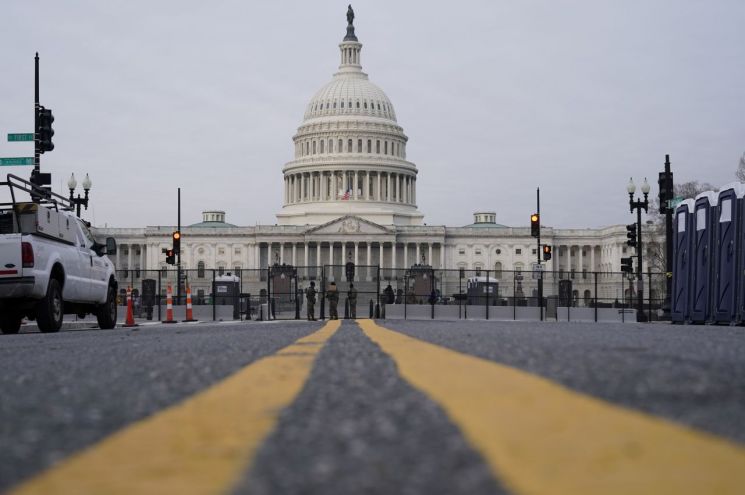
On the same day, the U.S. Senate also provided support fire for competition with China by passing the ‘China Containment Act’ with bipartisan support. The Senate passed the bill, which focuses $250 billion (approximately 280 trillion won) on developing and producing advanced industrial technologies such as semiconductors amid fierce competition with China, with 68 votes in favor and 32 against. The bill received significant support not only from all 50 Democratic seats but also from many Republicans.
Following the bill’s passage, $190 billion (210 trillion won) will be invested in technology development over the next five years, with $54 billion (60 trillion won) specifically allocated to semiconductors. $2 billion (2.2 trillion won) was allocated solely for semiconductor development for automotive parts.
The congressional move is expected to be a great boost to the U.S. administration. At a cabinet meeting held to discuss the White House’s supply chain review plan announced that day, there was a call for bipartisan support of $50 billion for semiconductor industry development.
President Biden also praised the Senate’s passage of the bill, saying, "We have established leadership for the U.S. to lead the most important future technologies, from artificial intelligence to semiconductors and lithium batteries."
He added, "We must win the competition of the 21st century. Other countries have already started investing, and we cannot fall behind," urging the House of Representatives to pass the bill to maintain the U.S.’s status as the most innovative and productive country.
© The Asia Business Daily(www.asiae.co.kr). All rights reserved.



















