Operation of a Venture Startup Fund Worth 170 Billion Won Over the Next 10 Years
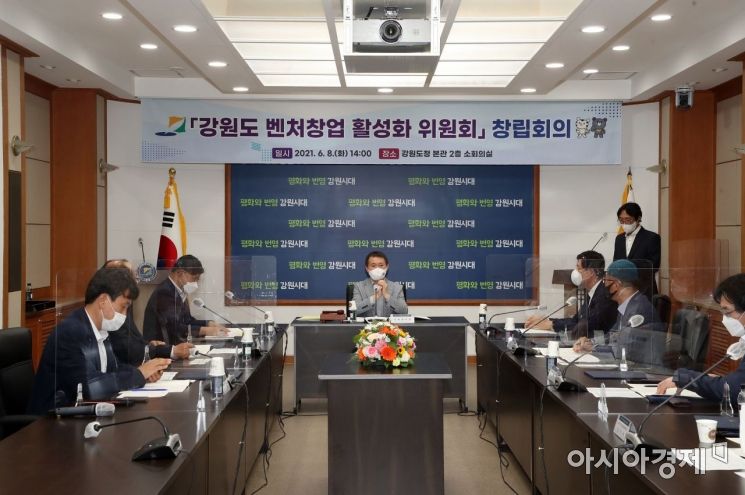
[Asia Economy Reporter Ra Young-cheol] The Gangwon Province Venture Startup Activation Committee held its inaugural meeting and resolved to operate a venture startup fund worth a total of 170 billion KRW over the next 10 years to foster venture startups within the province.
According to the province on the 8th, in the afternoon at the provincial government conference room, Professor Kang Shin-soo of the Entrepreneurship and Intellectual Property Department at Kwandong University was elected as the chairman of the Gangwon Venture Startup Activation Committee, forming a committee of nine members (including the chairman).
Following this, a report was given on the operation direction of the 'Gangwon-type Venture Fund' and other projects to create a venture startup ecosystem, deciding to establish a venture fund worth 170 billion KRW and support it through a Two-Track approach.
As the first phase of the investment plan, a fund of 25 billion KRW will be created in the first half of this year, and depending on the trend, a follow-up investment fund of 28 billion KRW will be operated as the 'Gangwon-type Venture Fund.'
The first phase 'Gangwon-type Venture Fund' will be operated through a total of three funds (Youth Startup Fund, Venture Fund No. 1 and No. 2) to focus on nurturing venture companies that leverage Gangwon Province's characteristics, targeting approximately 80 companies within the province.
The 'Youth Startup Fund' will invest in small-scale startup venture companies such as open military graduates who support technology startups to encourage active-duty soldiers in the province to settle locally after discharge, youth startup companies, and social enterprises.
'Venture Fund No. 1 and No. 2' plan to focus investments on existing Gangwon-specialized industries such as bio, medical devices, ceramics, and other new material industries, as well as innovative companies.
Through this, the province expects that up to 300 local companies will benefit directly or indirectly over 10 years, and the employment effect of venture companies through new youth startups will reach about 1,000 people.
The second phase will operate the venture startup fund over 10 years, including a 'Gangwon New Deal Fund' worth 120 billion KRW utilizing the Ministry of SMEs and Startups' mother fund, which is part of the government's New Deal policy.
The second phase 'Gangwon New Deal Fund' will be established with the province investing 15 billion KRW over four years, along with the government mother fund operated by the Ministry of SMEs and Startups, local public institutions, and private capital, totaling 120 billion KRW.
Initially, investments will be made in conjunction with already invested industries specialized in the province such as bio, medical devices, and new materials, and mid- to long-term investments will be made in future strategic industries such as digital healthcare, liquefied hydrogen, e-mobility, and attracting companies from the metropolitan area.
The raised funds will be required to invest at least 60% in startups and venture companies within the province, and by utilizing the province's investment of 15 billion KRW, an investment effect of 72 billion KRW is expected, creating a so-called 'leverage effect.'
Along with the fund establishment, various capacity-building measures such as 'accelerating' for early-stage companies, 'forum operation' involving local venture companies, and 'expert consulting' for venture companies will be simultaneously promoted.
Kim Myung-jung, Deputy Governor for Economic Affairs, said, "While continuously creating funds for venture development, we will create opportunities for local companies to secure competitiveness through extensive experience, attracting numerous investors nationwide."
Meanwhile, according to data from the Bank of Korea, as of January and February this year, the number of venture companies in the province was 776, which is only 1.94% compared to the nationwide total of 390,849 companies, indicating a low level.
The main difficulties faced by venture startup companies in the province were largely securing funds and fear of failure and recovery.
As a result, the proportion of reliance on government support funds rather than banks and venture capital for startup funding is high, and it has been consistently pointed out that it is difficult to establish a virtuous cycle structure of investment → profit → reinvestment.
© The Asia Business Daily(www.asiae.co.kr). All rights reserved.

















