'Nudge' that induces behavior by stimulating incentives and competitive spirit
Vaccination rates rise after introducing vaccine incentives and leftover vaccine reservations
Vaccine lotteries appear in countries like the US and Hong Kong
Experts say "Incentives can be considered if education alone is insufficient"
"Need to consider whether reliance on incentives will remain useful in the future"
 On the morning of the 8th, medical staff are administering vaccines at the COVID-19 vaccination center set up at Sadang Sports Complex in Dongjak-gu, Seoul. / Photo by Yonhap News
[Asia Economy Reporter Lim Juhyung] #Choi, a man in his 30s, has been fully engaged in same-day reservations for leftover COVID-19 vaccines recently. He explains that even when leftover vaccine doses occasionally appear, they quickly drop to zero within seconds, making it hard to take his eyes off his smartphone for even a moment. Choi said, "I used to think it was fine whether I got vaccinated or not, but recently, since the competition to get leftover vaccines first has become fierce among people around me, I got curious and decided to try it. Honestly, I didn't expect the vaccine to be this popular."
The COVID-19 vaccination rate has significantly increased as incentives for vaccinated individuals and the leftover vaccine reservation system have been made public. There is a view that the secret to this vaccination success lies in the 'nudge' effect. The sociological term 'nudge,' meaning 'soft intervention,' refers to a strategy that indirectly encourages citizens to take specific actions, and it has been widely used domestically and internationally to overcome distrust in vaccines.
According to the COVID-19 Vaccination Response Promotion Team, as of 6 p.m. on the 6th, the cumulative number of first and second COVID-19 vaccinations reached 10,738,089. Among them, on that day alone, 837,702 first doses and 19,767 second doses were administered, marking the highest daily vaccination count since the start of the vaccination campaign.
Domestic vaccine reservation rates declined due to concerns about rare blood clot side effects from the AstraZeneca vaccine but have recently shown a rebound. On the 26th of last month, despite it being a weekday, the number of vaccine reservations dropped to the 20,000 range. However, as the advance reservation rate recovered, on the 4th, the reservation rate for those aged 60 to 74 reached 80.6%, exceeding the government's target of 80%.
Jung Eun-kyung, Director of the Korea Disease Control and Prevention Agency, said at the COVID-19 regular briefing on the 6th, "In mid-May, the reservation rate among the elderly was as low as the 50% range, which was quite concerning," but added, "(Currently) the situation is somewhat better than expected. I sincerely thank the elderly who trusted the government and medical community and participated in advance reservations and vaccinations."
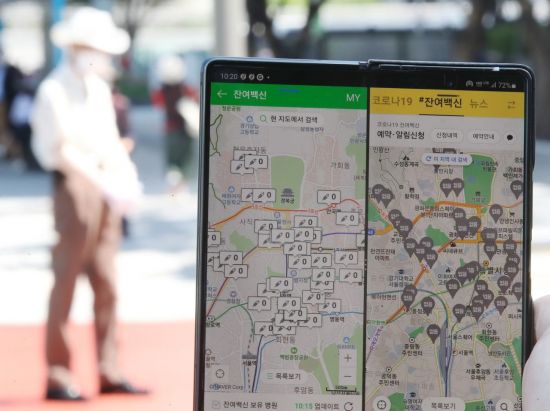 As the number of people hoping to receive leftover COVID-19 vaccines increases, a mobile phone screen showing no leftover vaccines at a medical institution near Gwanghwamun, Jongno-gu, Seoul, on the morning of the 4th / Photo by Yonhap News
The reason for the increased vaccination rate appears to be the government's announcement of so-called 'vaccine incentives,' which exempt vaccinated individuals from some social distancing restrictions such as bans on gatherings of five or more people and mask-wearing. Earlier, on the 26th of last month, Prime Minister Kim Boo-kyum revealed a three-stage incentive plan at the Central Disaster and Safety Countermeasure Headquarters meeting held at the Government Seoul Office.
The 'leftover vaccine reservation system,' which allows real-time checking of leftover vaccines that remain due to no-shows and enables others to receive vaccinations instead, is also a key factor in the vaccine's popularity. Interest in vaccines increased as those who received vaccines early shared their vaccination experiences on social networking services (SNS) and online communities. According to health authorities, from the 27th to the 30th of last month, a total of 9,110 people received leftover vaccines through online reservations.
This strategy of encouraging citizens to take specific actions through incentives and stimulating competitive psychology is called a 'nudge.' The nudge concept gained public attention when Richard Thaler, a leading figure in behavioral economics at the University of Chicago, and Cass Sunstein, a professor at Harvard Law School, published a related book in 2008.
According to Professor Thaler, a nudge is a phenomenon that changes people's behavior through non-coercive 'soft' methods. For example, including a phrase like "Over 90% of residents have already paid" on delinquent tax notices to increase payment rates among defaulters.
Nudges to increase vaccination rates are being attempted not only in Korea but also in other countries. The most representative case is the use of monetary rewards as nudges. In Ohio, USA, a 'vaccine lottery' worth about 1.1 billion Korean won, open only to vaccinated individuals, was used to boost reservation rates.
 In Hong Kong, to encourage vaccinations, an apartment worth 10.8 million Hong Kong dollars (approximately 1.5 billion KRW) was offered as the first prize in a vaccine lottery. / Photo by Internet homepage capture
In Hong Kong, apartments were offered as prizes to encourage vaccination. According to the South China Morning Post (SCMP) on the 29th of last month (local time), real estate giants Sino Group and Chinese Estates Holdings in Hong Kong offered a new apartment worth 10.8 million Hong Kong dollars (approximately 1.5 billion Korean won) as the first prize in a vaccine lottery. Additionally, 20 vaccinated individuals were to be awarded 100,000 Hong Kong dollars (about 14 million Korean won) each through a draw.
SCMP explained, "The prize offerings by real estate developers sparked a sensation in Hong Kong," adding, "Various vaccination incentives such as cash, free food, or beer are also being implemented in other countries like the United States."
Experts note that while nudges using various incentives can increase vaccination rates, relying solely on nudges may cause side effects.
Kevin Volpp, a professor at the University of Pennsylvania, USA, wrote in the scientific journal 'The New England Journal of Medicine' on the 26th of last month, "If providing 'information and education' about vaccines is insufficient, the government might consider financial support for those who get vaccinated," but he also pointed out, "However, it is necessary to consider whether such vaccine incentives will remain useful in the future."
According to Professor Volpp, vaccine incentives can attract those who refuse vaccination but pose equity issues. In other words, people who got vaccinated without incentives might feel relatively disadvantaged. This could lead to a passive attitude toward vaccination in the future.
Regarding this, Professor Volpp explained, "If a 'booster shot' is needed due to the emergence of virus variants, the current incentive strategy could set an undesirable precedent," adding, "In future vaccinations, people might expect rewards and may not act without incentives."
© The Asia Business Daily(www.asiae.co.kr). All rights reserved.
![From Hostess to Organ Seller to High Society... The Grotesque Scam of a "Human Counterfeit" Shaking the Korean Psyche [Slate]](https://cwcontent.asiae.co.kr/asiaresize/183/2026021902243444107_1771435474.jpg)


















