Kantar Consumer Syndicate Survey Results
Surge in 'Investment' Interest Post-COVID-19
Online Shopping Up 16% Compared to Global
Low Interest in Sustainability Such as Eco-Friendliness
[Asia Economy Reporter Lim Chun-han] A global survey has revealed that anxiety levels in Korean society have surged dramatically during the COVID-19 pandemic, and the obsession with money has become much stronger.
Market research firm Kantar held an online press briefing on the 8th to announce the results of the world's largest COVID-19 consumer syndicated study, the "Kantar COVID-19 Barometer."
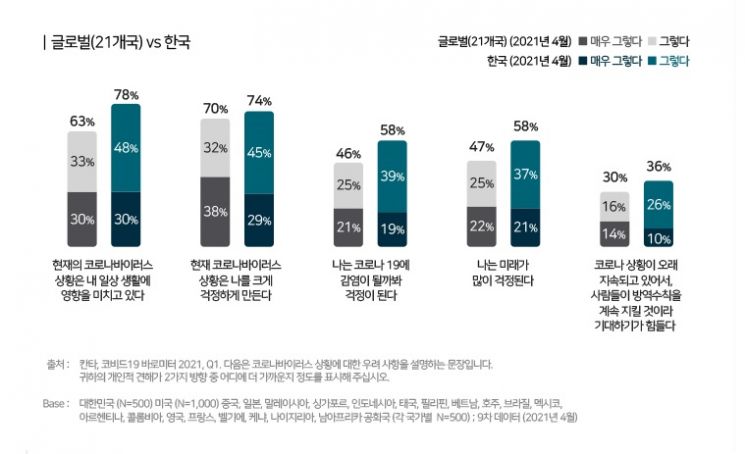
South Korea showed higher negative response rates compared to the global average in all items assessing concerns about the COVID-19 situation. For example, the current COVID-19 situation is affecting my daily life (Global 63% · Korea 78%), I am worried about getting infected with COVID-19 (Global 46% · Korea 58%), and I am very worried about the future (Global 47% · Korea 58%)?all three items were over 10 percentage points higher than the global average. The high level of concern among Koreans is analyzed to be correlated with the low vaccination rate.
Koreans have shown increased interest in investment during the COVID-19 period. In the item stating that COVID-19 led to actively planning asset management, 68% of Koreans agreed, surpassing the global 65%. According to last year's Kantar Global Monitor survey conducted in 25 countries, Koreans' desire for money was more than twice as high as the global average.
Additionally, analyzing keywords related to money mentioned by Koreans on social networking services (SNS) shows that while interest in real estate remains strong, stocks have rapidly emerged as an important asset management tool. Last year, the order of mentions was real estate, investment, and auction, but this year it shifted to investment, stocks, and real estate.
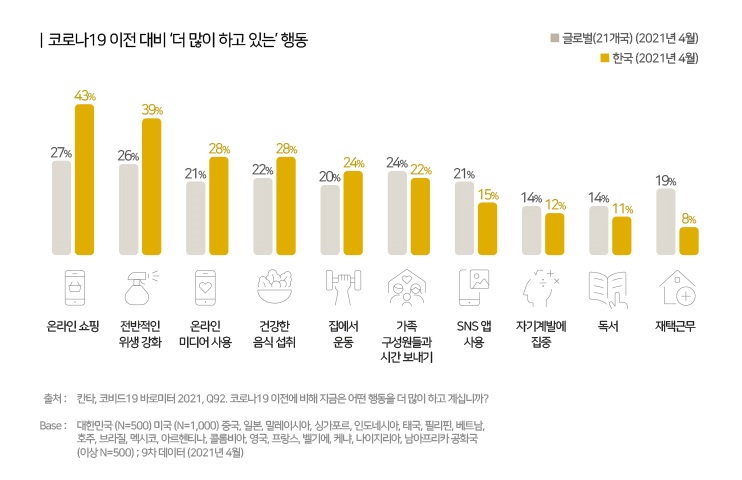
Korean consumers have strengthened their online shopping, media usage, and hygiene awareness and behaviors compared to before COVID-19. In particular, the online shopping growth rate was 43%, which is 16 percentage points higher than the global average. Sensitivity to product prices and hygiene also increased. Compared to last year's data, the percentage of people paying more attention to product prices rose from 49% to 64%, and those purchasing more disinfectant products increased from 40% to 47%.
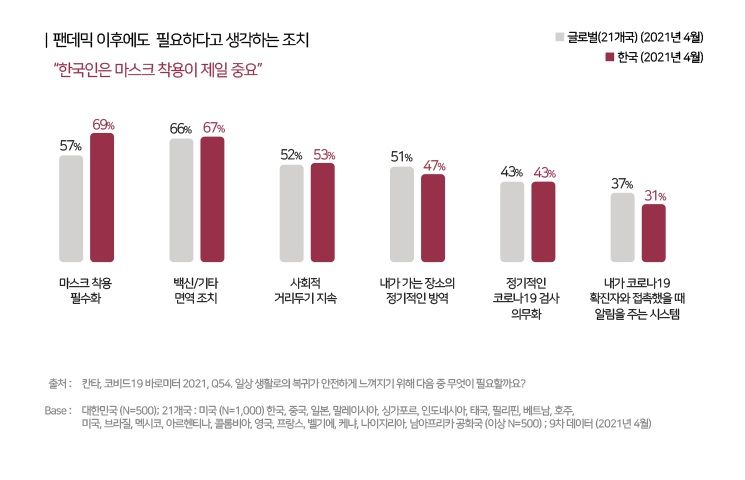
Koreans responded that wearing masks remains important even after the pandemic ends. When asked what measures are necessary to feel safe returning to daily life, the responses were mask-wearing mandates (69%), vaccination (67%), continued social distancing (53%), regular disinfection of places they visit (47%), and mandatory regular COVID-19 testing (43%). The global agreement rate for mask-wearing mandates was 57%, 12 percentage points lower than Korea.
Koreans showed low interest in sustainability issues such as eco-friendliness. Items such as "My friends and family are changing their behaviors to be more eco-friendly" (Global 54% · Korea 46%), "Employees try to purchase products from companies that do not discriminate" (Global 62% · Korea 55%), and "I try to buy products with eco-friendly packaging" (Global 69% · Korea 63%) all showed lower agreement rates compared to the global average.
Choi Moon-hee, Managing Director of Kantar Korea, said, "Companies need to actively consider changes in the role of offline stores due to increased consumer online activity," and added, "It is also important to provide detailed information about product specifications, origin, and ingredients, and to implement reasonable pricing policies."
© The Asia Business Daily(www.asiae.co.kr). All rights reserved.



















