UNIST Professor Myungsoo Na and Joint Research Team
[Asia Economy Reporter Kim Bong-su] Ulsan National Institute of Science and Technology (UNIST) announced on the 7th that a joint research team led by Professors Nam Myung-su, Baek Seung-bin, and Kim Young-sam from the Department of Chemistry has developed a fuel cell electrolyte membrane material (proton exchange membrane fuel cell) with excellent hydrogen ion conductivity.
This material is composed of a metal-organic framework (MOF), which is a mixture of metal and organic substances, unlike conventional polymer electrolyte materials. The team also elucidated the principle of enhancing hydrogen ion conductivity in the electrolyte, which is expected to aid in designing high-performance porous solid electrolytes in the future.
Hydrogen fuel cells are devices that produce electricity by chemically reacting hydrogen with oxygen in the air. They are eco-friendly power generation devices that emit only water as a byproduct. They consist of two electrodes and an electrolyte membrane that allows hydrogen ions to pass between the electrodes (hydrogen ion conduction). The hydrogen ion conductivity of this electrolyte membrane affects the chemical reaction rate and determines the fuel cell efficiency.
The research team developed an electrolyte material with a hydrogen ion conductivity of over 10^-2 S (Siemens)/cm at 60°C using a MOF, which forms a porous framework structure by combining metal and organic substances. This was made by adding amino sulfonate ions (guest molecules) to MOF-808, a type of MOF composed of zirconium metal and organic compounds.
Notably, the developed porous material showed more than 30 times higher ionic conductivity when heat-treated at high temperatures compared to untreated samples. Heat treatment increases the acidity inside the pores, creating a hydrogen bonding network that allows efficient hydrogen ion movement.
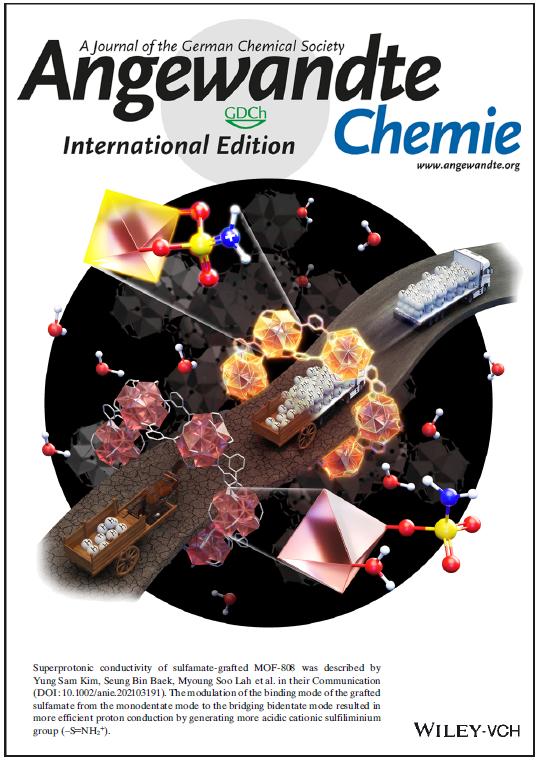
The team also analyzed the reason for the increased acidity inside the pores. It was found that the added guest molecule, amino sulfonate ion, plays a crucial role in forming the hydrogen bonding network. Upon heat treatment, one amino sulfonate ion binds with two metal ions (change in coordination number), increasing acidity. In contrast, without heat treatment, one amino sulfonate ion binds with one zirconium metal ion.
The developed MOF-808 solid electrolyte does not contain strong acids like sulfuric acid, allowing long-term use without performance degradation, and it is easy to synthesize. Generally, to increase hydrogen ion conductivity above 10^-2 S/cm using MOF solid electrolytes, strong acidic substances like sulfuric acid are fixed inside MOF pores (impregnation), or functional groups that easily release hydrogen ions are inserted into the organic ligands constituting the MOF structure. However, these methods have issues such as MOF stability degradation due to strong acids and difficulties in synthesizing organic ligands.
Professor Nam Myung-su stated, “It is academically significant that we have specifically identified the mechanism of hydrogen ion movement within the solid electrolyte,” adding, “This can provide guidelines for designing and developing new MOF-based solid electrolytes for hydrogen fuel cells.”
The research results were selected as the cover paper of the international chemistry journal 'Angewandte Chemie International Edition' and were published on the 17th of last month.
© The Asia Business Daily(www.asiae.co.kr). All rights reserved.
![Clutching a Stolen Dior Bag, Saying "I Hate Being Poor but Real"... The Grotesque Con of a "Human Knockoff" [Slate]](https://cwcontent.asiae.co.kr/asiaresize/183/2026021902243444107_1771435474.jpg)











