Expansion of Asset Registration to All Employees
Exclusion from Promotion to Grade 2 Senior Positions for Speculation
Strengthened Regulation and Monitoring of Retirees
However, No 'Dismantling'-Level Reorganization Plan
Ruling Party and Government Disagreement... Doubts Over Restoring Public Trust
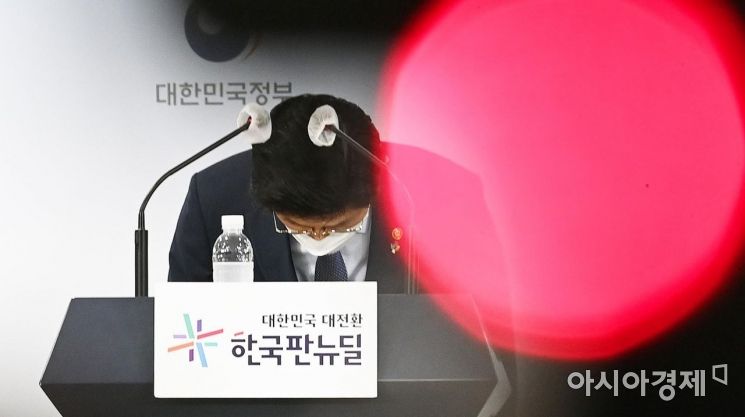 Minister of Land, Infrastructure and Transport Noh Hyung-wook bowed his head in apology for the LH speculation scandal during a joint briefing on the "Korea Land and Housing Corporation (LH) Innovation Plan" with related ministries at the Government Seoul Office in Jongno-gu, Seoul on the 7th. Photo by Kim Hyun-min kimhyun81@
[Asia Economy Reporters Moon Jiwon, Ryu Taemin] The innovation plan for Korea Land and Housing Corporation (LH) announced by the government on the 7th includes a large-scale restructuring plan that reduces the authority and personnel of the LH organization itself. This is because the government’s diagnosis is that the organization, which had become bloated by continuously expanding its tasks and personnel since LH’s launch in 2009, triggered moral hazard among executives and employees, such as land speculation in new towns.
However, the large-scale organizational reform plan at the level of ‘dismantling’ that the government and ruling party confidently promised in the early stages of the new town land speculation scandal was not included in this innovation plan. The reason is that there are significant differences of opinion between the ruling party, government, and local governments regarding the reorganization plan, and there is also a practical concern that if the LH organization is drastically reformed, there is no alternative organization to immediately lead the expansion of housing supply.
Double and Triple Regulations and Punishments Stricter than Civil Servants
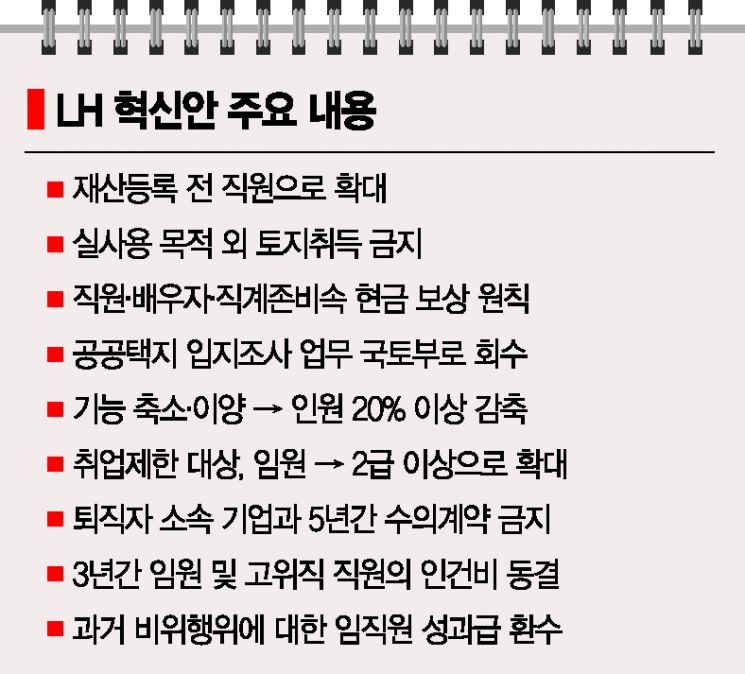
The government decided to impose double and triple restrictions on the possibility of real estate speculation by LH employees through the innovation plan. First, LH executives and employees are strictly prohibited from acquiring land unless it is for actual use purposes. Even in unavoidable cases, they must report the acquisition process and purpose. The scope of LH property registration, which currently applies only to seven executives including the president, will be expanded to all employees, numbering about 10,000.
In particular, the Ministry of Land, Infrastructure and Transport will conduct an annual real estate transaction investigation targeting LH employees. The purpose is to prevent speculative acts using undisclosed information in advance. If an employee owns housing or land for purposes other than actual use, they will be excluded from promotion to senior positions of grade 2 or higher, and even if prosecuted for violating land transaction restrictions, they will be dismissed. This is a sanction at the same level as sexual violence and sexual harassment.
Considering that LH has greatly lost public trust, the government also decided to strengthen internal control mechanisms. Departments with a high possibility of speculation using undisclosed information, such as land project planning, will be specially managed, and employees will be restricted from working in these departments for extended periods. A compliance officer system specializing in monitoring LH executives and employees will also be newly established.
The government will also strengthen disadvantages for LH executives and employees involved in the recent scandal. It will strictly discipline all actors related to real estate speculation, incitement of public outrage through SNS, real estate investment instructor incidents, derogatory remarks, and those at grade 1 or higher who failed to properly manage these issues.
Considering the criticism that there is no way to prevent retirees from engaging in speculation, the government will expand the employment restriction target to grade 2 or higher and restrict companies with retirees from signing exclusive contracts with LH for five years. Retirees will even be banned from entering LH headquarters and regional offices.
Organizational Restructuring Excluded... Differences Between Ruling Party and Government Continue
The focus is on the organizational restructuring plan excluded from this innovation plan. The ruling party and government have been reviewing three options: △ separating the Land Corporation and Housing Corporation (horizontal separation, option 1) △ keeping land and housing supply tasks within LH and separating only residential welfare tasks (establishing a Residential Welfare Corporation, option 2) △ downsizing LH as a subsidiary under the Residential Welfare Corporation (vertical separation, option 3), but due to significant differences, no conclusion has been reached.
Option 1 risks disrupting the expansion of supply measures such as the 2.4 Plan by separating land and housing tasks, while option 2 raises concerns that separating residential welfare functions could weaken housing welfare policies for low-income households.
The government is pushing option 3, emphasizing smooth implementation of the 2.4 Plan and strengthening residential welfare functions, but it has not received broad support in parliamentary discussions. The ruling party is reportedly insisting that the company must be clearly separated. The ruling party and government plan to gather extensive opinions focusing on these three options and finalize the plan later.
Innovation Plan Also Faces Criticism Over ‘Efficiency Doubts’
Experts generally evaluate the plan as a necessary measure but still find it lacking in authority distribution and organizational efficiency. Professor Cho Joohyun of Konkuk University’s Department of Real Estate said, "Cooperation and division of labor with local governments are necessary, but such aspects were not considered at all, and in the long term, it could become bloated again."
Professor Shim Gyoeon of Konkuk University’s Department of Real Estate said, "It is questionable whether the Ministry of Land, Infrastructure and Transport can handle all land development tasks," adding, "Since many personnel are needed when promoting new towns, we need to observe the innovation process further." Professor Baek Seongjun of Hansung University’s Department of Real Estate said the innovation plan is "a natural system to apply to institutions responsible for planning and promoting land and housing development." Regarding the postponement of the organizational restructuring plan, he explained, "It is better than rushing to decide hastily due to public opinion."
© The Asia Business Daily(www.asiae.co.kr). All rights reserved.
![Clutching a Stolen Dior Bag, Saying "I Hate Being Poor but Real"... The Grotesque Con of a "Human Knockoff" [Slate]](https://cwcontent.asiae.co.kr/asiaresize/183/2026021902243444107_1771435474.jpg)












